
The Financial Strength Behind Embraer's Global Ascent: A Boeing-Airbus Challenger?
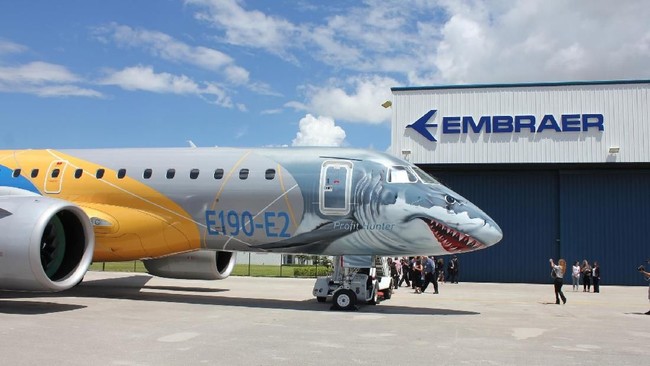
Embraer is enjoying one of its best periods in history. Demand for its commercial aircraft, private jets and military aircraft has risen sharply, sending its share price performance soaring far beyond Airbus and Boeing over the past five years.
This growth is reflected in Embraer’s aircraft deliveries throughout 2025, which reached 244 units, up 18% compared with 206 units in 2024.
The total comprised 78 commercial aircraft — 44 E2 units and 34 E1 units — as well as 155 private jets, including 86 light aircraft and 69 medium-sized aircraft. Embraer also delivered three KC-390 Millennium military transport aircraft and eight A-29 Super Tucano light attack aircraft.
This momentum has given rise to even greater ambitions for Embraer to expand.
Before discussing its ability to build larger aircraft, there is an important question: how strong is Embraer’s financial position compared with Airbus and Boeing?
The results are quite interesting. Embraer is still far smaller in terms of revenue and assets. However, the Brazilian company has a relatively healthy balance sheet structure and has been able to keep cash flow positive. Its condition is even more stable than Boeing’s on several indicators.
This comparison uses financial report data from 2019–2025 published via TradingView. All figures are presented in US dollars, including Airbus data converted from euros at the European Central Bank’s average annual exchange rate.
Boeing’s revenue is the largest
Among the three aircraft manufacturers, Boeing recorded the largest revenue at US$89.46 billion in 2025. Airbus followed with US$82.96 billion, while Embraer’s revenue lagged considerably behind at US$7.50 billion.
Although the smallest, Embraer’s revenue showed significant growth compared with its two competitors.
Its revenue increased 96.9% from US$3.81 billion in 2020 to US$7.50 billion in 2025 — nearly doubling in five years.
However, when examined in terms of its ability to generate net profit, Airbus is the most effective of the three rivals. The European company posted a net profit of US$5.90 billion in 2025, producing a net profit margin of around 7.1%.
By comparison, Embraer recorded a net profit margin of 4.7% with a profit of US$0.35 billion, while Boeing’s margin was only around 2.5% despite posting a profit of US$2.23 billion.
Airbus has also consistently recorded positive net profit every year since 2021. Meanwhile, Embraer only emerged from losses in 2023. Its net profit reached US$0.16 billion in 2023, then rose to US$0.36 billion in 2024 and fell slightly in 2025.
Boeing’s condition has been far more volatile. The company continued to record losses from 2019 to 2024, including a net loss of US$11.82 billion in 2024. Boeing only returned to profit in 2025.
However, that profit did not come entirely from a business recovery. Boeing’s annual report shows the company booked a net gain through divestments in 2025 amounting to US$9.67 billion, mainly from the sale of its Digital Aviation Solutions business.
Airbus has the strongest balance sheet; Boeing has just emerged from negative equity
In terms of balance sheet size, Boeing remains the largest. Its total assets reached US$168.24 billion at the end of 2025, followed by Airbus at US$158.55 billion and Embraer at US$12.97 billion.
However, the size of Boeing’s assets also comes with equally large liabilities. Boeing is recorded as carrying the largest liabilities among the three companies, at US$162.78 billion. That amount is equivalent to almost 97% of its total assets. Boeing’s equity is left at only around US$5.46 billion.
Even so, that position is already much better because Boeing has finally emerged from negative equity.
The company’s equity was recorded at minus US$8.30 billion in 2019 and worsened to minus US$18.07 billion in 2020. Its equity position was still minus US$3.91 billion at the end of 2024.
The pressure Boeing has faced is indeed quite severe. Major problems began to hit the American company after two Boeing 737 MAX crashes — an aircraft that had previously been touted as one of Boeing’s future sales growth engines.
The first crash involved Lion Air flight JT 610 in October 2018, followed by Ethiopian Airlines flight 302 in March 2019. The two crashes killed a total of 346 people and caused the 737 MAX fleet to be grounded globally for almost two years.
The grounding led to a decline in aircraft production and deliveries, while also forcing Boeing to pay substantial compensation costs.
On the other hand, Airbus has a far stronger balance sheet structure. With assets of US$158.55 billion and liabilities of US$123.54 billion, the company recorded equity of US$30.76 billion at the end of 2025. That amount has increased more than fourfold compared with 2019, when it stood at US$6.73 billion.
Looking at Embraer, however, the Brazilian company has smaller assets and equity in nominal terms than the others. Yet its liabilities-to-assets ratio is the lowest among the three.
Embraer’s liabilities of US$9.15 billion are equivalent to around 71% of its assets, which reached US$12.97 billion. Its equity was recorded at US$3.81 billion.
Free cash flow: Airbus leads, Embraer remains positive
The differences in the three companies’ strength are increasingly visible in their free cash flow. This indicator shows the cash remaining after a company finances its operations and capital expenditure.
Airbus generated free cash flow of US$4.99 billion in 2025, up from US$4.25 billion the previous year. After recording negative free cash flow during the 2020 pandemic, Airbus has consistently generated positive free cash flow since 2021.
Embraer has also been able to keep free cash flow positive. Its value reached US$0.62 billion in 2025, down from US$0.83 billion in 2024. Compared with its revenue scale of only US$7.50 billion, that ability shows Embraer’s business continues to generate fairly solid cash.
In contrast, Boeing still recorded negative free cash flow of US$1.88 billion in 2025. That condition has improved compared with negative US$14.31 billion in 2024, but it shows that the profit recovery has not yet been fully matched by a cash recovery.
Based on the three reports, Airbus remains the company with the strongest financial position. The company has the largest profit, the thickest equity and the most consistent free cash flow. Meanwhile, Boeing is still undergoing a recovery process despite recording the largest revenue.
Between these two giants, Embraer’s financial scale still looks very small.
Even so, that small size goes hand in hand with very rapid growth.
Embraer’s revenue has nearly doubled in five years, the company has returned to profit, its balance sheet is relatively healthy, and its free cash flow remains positive. Embraer is not yet the third giant in the global aircraft industry, but its financial foundations are becoming strong enough to carry the company to the next level.
Source: jawawa.id (https://jawawa.id/newsitem/the-financial-strength-behind-embraers-global-ascent-a-boeing-airbus-challenger-1786074676)
Originally published by CNBC Indonesia (https://www.cnbcindonesia.com/research/20260806162307-128-757203/ini-kekuatan-uang-embraer-kuasai-langit-dunia-pembunuh-boeing-airbus), translated from Indonesian