
The Fed Raises Interest Rates by 25 Bps, Rupiah Faces Potential Pressure
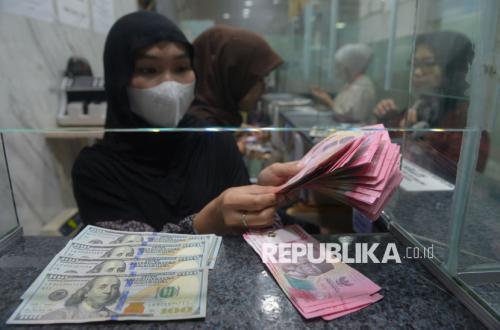
The US Federal Reserve has decided to raise its benchmark interest rate by 2_5 basis points (bps) to a level of 3.75–4 per cent during its meeting on Wednesday (16/09/2026), marking the first increase since July 2023. The decision is projected to exert pressure on emerging market currencies, including the Rupiah.
“The 25 bps increase by the Federal Reserve to 3.75–4.00 per cent may appear small. However, the impact on the Rupiah could be far greater than the figure itself,” said Syafruddin Karimi, an economist from Andalas University, in a statement on Thursday (17/09/2026).
Syafruddin explained that the primary concern is not merely the rate hike, but that the Federal Reserve is beginning to view inflation as a broader and more persistent pressure.
“Sixteen out of 18 policymakers anticipate at least one more hike before the end of 2026. This is the main thesis: the threat to the Rupiah is not a single Fed hike, but a regime shift from ‘higher-for-longer’ to ‘higher-again’,” he clarified.
He noted that the root of the problem lies in an uncomfortable combination for emerging markets. US Personal Consumption Expenditures (PCE) inflation is projected to be 3.7 per cent in 2026 and is only expected to return to the 2 per cent target by 2029, while real Gross Domestic Product (GDP) growth is projected at 2.3 per cent and the unemployment rate at 4.1 per cent.
“Fed Chair Kevin Warsh assesses that domestic spending remains resilient, productivity is strong, capital investment is robust, and the labour market is strengthening. This means the US economy is still strong enough to withstand tightening. Paradoxically, the strength of the US economy can become a source of external pressure for Indonesia,” he stated.
Furthermore, Syafruddin explained that the mechanism works through global money pricing. When the Fed raises interest rates and the market anticipates further increases, the yield on dollar assets becomes more attractive. The 10-year Treasury yield was observed at approximately 4.96 per cent shortly after the Fed’s decision.
“Investors then compare the returns of Rupiah assets with dollar assets after accounting for exchange rate risk. If the return differential narrows while Rupiah risk increases, global capital has no reason to take additional risks in Indonesia,” he said.
“The dollar strengthens, demand for hedging increases, and pressure on the Rupiah can intensify. Therefore, changes in expectations regarding the Fed’s path can affect the Rupiah even before the next hike is officially announced to the market,” he continued.
From that point, Syafruddin stated that the pressure does not stop at the foreign exchange market. A weakening Rupiah increases the risk of imported inflation and narrows the room for Bank Indonesia (BI) to ease policy. In August, BI maintained its benchmark BI Rate at 5.75 per cent to ensure Rupiah stability, inflation control, and growth.
“If external pressure strengthens, BI faces a trade-off: maintaining high interest rates to preserve the attractiveness of Rupiah assets, or providing greater support to credit and domestic growth. The first option holds back activity, while the second could exacerbate exchange rate pressure,” he explained.
Syafruddin noted that the second-order effects are even more critical. Fed tightening can drive up yields on Government Securities (SBN) as investors demand greater compensation for exchange rate and interest rate risks. Consequently, government funding costs rise, private capital costs follow, credit becomes more expensive, and investment projects with thin returns may lose their viability.
“The transmission chain is clear: a Fed hike drives dollar returns, tightens capital flows, pressures the Rupiah, limits BI’s manoeuvrability, raises funding costs, and ultimately reduces investment momentum and growth,” he emphasised.