
The Fate of Orangutans Amid the Siege of Kalimantan Forest Fires
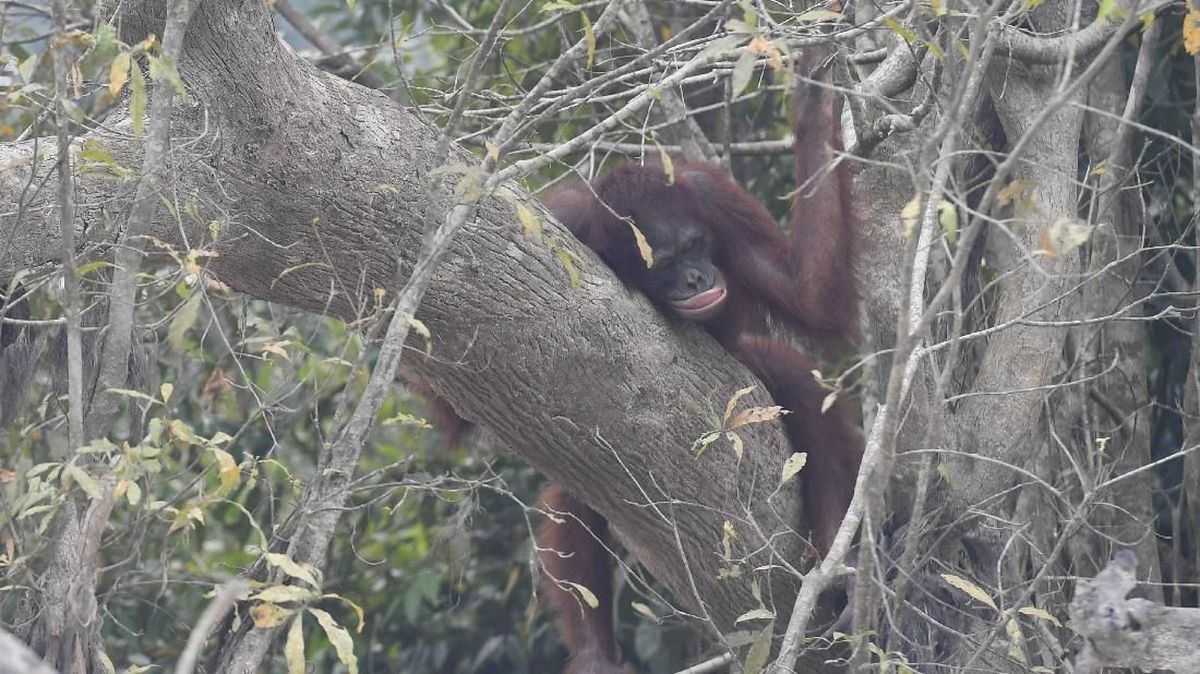
Forest and land fires in Kalimantan threaten not only humans but also wildlife, including Indonesia’s endemic Bornean orangutan (Pongo pygmaeus). Kalimantan is home to approximately 57,350 individual Bornean orangutans, according to the 2016 Population and Habitat Viability Assessment conducted by Indonesia’s Ministry of Environment and Forestry together with various institutions and orangutan conservation practitioners. This number represents a decline of 80 percent in less than 50 years. Citing the Borneo Orangutan Survival Foundation, the orangutan population was estimated at 288,500 in 1973.
The Bornean orangutan species is further divided into three distinct subspecies. The first is Pongo pygmaeus wurmbii, with an estimated 38,200 individuals in Central and West Kalimantan. The second is Pongo pygmaeus pygmaeus, which lives in West Kalimantan, Indonesia, and Sarawak, Malaysia, numbering around 4,520 individuals. The last is Pongo pygmaeus morio, found in East Kalimantan, Indonesia, and Sabah, Malaysia, with an estimated 14,630 individuals.
The threat of forest fires to Bornean orangutans is not new. In the 2016 study, Pongo pygmaeus morio and its habitat were already reported to be threatened by forest fires. As of Thursday (20/8), the National Disaster Management Agency reported a total of 1,487 hotspots across Kalimantan. The most hotspots were in Central Kalimantan with 767 points, while West Kalimantan had 560, South Kalimantan and East Kalimantan each had 74, and North Kalimantan had 3.
The spread of these fire hotspots has reportedly begun to approach orangutan habitats, which are generally in lowland areas. “In West Kalimantan it has already happened, in Central Kalimantan it is also starting to get closer to population centres such as near Sebangau National Park, in the Pulang Pisau area, these are areas that also have orangutans, and quite large ones,” said Jamartin Sihite, CEO of the Borneo Orangutan Survival Foundation.
However, it is not only the fire itself that is a problem, but also the smoke. For humans, exposure to forest fire smoke can perhaps be reduced by wearing masks, but the same does not apply to orangutans and their habitats. Jamartin explained that forest fire smoke affects the pollination function of bees and plants in the forest. This phenomenon can lead to the further loss of food sources for orangutans.
“Our data shows that at our research centre in Tuanan, the longer the smoke period, the smaller the chance of forest plants flowering and fruiting. This means that when the smoke is heavy, the chance of orangutans losing food is also quite large,” he explained.
The impact of the smoke can also cause orangutans to seek areas with less smoke. This drives them to leave the forest and enter settlements or agricultural areas. Several incidents of orangutans entering community settlements due to forest fires have been reported recently. For example, in East Kotawaringin Regency, Central Kalimantan, orangutans sought refuge in local plantations. When inspecting the location on Monday (10/8), the Central Kalimantan Natural Resources Conservation Agency suspected that the thick smoke and fire in the orangutan habitat caused the incident.
Jamartin explained that all the impacts of these forest fires do not end once the fires are extinguished. Forest fire smoke lasting 2-3 months can lead to food scarcity for animals, including orangutans, for 6-7 months. Moreover, replacing a single burned tree requires at least 15 years with adequate care.
Therefore, Jamartin stressed the importance of maintaining memory about forest fires and replanting as an effort to protect orangutans. “Do not let when the fire is gone, the smoke is gone, our memory of forest fires also disappears. This must not happen. After a forest fire, let us replant those trees. If our trees burn a thousand times, we plant them back a thousand and one times so that we can have forests for orangutans,” he concluded.
In the latest developments, no orangutans have been found dead due to the forest fires so far. However, the same cannot be said for other animals, including reptiles such as snakes. The Manggala Agni team in Ketapang, West Kalimantan, stated that snakes are among the animals most frequently found dead due to forest fires. “For orangutans or bears, so far we have not found any, because these animals usually have stronger instincts. When they hear the sound of fire from a distance, they will quickly move away and leave,” said Efendi, Acting Head of the Manggala Agni Operations Region X/Ketapang.
Various parties, including the government, have undertaken efforts to handle the forest fires in Kalimantan. The Indonesian Air Force has just sent three Casa NC-212 aircraft from Air Squadron 4 to Kalimantan to support weather modification operations. Currently, 20 aircraft have been deployed by the Regional Disaster Management Agency operating in Kalimantan, consisting of five helicopters, three aircraft for weather modification, and 12 large helicopters for water bombing operations.
Source: jawawa.id (https://jawawa.id/newsitem/the-fate-of-orangutans-amid-the-siege-of-kalimantan-forest-fires-1787363488)
Originally published by CNN Indonesia (https://www.cnnindonesia.com/nasional/20260821193328-20-1395109/nasib-orangutan-di-tengah-kepungan-karhutla-kalimantan), translated from Indonesian