
The Expensive Fire
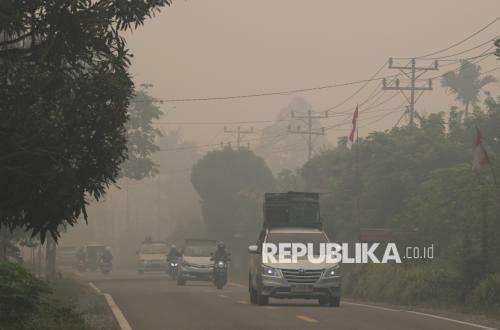
Fire devours the expanses of peatland on both sides of the toll road. That is what I witnessed last weekend while traversing the Palembang-Indelalaya toll road in South Sumatra. From the moment I disembarked at Sultan Badaruddin II Airport, my nose felt congested by the smoke from the fires. It was so pungent, reminiscent of the smell of waste at Bantargebang in Bekasi.
Our land has been burning for months. So have our forests. Smoke thickens in the air, while citizens even in neighbouring countries are beginning to feel the effects of coughing. From Jakarta, the news arriving is instead about technology that has only just been “prepared” and “offered” to extinguish the fires burning the forests and lands.
The Ministry of Forestry, alongside the TNI, Polri, Manggala Agni, and village officials, have already attempted to intervene. President Prabowo Subianto has proposed the use of smoke jumpers. Furthermore, the Head of the National Research and Innovation Agency (BRIN), Arif Satria, has appeared to introduce AI-based technology, weather modification, and micro-sized salt seeding materials.
A somewhat troubling question arises: when the fire is already raging, why is the technology only just being offered? Why has it not been utilised? This question is certainly unfair if directed solely at BRIN. A research institution is not a fire brigade, and not all technologies discovered by researchers can instantly become operational tools.
However, that is precisely where the issue becomes interesting. If BRIN’s engineering technology is mature enough to be offered to the relevant authorities, why does the state not yet have a mechanism to ensure it is ready for use when fires remain unresolved for days?
Moreover, the technology being offered this time is not merely a new name for an old task. BRIN claims to have long been developing Dumakron, a seeding material consisting of sodium chloride (NaCl) in very fine particle form. The salt size is approximately 2–5 micrometres, and its dispersal can be carried out using drones.
This idea is compelling because it touches upon an issue rarely discussed in news regarding artificial rain: the cost is not cheap. Weather Modification Operations (OMC) require aircraft, pilots, seeding materials, logistics, maintenance, flight coordination, and various other aerial operational needs.
The Head of BNPB, Suhary, mentioned in March 2025 that the cost of a single OMC flight sortie is around Rp200 million. The Head of BMKG has also previously estimated that the cost could reach Rp300 million or more, depending on the type of aircraft used.
We can see the scale of these costs from operations in Kalimantan. In West Kalimantan, OMC between 13–17 August 2026 required nine flight sorties. In Central Kalimantan, OMC was conducted in two periods, 27 July–4 August and 11–15 August, involving 13 sorties. Thus, from those two provinces alone, 22 sorties were conducted.
If one sortie is calculated at Rp200 million, the indicative cost reaches Rp4.4 billion. If using the Rp300 million benchmark, it rises to Rp6.6 billion. This is not a realised budget figure, but a rough calculation based on the range of flight costs previously stated by the government.
From those 22 sorties, the government estimates that the resulting rainfall reached 15.72 million cubic metres. If the operational costs are compared to that volume, mathematically, the ratio is approximately Rp280–Rp420 per cubic metre of rainwater.