
The Era of Green Industry: Carbon Markets and Indonesia's Energy Supply Chain
The old industrialisation model, which relied solely on raw material extraction, is gradually losing its relevance. The world is moving towards a new economic standard, where industrial competitiveness is no longer measured only by price and production capacity, but also by the low level of carbon emissions generated throughout the entire production chain.
This change is not a passing trend; it has become the new direction of the global economy. International markets are beginning to demand products produced with clean energy, sustainable manufacturing processes, and transparent supply chains. Global financial institutions are moving in the same direction. International capital is becoming increasingly selective, aggressively entering sectors capable of meeting environmental, social, and governance (ESG) principles.
In this context, Indonesia stands at a critical crossroads. We can either remain exporters of raw materials with limited added value, or leverage the momentum of the global energy transition to build a new foundation for a more modern and high-value national industrialisation. This choice is ultimately not just about energy, but about the direction of Indonesia’s economy over the next two to three decades. Therefore, Indonesia requires a much more integrated policy approach.
An energy transition cannot be achieved through power plant projects alone. We need a green industrial architecture capable of uniting clean energy, manufacturing supply chains, carbon markets, investment, and domestic technology development into a single, cohesive national economic strategy. From a modern industrial governance perspective, the success of the energy transition is heavily determined by the state’s ability to engineer markets so that low-emission business practices become more profitable than maintaining the old carbon-intensive economic model.
This means the energy transition will not proceed through moral appeals or sustainability slogans alone. It must be supported by rational economic incentives, strong legal certainty, and an industrial ecosystem that supports itself from upstream to downstream. The most fundamental step is building domestic independence in clean energy technology industries.
Discussions regarding renewable energy in Indonesia have often been overshadowed by fears that the transition will only increase imports of solar panels, batteries, or turbines from abroad. These fears are valid if Indonesia merely becomes a consumer market. However, the situation will differ if Indonesia can use its domestic market power as a tool for industrialisation negotiation. Indonesia possesses a large population, growing electricity needs, and massive-scale energy transition targets. This combination represents significant market power. This domestic demand should be used to attract green technology manufacturing investment into the country.
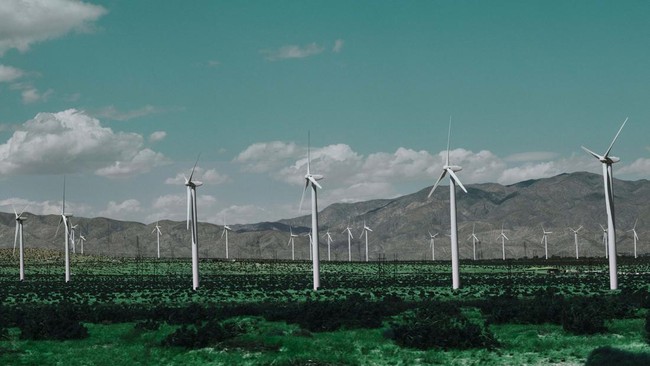
We can see a great opportunity in the development of wind energy. Indonesia’s wind potential is widespread, across coastal areas, eastern Indonesia, and offshore regions. With the development of modern turbine technology, wind power plants can now operate efficiently even at medium wind speeds. Therefore, the government needs to provide significant incentives for global companies willing to build component manufacturing facilities in Indonesia. They should not merely sell finished products; they must establish turbine blade factories, assembly centres, research facilities, and local supplier networks.
This is where industrial added value is created. When the supply chain grows domestically, Indonesia gains not only clean electricity but also technology transfer, job creation, and a strengthened national industrial base. The second step is to optimise the carbon market as a strategic economic instrument. Currently, the carbon market is often viewed merely as an administrative obligation to meet international commitments. In global practice, however, the carbon market has evolved into a massive instrument for financing and driving investment.
A transparent and credible carbon pricing mechanism will send a strong signal to the business world. Companies that succeed in reducing emissions will gain additional economic benefits. Conversely, industries that persist with carbon-intensive production models will face increasing cost pressures. In this way, the carbon market becomes a tool for economic transformation. Companies will be driven to use renewable energy, increase production efficiency, and improve their sustainability standards. Simultaneously, integrating the domestic carbon market with international standards will open access to new financing from global investors seeking large-scale green projects.
This means the challenge of carbon emissions can be transformed into a new source of capital accumulation for national development. However, such a massive transformation cannot occur without close collaboration between the government and the business sector. The government must act as the primary architect, ensuring policy direction remains consistent. Cross-ministerial regulations need to be simplified, licensing processes must be accelerated, and investment certainty must be maintained. In the energy sector, uncertainty is an extremely expensive cost.
On the other side, business players must move faster to build technological capacity, strengthen operational standards, and prepare human resources capable of competing in the global green industry. This collaboration must also be inclusive. Green industrialisation should not only benefit a few regions or large groups. Local entrepreneurs, medium-sized industries, regional cooperatives, and small businesses must be involved in the emerging new supply chain.
Source: jawawa.id (https://jawawa.id/newsitem/the-era-of-green-industry-carbon-markets-and-indonesias-energy-supply-chain-1780931911)
Originally published by CNBC Indonesia (https://www.cnbcindonesia.com/opini/20260517222622-14-735375/era-industri-hijau-pasar-karbon-dan-rantai-pasok-energi-indonesia), translated from Indonesian