
The Entourage in God’s House
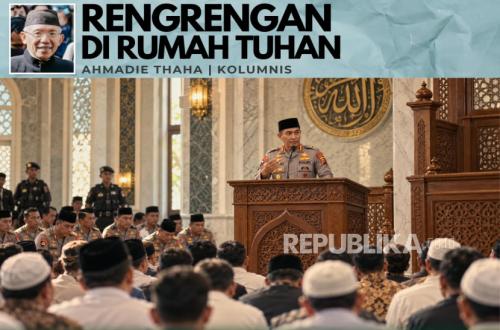
A police general stood on a wooden pulpit. His body was clad in a brown uniform, rank insignia fixed to his shoulders and official badges displayed on his chest. A black peci sat on his head.
Before him, the Friday congregation listened to the sermon. The scene brought together two symbols: a pulpit that reminds people of humility, and a uniform that denotes a position in the hierarchy of power.
Police General Suyudi Ario Seto, the newly inaugurated chief of police, delivered the sermon at Al-Ikhlas Mosque at National Police Headquarters in Jakarta on Friday, 9 October 2026. He urged the congregation to avoid arrogance, respect one another and treat public office as a trust.
The advice sounded familiar. But when delivered by the country’s most senior police official, it acquired several layers of meaning. It was directed at himself, the congregation and the entire entourage accompanying him.
The Sundanese term rengrengan describes a group of people accompanying a prominent figure. In official settings, senior officials are commonly accompanied by aides, security personnel, staff and other officials as required by their duties and protocol.
A voorijder team can clear the way, security officers carry out their protective duties, and local officials receive a visiting dignitary in accordance with regulations. Each has a function. Yet these arrangements also display the official’s status to the public.
When a general steps up to the pulpit, then, he brings more than himself. The entire hierarchy surrounding him enters the place of worship too. His rank remains visible, protocol continues to operate and the entourage stays by his side. Meanwhile, the sermon calls on people to be humble.
Here lies a paradox worth considering. The sermon first returns to the general himself. When he describes office and power as a trust, he reminds himself of the responsibility attached to his position. The highest rank grants him great authority, but also calls for greater self-restraint.
The message then reaches the congregation. They hear a police leader emphasise simplicity and respect for others. The speaker’s office connects the advice directly to public life: how power is exercised and how those who hold it treat other people.
The third circle reached by the message is the force under his command. Officers, aides, security personnel, staff and police members who witnessed the sermon can take from it more than personal advice.
In his sermon, Suyudi advised against using rank to belittle others, turning a uniform into a means of intimidating the public, or assuming superiority simply because one has access to a superior.
Of course, we do not know how each person interpreted the sermon. But Suyudi’s position gives his words a reach different from that of an ordinary member of the congregation delivering a sermon.
He spoke both as a Muslim and as the leader of an institution with an extensive chain of command. His moral advice could serve as a message about leadership for the entire force.
The question is whether official hierarchies always sit comfortably with the spirit of humility. Not necessarily.
During congregational prayers, people stand in the same rows. Rank, wealth and social status do not determine a person’s standing before God. Outside the rows, life resumes according to structures and rules.
The police need a chain of command to carry out their duties in an orderly fashion. Protocol also serves security and administrative purposes. There is no need to regard all of this as arrogance.
Yet hierarchy creates social impressions that do not always stop at its official functions. The arrival of a general with a security escort may make people feel honoured, but it may also make some feel intimidated.
A religious event, too, can take on a different atmosphere when a powerful figure arrives with an entourage.
In sociology, Erving Goffman explains how appearance, setting and conduct shape impressions in social interactions. His ideas can help us interpret the photograph of Suyudi.
Before he utters a single word, the general’s uniform, rank and position have already conveyed information about his status. When he speaks about humility, the public hears his words while also reading the social stage around him.
There is no need to accuse Suyudi of deliberately putting power on display. Protocol may be followed because of official duties, not out of a desire to command respect.
But a person’s intention and the impression created by their presence are two different things. Protocol governs how an official appears; it does not entirely determine how society interprets that appearance.
The Qur’an offers a relevant foundation in Surah An-Nisa, verse 58: people are instructed to return trusts to those entitled to them and to judge fairly.