
The Employment Protection Bill is Key to Expanding Formal Employment Opportunities
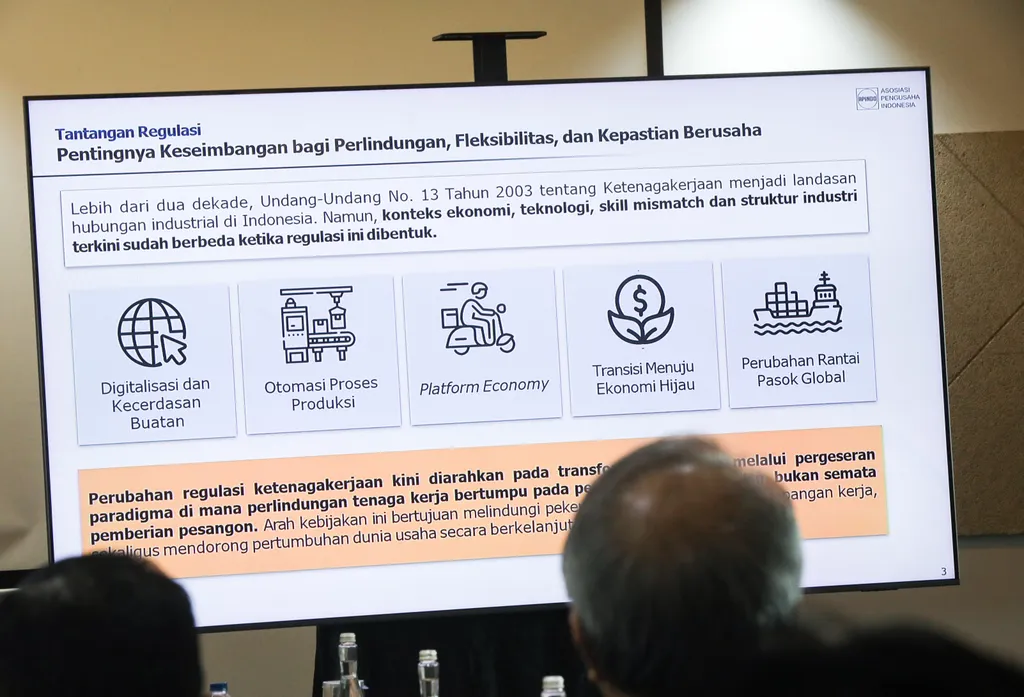
The Employment Protection Bill is expected to be the key to spurring the creation of decent formal employment opportunities based on competence and work productivity.
24 Sep 2026 06:00 WIB · Ekonomi & Bisnis
KOMPAS/TOTOK WIJAYANTO
By Abdullah Fikri Ashri, Dionisius Reynaldo Triwibowo, Hamzirwan, Ratna Sri Widyastuti
JAKARTA, KOMPAS — The share of informal labor still dominates the Indonesian job market. The drafting of the Employment Protection Bill, which is still underway in the DPR, could be the key to driving the creation of decent formal jobs based on competence and work productivity.
This emerged in a focus group discussion held by the Kompas Daily (Kompas.id) entitled “Maintaining Competitiveness and Protecting Workers for Indonesia’s Future”, at the Kompas Tower, Jakarta, Wednesday (23/9/2026). The discussion, which was opened by the Managing Editor of the Kompas Daily (Kompas.id) Marcellus Hernowo, presented speakers including members of the House of Representatives’ Employment Protection Bill Working Committee from the National Awakening Party faction Zainul Munasichin, Head of the Labor Market Center of the Ministry of Manpower R Nurhidajat, Head of the Manpower Division of the Indonesian Employers Association (Apindo) Bob Azam, President of the Confederation of Indonesian Trade Unions (KSPN) Ristadi, and Professor of the Faculty of Economics and Business, University of Indonesia Budi W Sutjipto.
The National Labor Force Survey data in February 2026 recorded an increase in the number of workers by 1.89 million compared to February 2025. However, only 0.74 million workers (39 percent) are employed in the formal sector. Meanwhile, 1.16 million people (61 percent) work in the informal sector.
Even from the 148.19 million workers as of May 2026, according to BPS data, as many as 87.88 million people or 59.30 percent work in the informal sector, which includes self-employed jobs or businesses that generally do not have official contracts, social security, or wage certainty.
Bob stated that the increase in informal workers cannot be separated from the declining contribution of the manufacturing industry to Indonesia’s gross domestic product (GDP) since 1999. He continued that the manufacturing industry is now the backbone of the Indonesian economy in absorbing formal workers, accounting for 61 percent of the industrial sector compared to others.
The highest contribution of the manufacturing sector, including automotive, footwear, as well as textiles and textile products, to GDP peaked at 30 percent during the 1990s. At that time, the performance of Indonesia’s textile and textile products industry was even above that of China.
“However, after the enactment of Law Number 13 of 2003 concerning Manpower, its contribution has continued to decline to 19 percent (in 2025),” he stated.
The erosion of the manufacturing industry’s contribution to Indonesia’s GDP has a direct impact on the increase of the informal sector. One of the triggers is the regulation regarding the amount of severance pay for layoffs that overwhelms business actors in developing their business scale organically.
As a result, according to Bob, around 60 percent of companies are unable to pay severance to workers. “Thus, Law No. 13/2003 is a farewell message for labor-intensive industries,” said Bob.
This condition also affects the competitiveness of the industry. According to data from Apindo, Indonesia is currently ranked 48th in the world in terms of competitiveness, a decline from the previous rank of 40th in 2025. This situation is also influenced by the education level of Indonesian workers, of which 36.5 percent have a background in elementary school education.
The competitiveness of Indonesian workers in Southeast Asia is also quite concerning, with only 9 percent of workers being highly skilled, far below Malaysia (25 percent), Thailand (14 percent), and Vietnam (10 percent). Apindo also noted that the number of inactive workers due to layoffs from January to May 2026, based on old-age insurance (JHT) claims from the Social Security Agency for Employment (BPJS Ketenagakerjaan), is at least 126,000 individuals.
We sincerely hope that the substance of this bill is based on the spirit of seeking balance or ‘flex-security’. Flexibility for businesses, but formal job security for workers (‘security’).
Therefore, according to Bob, discussions on the Employment Protection Bill should prioritize a balance between protection, job creation, and competitiveness, making it easier for businesses to create quality formal jobs. “We sincerely hope that the substance of this bill is based on the spirit of seeking balance or flex-security. Flexibility for businesses, but with formal job security for workers (security),” Bob said.
The flexibility implied by the Employment Protection Bill is more adaptive in encouraging real investment, business growth, and the absorption of formal labor. Apindo has proposed that severance pay revert to using a proportional formula referring to Law Number 6 of 2023 concerning Job Creation and Government Regulation No. 35 of 2021 regarding Fixed-Term Employment Agreements, Outsourcing, Working Hours and Rest Periods, and Termination of Employment.
They also encourage the enhancement of worker skills. “We have a large workforce, but few possess certified skills. For example, Vietnam currently has 29 percent of certified workers. How many are certified in Indonesia? We might find it difficult to answer that because the data does not support it,” said Bob.
In addition, Bob believes that the Employment Protection Bill this time contains a significant number of criminal sanctions. The enforcement of labor law should prioritize the tripartite and corrective functions through inspection notes from labor supervisors before moving on to legal sanctions that could potentially harm efforts to create formal job opportunities.
According to him, balanced, flexible, and adaptive regulations can encourage more agg
Source: jawawa.id (https://jawawa.id/newsitem/the-employment-protection-bill-is-key-to-expanding-formal-employment-opportunities-1790207445)
Originally published by kompas.id (https://www.kompas.id/artikel/employment-protection-bill-is-key-to-expanding-formal-employment-opportunities?open_from=English_Page)