
The Economic Map of Mecca and Medina at the Time of the Prophet's Hijrah
When Prophet Muhammad migrated from Mecca to Medina in 622 CE, the world around him was also changing. The two greatest powers of the time, the Byzantine and Sassanian Persian empires, had just spent decades in exhausting wars. Trade routes were disrupted, border regions were unstable, and the old centres of power were beginning to lose their strength. Amid this uncertainty, one city in the Arabian Peninsula was actually flourishing: Mecca.
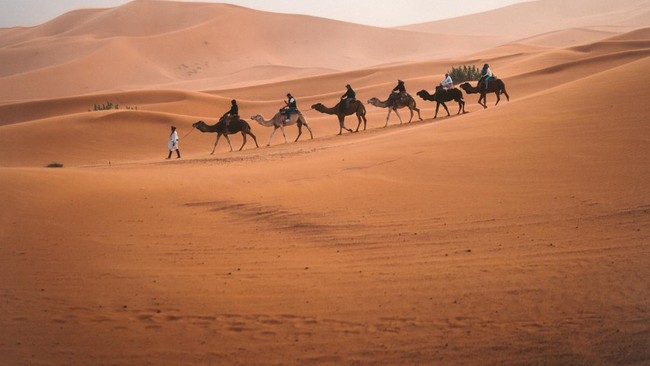
Mecca did not have large rivers or vast agricultural land. Compared to Medina, its water supply was far more limited. However, the city possessed one nearly unmatched advantage: its location. Situated at a crossroads of important trade routes in the Arabian Peninsula, caravans carrying spices, textiles, leather, and other valuable commodities stopped there before continuing north or south. In the harsh desert landscape, Mecca also served as a crucial point for rest and resupply. At the same time, the Kaaba had long been a centre of pilgrimage for various Arab tribes even before the arrival of Islam. The flow of pilgrims created additional economic activity that supported local trade. The combination of commerce and pilgrimage made Mecca one of the most prosperous cities in Western Arabia at the time. In modern terms, Mecca’s strength resembled a trade transit hub like Singapore rather than a city dependent on natural resources.
It was this environment that shaped the early life of Prophet Muhammad. Long before receiving his first revelation, he was known as a trusted trader, earning the title Al-Amin, meaning ‘the trustworthy one’. At around the age of 25, he was entrusted to manage the trade of Khadijah, with historical accounts noting that the trading journeys yielded profits beyond expectations. By the time the first revelation came in 610 CE, he had around two decades of experience in commercial activity. The man who would later lead the birth of the first Islamic state grew up in a highly active business environment, understanding the importance of reputation, contracts, and trust in transactions.
When the Hijrah took place in 622 CE, it was not merely a physical relocation. It marked the beginning of a more politically, socially, and economically organised community, where the institutions that would later be recognised as the foundations of the Islamic economy began to develop. Mecca and Medina represented two different economic worlds. While Mecca relied on trade, Medina, then known as Yathrib, lived from agriculture. It had more fertile land, more abundant water sources, and numerous oases and date palm groves. The migration thus meant a shift from a commercial economy to an agrarian one. In Mecca, wealth depended on the flow of goods and long-distance trade. In Medina, economic stability was supported by land, harvests, and food production. These two distinct economic characters were then brought together in a new community.
The greatest challenge after the Hijrah was not just about housing or security, but about building rules that would allow the new society to survive. During the Medina period, various economic principles began to be institutionalised in a more structured way. Zakat developed into a more organised instrument, markets were built with clearer rules, property rights were recognised, and trade contracts received stronger protection. Numerous narrations also emphasise honest trade, fair weights and measures, and the prohibition of hoarding and fraud. Trust became the primary capital. In a society heavily dependent on economic activity, reputation was often as valuable as wealth itself.
In the 7th century, many kingdoms built influence through territorial expansion and military might. Medina took a different path. The new state that emerged after the Hijrah was built on markets, respect for contracts, social solidarity, and the distribution of wealth to those in need. These principles later evolved as the Islamic world expanded. In the centuries that followed, cities such as Damascus, Baghdad, Cairo, and Cordoba grew into centres of trade, finance, science, and the exchange of ideas, connecting Asia, Africa, and Europe. The Hijri calendar begins with a journey between Mecca and Medina, but its impact extended far beyond.
Source: jawawa.id (https://jawawa.id/newsitem/the-economic-map-of-mecca-and-medina-at-the-time-of-the-prophets-hijrah-1781592715)
Originally published by CNBC Indonesia (https://www.cnbcindonesia.com/research/20260616052001-128-743100/saat-nabi-muhammad-hijrah-ini-peta-kekuatan-ekonomi-mekkah-madinah), translated from Indonesian