
The Dollar May Be Strong, but It Is Still Losing Ground in Asia: Ringgit and Yen Shine
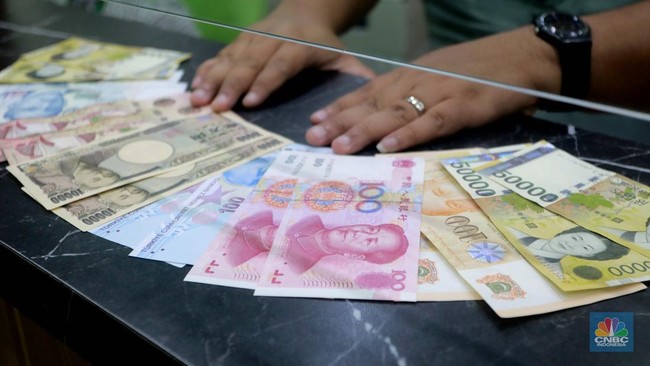
Jakarta, CNBC Indonesia – Most Asian currencies strengthened against the US dollar in morning trading. A slight correction in the dollar on global markets gave several currencies room to advance, although the greenback remained near its highest level in 20 months.
Refinitiv data showed that, as of 9.17am WIB on Tuesday (24 November 2026), six of nine Asian currencies had risen against the US dollar, while the other three were in negative territory.
Malaysia’s ringgit recorded the biggest gain, strengthening 0.12% to MYR4.115 per US dollar.
The Japanese yen followed, appreciating 0.11% to JPY158.83 per US dollar. The Singapore dollar gained 0.05%, while the Chinese yuan rose 0.04%.
The rupiah also edged up 0.03% to Rp18,185 per US dollar, matching the Thai baht’s gain.
At the other end of the market, the South Korean won came under the heaviest pressure, weakening 0.24% to KRW1,344.19 per US dollar.
The Taiwan dollar fell 0.05%, while the Philippine peso slipped 0.04%.
Most Asian currencies advanced as the US dollar began to lose some of its momentum after a sharp rise in the previous session. The morning’s pullback was limited, however, and pressure from the greenback had not fully subsided.
The US dollar index (DXY) was down 0.09% at 104.223 in morning trading.
The decline followed a sharp 0.49% rise in the DXY at Monday’s close, when it briefly reached 104.53.
That was its highest level in around 20 months, indicating that the US dollar continued to enjoy strong support in global markets.
The dollar’s previous-session gains were supported by improving optimism about the US economy and expectations of further interest-rate rises by the US Federal Reserve (Fed).
Sentiment towards the US economy improved again after recent developments in the artificial intelligence (AI) industry bolstered investors’ confidence in the country’s investment and growth prospects.
Jensen Huang’s return as Nvidia chief executive also helped lift optimism about the outlook for the AI industry. The development is seen as potentially sustaining capital flows into the US and supporting the dollar.
Carol Kong, a currency strategist at Commonwealth Bank of Australia, said this sentiment remained an important source of support for the greenback.
“For now, these developments appear positive for the AI industry, which has been one of the key pillars of US economic outperformance and has supported the dollar,” Kong said, according to Reuters.
Optimism about US economic growth has also strengthened market expectations that the Fed still has room to raise interest rates further.
According to CME FedWatch, markets are now fully pricing in a 25-basis-point rate rise at the Fed’s December meeting.
The possibility of a larger, 50-basis-point increase has also re-emerged, although it remains small.
Those expectations have risen after financial-market volatility had led investors to question how well the US economy could withstand further rate rises.
But improving market sentiment has again raised the prospect that the Fed could continue tightening policy to curb persistently high inflation.
Citi market analyst Preston Pagli said earlier market pressure had been a factor that could constrain the Fed’s actions.
“Our US economists have cautioned that tighter financial conditions and lower equity valuations could limit the Fed’s appetite for further tightening, although Monday’s moves began to reverse some of that pressure,” Pagli said, according to Reuters.
With the US economic outlook still strong, higher interest rates could help preserve the appeal of dollar-denominated assets.
This presents a challenge for Asian currencies. When markets expect US interest rates to rise again, investors tend to view the dollar as more attractive because of its potentially higher returns.
Even so, the US dollar is not immune to corrections. After its relatively sharp gains, some market participants began taking profits, giving other currencies room to strengthen.
Markets will next focus on US economic data and statements from Fed officials for clues about how aggressively interest rates may rise.
If the data again point to a strong economy, the likelihood of further tightening could increase and drive the dollar higher.
Conversely, if inflationary pressure starts to ease or economic activity slows, expectations of rate rises could diminish, potentially prompting another correction in the dollar.
Source: jawawa.id (https://jawawa.id/newsitem/the-dollar-may-be-strong-but-it-is-still-losing-ground-in-asia-ringgit-and-yen-shine-1795492269)
Originally published by CNBC Indonesia (https://www.cnbcindonesia.com/research/20261124092206-128-787856/dolar-boleh-perkasa-tapi-tetap-keok-di-asia-ringgit--yen-bersinar), translated from Indonesian