
The Desil Machine
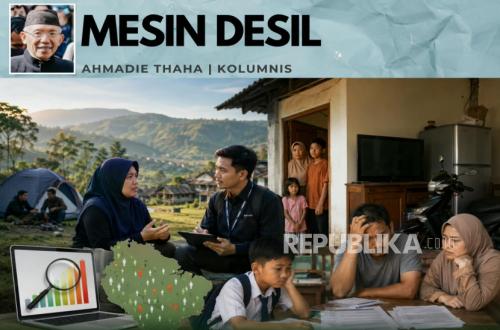
Morning in Salabintana has its own way of making people think more clearly. After a night sleeping in a tent with a mattress—under a Sukabumi sky as cold as an air conditioner without a remote—I chatted with Aliyah, a teacher at a TAUD (Early Childhood Tahfidz) school. From light conversation about village life in her area, our talk suddenly turned to a word that lately seems to determine the fate of many people: desil. Aliyah said she and other residents were complaining about the desil system in DTSEN (National Socio-Economic Single Data). Her complaint was not solely about social assistance, but extended to children’s education. A desil position now determines a child’s chance of entering a state school, including in West Java. That is where a statistical term that usually only lives on a BPS desk suddenly enters the family room. It determines whether a child may hope for a particular school.
We are indeed entering an era when poverty can no longer be adequately described through a leaking roof, an old motorcycle, or a wallet that empties quickly. Poverty must now be numbered and ranked. Desil 1, 2, 3, up to 10. A country with a population of nearly 300 million certainly cannot distribute aid based solely on a village head’s memory. Data is needed so that aid does not go to the wrong address. Simply put, desil is the division of the population into ten welfare groups. Desil 1 is the bottom 10 percent, while desil 10 is the top 10 percent. So desil does not show exact income in rupiah, but rather a person’s ‘relative position’ within the population.
This is where the first problem begins to appear. Poor people live concretely, while desil lives statistically, calculated by machine. People pay school fees with cash that truly exists or does not exist, while statistics work with scores and variables. Imagine a resident named Ibu Rani, still in Sukabumi. She lives in a simple house owned by her parents, so in the data she is recorded as having no rental burden. Her husband works odd jobs, and in the yard an old motorcycle is parked for work. From Rani’s perspective, her life is very hard. But from the algorithm’s perspective, a house without rental burden and motorcycle ownership actually become signals that her family is not in the bottom layer.
Desil is not a CCTV camera of life. It is the result of data processing to place a family in a certain relative position. It is very possible for someone to feel their life is difficult, while the system places them in a high desil. Field censuses also often confront complex social realities. Officers who come are sometimes rejected. They are even driven away until they cry—because residents worry that the data collection will produce the wrong desil. Imagine residents who live in a parent-in-law’s house or rent a room in a boarding house. There is a television, a refrigerator, and a motorcycle. Officers record what is visible to the eye, even though all those facilities belong to the in-laws or the boarding house owner. If officers do not dig into who actually owns the assets, the data can become very neat and at the same time very wrong.
Source: jawawa.id (https://jawawa.id/newsitem/the-desil-machine-1787208779)
Originally published by Republika (https://analisis.republika.co.id/berita/tk20jt415/mesin-desil), translated from Indonesian