
The Collapse of Salim's Business Empire After Three Decades of Glory
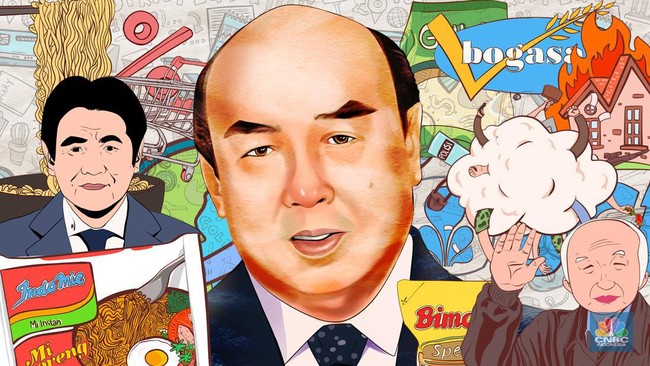
Sudono Salim, also known as Liem Sioe Liong, had a long business history. He was a conglomerate known for his closeness to President Soeharto when the latter was still a colonel. During the early days of Indonesia’s formation as a nation, Sudono Salim was known as a clove importer and army logistics supplier. His extensive business network led Colonel Soeharto to seek cooperation with him. An introduction was made after Soeharto’s cousin, Sulardi, acted as an intermediary for their meeting. Salim subsequently became the logistics supplier for Colonel Soeharto’s troops during the War of Independence (1945-1949).
After Soeharto gained power in Indonesia in the mid-1960s and became president, he was supported by a group of crony businessmen, the largest and most powerful of whom was Liem Sioe Liong. The two were involved in a mutually beneficial relationship for three decades. Soeharto protected Liem and ensured his business ran smoothly. Liem, through the Salim Group business empire, channelled funds to Soeharto, his family, and other cronies. As a result, both parties prospered in their respective paths. Salim was successfully listed as the richest person in Indonesia, while Soeharto successfully held power in the country. However, their glory was suddenly destroyed in just a few days in May 1998.
Salim successfully built three business empires in three sectors: banking (Bank Central Asia, BCA), construction (Indocement), and food (Bogasari and Indofood). However, all of this gradually collapsed when the 1998 crisis hit. BCA was the worst affected. During the crisis, customers withdrew funds en masse. Hundreds of people were willing to queue for hours to drain all their savings. This situation left BCA, which was no longer trusted by the public, on the verge of bankruptcy. This series of crises reached its peak in May 1998.
Salim’s closeness to Soeharto proved to be a disaster at that time. The emergence of anti-Soeharto sentiment following the spread of the economic crisis into political turmoil was a severe blow to Salim. The public, aware of their closeness, made Salim a target. This occurred after demonstrations turned into racial riots on 13 May 1998. That day, Jakarta and its surroundings were hit by riots, looting, and the burning of houses, shop buildings, and many vehicles. The action was carried out by a provoked mob. They targeted buildings and vehicles belonging to ethnic Chinese, and even targeted the Chinese people themselves.
Jemma Purdey explained that racial sentiment against the Chinese arose because of a stereotype that they deserved to be hated simply for being wealthy and close to the ruler Soeharto. The central figure fitting this description was Sudono Salim. The companies of the ‘cukong’ (tycoons) and the Soeharto family were the main targets of the burning and looting. Bank Central Asia, owned by Liem Sioe Liong, was the primary object of the attack.
Although he was a target of the mob’s fury, Sudono Salim, his wife, and some of their children were in the United States accompanying Salim for an eye operation. Only Anthony Salim was in Jakarta, working at the Indocement building on Jalan Sudirman. Anthony did not dare to return to his father’s house in the Roxy area, as the mass riots also targeted Chinese residential areas. It was feared that if Salim stayed at home, he could be killed. This prediction proved true. On the morning of 14 May, Anthony received news that his father’s house had been approached by a group of threatening youths armed with jerry cans of fuel and tools. They wanted to enter Liem’s luxury house. Anthony did not fight back. He immediately ordered the security guards to let the mob in to destroy the house, rather than block them and risk bloodshed.
In an instant, all the cars in the garage were on fire, along with the entire contents of the house. They burned furniture, removed paintings, and ransacked the rooms. They even scrawled inappropriate words on the house. After a few minutes, thick black smoke billowed from Salim’s residence. On the streets, photos of Salim were pelted with stones and burned by the angry mob. Seeing the dire situation in Jakarta, Anthony immediately thought of leaving his office. He feared his office would suffer the same fate as his house. He then went to Halim Airport to fly to Singapore on a private jet. From there, Anthony monitored the development of his business after those difficult times.
After the riots subsided and Soeharto eventually stepped down, BCA suffered the most severe losses. A total of 122 branches were damaged, of which 17 offices were completely burned down, 26 branches were vandalised and looted, and 75 branches were damaged but not looted. Additionally, 150 ATMs were damaged and their cash stolen, resulting in a loss of Rp 3 billion. Besides BCA, Indofood also came under attack. Its factory in Solo was looted and burned, causing a loss of Rp 42 billion. Its distribution centre in Tangerang was also destroyed by the looting mob. Only Indocement managed to survive. Nonetheless, the decisive blow occurred in the banking sector. A week after Soeharto stepped down on 21 May 1998, BCA was taken over by the government because its financial condition was haemorrhaging and beyond help. The government, through the Indonesian Bank Restructuring Agency (IBRA), officially designated BCA as a Bank Taken Over (BTO). This takeover was intended to save BCA from collapse.
Source: jawawa.id (https://jawawa.id/newsitem/the-collapse-of-salims-business-empire-after-three-decades-of-glory-1783137063)
Originally published by CNBC Indonesia (https://www.cnbcindonesia.com/market/20260704074808-17-747982/kisah-robohnya-kerajaan-bisnis-salim-usai-berjaya-3-dekade), translated from Indonesian