
The Cocoklogy of Ibam
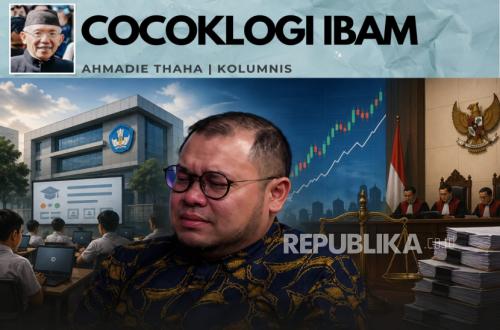
Let us begin with a story that, if told without context, sounds like a film plot. Unfortunately, this is not fiction. It concerns the procurement of Chromebook laptops by the Ministry of Education following the Covid-19 pandemic a few years ago.
It was a major project for the digitalisation of schools in Indonesia, valued in trillions of rupiah. The noble aim: to ensure that the nation’s children are no longer technologically illiterate, and for educational digitalisation to proceed smoothly.
Coincidentally, during the pandemic, students and teachers were “forced to mature” by screens. They learned, taught, and even held meetings through internet connections that were sometimes more emotional than stable.
In that project, the government involved various parties: ministry officials, vendors, and external experts or consultants. One of them was Ibrahim Arief—Ibam—who was asked to provide technical studies.
His role, simplified, was like an architect drawing the blueprint—not the contractor building it, let alone the treasurer holding the money. He was sought for his views: what specifications would be suitable, the direction of digitalisation policies, and so on.
However, the project’s journey was not smooth. Recently, allegations of corruption in the laptop procurement emerged. Several parties were examined. Some are suspected of receiving fund flows, others admit involvement in budget distribution.
The legal process is underway. Big names are mentioned. The courtroom becomes a busy stage: witnesses come and go, documents are opened, narratives are built. Up to this point, it all seems like a typical corruption case.
Then, somehow, the story takes a sharp turn—too sharp to be called just a bend. The public wonders: is this a drama with a special script and budget?
Ibam—who is not an official, not a decision-maker, and in trial facts, no fund flows to him were found—is pulled in as a defendant. He is even demanded 15 years in prison and required to pay restitution of Rp 16.9 billion.
The total punishment, as per the prosecutor’s demands, could swell to 22.5 years if he cannot pay the restitution. At this point, the public following the trial begins to furrow their brows—not because they do not understand the law, but because they understand basic logic too well.
No fund flows to him were found. Ibam did not sign decision documents. His name does appear in some documents, but without a signature. He even claims he never approved its inclusion.
So, what is the basis of the accusation? This is where our legal logic starts to feel like a forced crossword puzzle. The prosecutors apparently saw a wealth surge in Ibam’s tax reports—from hundreds of millions to Rp 16.9 billion in one year.
This surge is then assumed to be the result of corruption. An assumption that, once entered into the case file, seems to be promoted to “administrative truth”—stronger than explanations, harder than facts.
In reality, Ibam explains that the wealth came from the cashing out of Bukalapak shares (vesting) that he had long owned since working there. Its value skyrocketed after the company listed on the stock exchange—an event in the tech world that is considered normal, even eagerly awaited like a bountiful harvest.
This is where the clash feels real. The tech world operates on exponential logic: values can surge in days, even hours. Meanwhile, some law enforcement still thinks linearly: if it rises drastically, something must be “off”.
Thus, we arrive at a somewhat surreal point: a person is not proven to have received money from the project, even his signature was omitted, but he is demanded punishment for having money—that is considered “must” come from the project.