
The Chokepoint Risk in Indonesia’s Economic Diplomacy
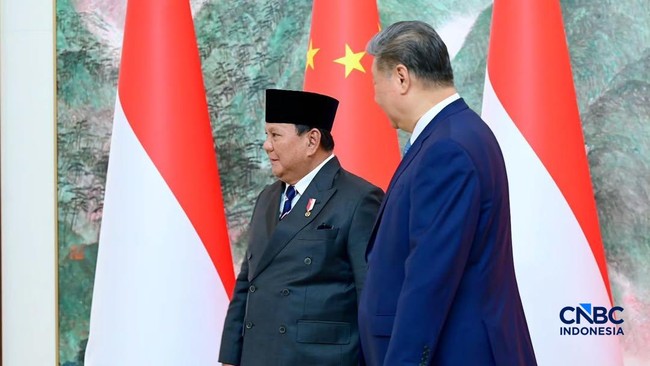
In Shenzhen, China, on 19 November 2026, US President Donald Trump, Chinese President Xi Jinping and Russian President Vladimir Putin sat at the same table for the first time. The following day, Indonesian President Prabowo Subianto met Xi during his fourth visit to China in two years, returning with a series of memorandums of understanding and Indonesia’s membership of WAICO, an AI cooperation organisation initiated by Beijing.
On paper, Indonesia is pursuing three-pronged diplomacy: it joined BRICS in 2025, maintains trade relations with Washington and Beijing, and is expanding strategic cooperation with Moscow. Prabowo has emphasised open and fair global cooperation without creating dependency. The question is whether all three prongs can really bear equal weight.
Trump, the “deal maker”, uses transactional diplomacy to maintain US hegemony. Xi Jinping, the “system architect”, seeks to preserve global economic stability while strengthening China’s strategic position.
For Putin, the “sovereignty defender”, resilience to external pressure is the measure of national sovereignty. Prabowo, meanwhile, as a “nation builder”, sees economic openness as a means of developing productive capacity, technological mastery and national prosperity, rather than as an end in itself.
Contemporary political economy is not only about who benefits from cooperation, but also who controls the chokepoints in global economic networks and who bears the greatest risks when access to them is disrupted or deliberately cut off.
For Indonesia, the measure is not how many partners it embraces, but how readily one partner can be replaced by another when the tap is turned off. Without that capacity, three-pronged diplomacy risks becoming merely apparent diversification: the partners may be varied, but dependence remains concentrated.
From Interdependence to Economic Coercion
Since the US-China tariff war in 2018, major powers have become increasingly explicit in using their economic strength for political purposes. In international political economy, this phenomenon is known as neo-mercantilism: the state once again becomes the principal manager of the economy, with national security placed above market efficiency.
This pattern is not new. When its oil supplies were cut off by an embargo in 1941, Japan responded with war and invaded the Dutch East Indies for its oil. History does not repeat itself exactly, but the pattern is clear enough to warrant caution: when the economy is turned into a weapon, the path to open conflict can become shorter. And conflict is already at hand: the US-Israeli war against Iran, which began in February 2026, is an open war with multiple objectives.
Whatever the main motive, Asian countries are bearing the heaviest burden, including China, the main buyer of Iranian oil. The US, meanwhile, is relatively protected because it is now the world’s largest oil producer and depends only modestly on supplies from the Gulf.
Oil prices at one point rose far above the 2026 state budget assumption of US$70 a barrel, logistics and shipping costs tripled, and the rupiah weakened from around Rp16,800 before the war to more than Rp18,200. This is the stark reality of an economy used as a weapon: those who bear the risks are not always the parties at war.
The Contest for Control of the Global Economy
Why does the burden fall on those who are not fighting? The answer lies in who controls the networks. As Susan Strange (1988) warned, the increasingly decisive form of power is not simply control of resources, but the ability to set the rules others must follow.
Henry Farrell and Abraham Newman (2019) describe this as “weaponised interdependence”: those who control network nodes—such as international payment systems, chip technology or mineral-processing facilities—can cut off others’ access when needed.
For example, in 2022 the United States and its allies removed several major Russian banks from the SWIFT financial messaging system and froze about US$300 billion in Russian central bank foreign-exchange reserves. Moscow retaliated by cutting pipeline gas supplies to Europe. China, which controls almost 90 per cent of the world’s rare-earth processing, imposed export controls in 2025 amid an escalation of its tariff war with the US.
Indonesia has applied similar logic on a more limited scale, reinstating its ban on nickel ore exports in 2020 to compel the construction of domestic smelters, although the policy was challenged by the European Union at the WTO.
This contest is gradually slowing the world economy, and the burden is not shared evenly. The IMF projects global growth of just 3.1 per cent and inflation of 4.7 per cent in 2026. Inflation in developing countries is expected to reach 5.7 per cent, almost twice the 3.1 per cent forecast for advanced economies.
The US controls financial chokepoints and China holds those in manufacturing. Indonesia has a lever in raw materials, but almost every subsequent link—from processing capital to end buyers—depends on a handful of difficult-to-replace players. As a result, Indonesia absorbs shocks more than it mitigates them. Downstream processing is intended to change this position.
The Paradox of Downstream Processing and Indonesia’s Dependence
Downstream processing should offer a way out of the dependency trap. Yet nickel, the flagship of downstream processing over the past decade, has exposed its limits. Indonesia accounted for 67 per cent of global nickel production in 2025, but excessive expansion created a surplus of 283,000 tonnes on the global market. This drove nickel prices down from US$25,867 in 2022 to US$15,161 per tonne in 2025, a decline of 41.4 per cent.
The government responded by cutting 2026 nickel ore mining quotas by almost a third to support prices. Yet by the end of November 2026, the benchmark nickel price was only about US$15,600 per tonne. Why is the world’s largest producer, which can even cut its own mining quotas, still unable to control prices and the direction of its industry?
The answer lies in ownership and control. A 2025 C4ADS study estimated that 75 per cent of Indonesia’s nickel-processing capacity in 2023 was under the beneficial ownership of Chinese companies and shareholders.
When quotas are cut, it is Chinese producers in industrial parks who determine how much processed production is reduced; they are now planning coordinated cuts. This dependence works both ways: Chinese capital is embedded in smelters built specifically for Indonesian ore and cannot easily be moved. The two sides hold one another in a form of mutual dependence, but not on equal terms.
According to the IEA, more than 55 per cent of electric-vehicle batteries installed in 2025 were LFP batteries, which do not use nickel. In developing countries, LFP now powers more than half of electric-car sales, largely through imports from China. Ironically, the way out of dependence on nickel also leads to China, which controls more than 80 per cent of global battery-cell production. The question then is: where will the technology come from, and on what terms?
From Apparent Diversification to the Ability to Switch
This is where the paradox of Indonesia’s economic diplomacy becomes clear. Indonesia can expand cooperation with the US, China and Russia, but adding new partners does not automatically reduce vulnerability if every important chokepoint still depends on one party. The success of economic diplomacy should therefore not be measured solely by the number of investment agreements, but by how many dependency chokepoints have a backup.
There are at least three steps. First, apply a substitutability test to every strategic agreement: before signing an MoU, the government should ask whether the partner could be replaced if relations deteriorated. Second, limit ownership concentration at critical chokepoints such as processing capacity, so that no single business group or country of origin for capital controls most of the capacity.
Third, establish alternatives at every chokepoint—such as a second financier, technology supplier and buyer—including through battery-technology partnerships with suppliers outside China. This would ensure that the shift to LFP does not simply move dependence from one chokepoint to another. Without these measures, the nation builder will only be building on foundations owned by others.
Source: jawawa.id (https://jawawa.id/newsitem/the-chokepoint-risk-in-indonesias-economic-diplomacy-1795506700)
Originally published by CNBC Indonesia (https://www.cnbcindonesia.com/opini/20261124132434-14-787954/risiko-titik-kendali-dalam-diplomasi-ekonomi-indonesia), translated from Indonesian