
The Busok Cat: A Native Madura Breed with Seven Unique Characteristics
Jakarta (ANTARA) — Indonesia is known as one of the countries with rich biodiversity. This wealth is evident not only in the abundance of plant species and wild fauna, but also in the presence of animals with distinctive characteristics found only in particular regions.
One of these is the Busok cat, also known locally as the Raas cat. It originates from Raas Island, a small island lying to the east of Sumenep Regency, Madura, East Java.
The Busok cat is fascinating because it has developed over generations within the environment of Raas Island and possesses physical characteristics that differ from ordinary domestic cats.
The Busok is recognised as a local cat from Raas Island. The name “Busok” itself derives from the local term for one of its coat colours, while “Raas” refers to its place of origin.
As an island relatively isolated from mainland Madura, the cat population on Raas developed under distinct geographical conditions. This has given the island’s local cats unique characteristics that have captured the attention of cat enthusiasts.
The local community also maintains its own rules and beliefs concerning the Busok cat. Traditionally, its spread beyond Raas Island is restricted. One known provision is that only neutered male cats may be taken off the island.
One of the things that makes the Busok cat so appealing is its physical appearance. Its body and facial shape are considered by some enthusiasts to resemble wild cats or even leopards.
Its posture also tends to be larger than that of the ordinary village cat. Its body appears sturdy, with short, smooth fur that serves as one of its distinguishing features.
The tail is another distinguishing feature. Busok cats generally have medium-length tails with curved or bent tips, a characteristic known as a “kinky tail”.
Meanwhile, the Busok cat’s face is relatively oval in shape, an appearance that can vary depending on the colour of its coat.
Two colours known to the public
The Busok cat is known to come in two frequently found colour variations: buso and kecubung.
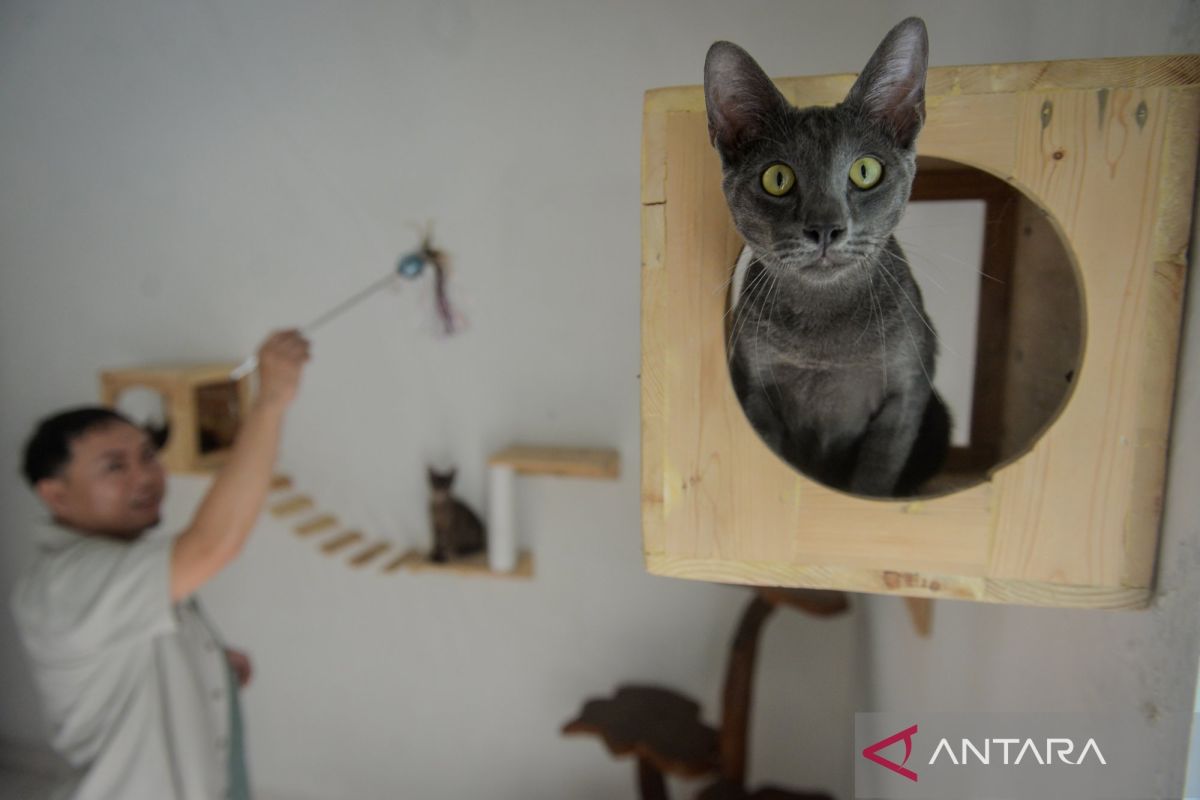
The buso colour is a bluish-grey, or “blue”, appearing plain on the coat. At a glance, this resembles the coat of pedigree breeds such as the Russian Blue or British Shorthair.
The kecubung colour, meanwhile, is a brown shade similar to that seen in several brown pedigree cats.
Cats with the kecubung colouring are said to have faces more closely resembling the ordinary village cat, whilst the more distinctive physical traits are found in the bluish-grey Busok cats.
In addition to body colour, the underside of the body, chest and belly of some Busok cats may be white. The boundary between the grey and white colouring is usually not sharply defined.
Another interesting feature of the Busok cat is its eye colour. These cats generally have dark green or deep green eyes.
The combination of bluish-grey fur, dark green eyes, a relatively large body and a tail with a bent tip makes the Busok cat easily recognisable.
The uniqueness of the Busok cat has since attracted the attention of cat communities and clubs across Indonesia. Efforts are under way to preserve the breed whilst also pushing for its recognition as one of Indonesia’s native cat breeds.
However, establishing a local cat population as a stable breed is no easy task. It requires planned breeding carried out over a long period.
Breeding programmes are needed to preserve the Busok cat’s distinctive characteristics whilst reducing the likelihood of genetic problems arising from uncontrolled mating.
On the other hand, the natural breeding conditions of the Busok cat on Raas Island present their own challenges. Naturally developing populations are not always subject to supervision or structured breeding programmes.
A heritage worth protecting
The existence of the Busok cat shows that Indonesia’s biodiversity does not always take the form of large wildlife or forest-dwelling animals. Locally developed domestic animals can also carry fascinating genetic characteristics and histories.
For the people of Madura, particularly the residents of Raas Island, the Busok cat is not merely a pet. It holds its own cultural and social significance. Indeed, the birth of grey-coloured kittens is eagerly anticipated, as such cats carry particular value and appeal.
For this reason, conserving the Busok cat requires more than simply increasing its numbers. Such efforts must also take into account health, genetic diversity, animal welfare and the involvement of the communities that have long lived alongside these cats.
If managed well, the Busok cat could become one of the examples of Indonesia’s local genetic heritage deserving wider recognition. From a small island in Sumenep, this cat carries a story of how environment, community and natural processes can shape an animal with characteristics distinct from other cat populations.
Source: jawawa.id (https://jawawa.id/newsitem/the-busok-cat-a-native-madura-breed-with-seven-unique-characteristics-1789455388)
Originally published by Antara (Indonesian) (https://www.antaranews.com/berita/5741468/kucing-busok-kucing-asli-madura-dengan-7-ciri-unik), translated from Indonesian