
The Bojan statue and Persib's five-star dream
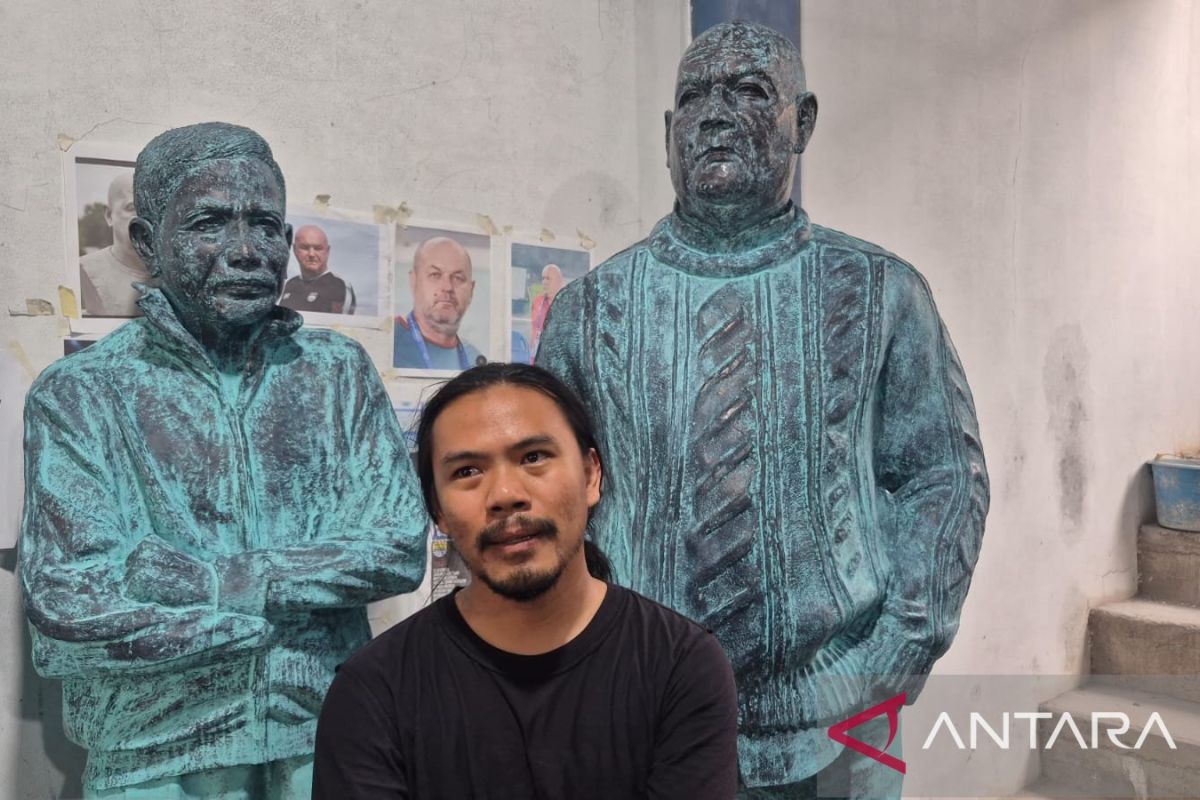
In a small studio in South Bandung, the scents of resin, paint, and sketches mingle as witness to the birth of a work that is not only about art but also about a love that grew from the football pitch.
In that simple room, Ridwan Solehhudin, 33, known as Iwonk, pieces together memories of the city, his childhood, and the club that has long lived inside him: Persib Bandung.
For Iwonk, sculpture is not merely an aesthetic medium. The work is a way for a Bandung-born youth to celebrate his emotional journey with Persib.
From the stadium terraces, from childhood as a school footballer, to now being an artist, that feeling has never truly changed, only changing form.
‘In my mind, I have a desire to give something back to Persib through sculpture,’ Iwonk said when met in his studio.
That desire grew into a large project at Studio Perahu Terbang.
In the middle of the process, a moment arrived that gave his work deeper meaning: the great hope of Persib towards the fifth title, the ‘five stars.’
In the eyes of many bobotoh, this season is not just another competition. There is a belief that Persib is moving toward a new history.
That atmosphere also secretly brings Iwonk’s work to life. The sculptures he makes seem to become part of the club’s long narrative that passes from generation to generation.
Honouring history through art
The four figures he presents in the project are Bojan Hodak, Janur, Indra Thohir, and Haji Umuh.
Each figure carries a different layer of the club’s journey. Some represent tactical intelligence, some are symbols of the coaching foundation, and others represent the long loyalty behind the scenes.
But for Iwonk, those four names are not the end of Persib’s history. He wants to make them openings for conversations so the club’s history stays alive.
‘If we talk about history, of course there were figures before Bojan. This doesn’t mean that only these four are the history makers,’ he said.
Therefore, he positions the work as a trigger, not a finale. He realises Persib’s history is too long to be summarised by a few figures. There are many names, many eras, and many stories living in the memory of bobotoh.
In the midst of the euphoria toward the five-star dream, the work seems to connect past and future. The figures that stand still act as reminders that the club’s history was not born in a single night, but built from a long journey passed down.
Art, football, and the city’s identity
For Iwonk, Persib is more than just a football club. Persib is part of Bandung’s identity itself. So when art meets football, he feels he is celebrating something much bigger than a mere match.
In Bandung, football grows with the city’s pulse. Persib features in coffee shop chats, street murals, distro tees, and songs sung in the stands. In that space, Iwonk’s art finds its place.
He wants the statue to be an ‘artefact’ of culture, something that can become a marker of the era as well as a reminder of the club’s journey.
‘I am celebrating the history itself through sculpture,’ Iwonk says.
Yet, the reality behind the monumental work is far from glamorous. All statues are made from resin, not bronze. The reason is simple: cost constraints.
‘If we used bronze, the cost would be much higher. Because of cost limits, I am trying to camouflage the resin with paint to make it look like bronze,’ he explains.
From that experimentation comes a blue‑green patina effect that gives the impression the statues have endured a long journey through time.
The sizes of the four figures are also substantial. The Bojan Hodak statue stands about 2.17 metres tall, while Janur, Indra Thohir, and Haji Umuh are each roughly 1.89 to 1.90 metres.
From a dream of a footballer to a sculptor
Iwonk’s life has never strayed far from football. In junior high, he played for SSB Uni and once aspired to become a professional player. But an injury redirected his path.
He later attended SMK 14 Bandung, formerly Sekolah Menengah Seni Rupa. There he began to pursue the world of art. From there his career advanced to design, stagecraft, and eventually sculpture during the pandemic.
This Persib project became a meeting point for all his life’s journeys: football, art, and Bandung.
He says he learned a lot from many artists, including Nyoman Nuarta, known for monumental works. But I won’t simply imitate; he wants to find his own visual language, a language born of his love for the city and for football.
His experience seeing large statues in Egypt also left a strong influence. From that, he understood that monumental works are not just about size, but about how people nurture history and its spirituality.
Hope that continues to live
The project began in December 2025. The process was never instant or easy. From the first sculpture’s head of Bojan to the four figures finally standing together, the journey progressed slowly, sometimes stalling.
Along the way, public critique appeared, especially on social media. But for Iwonk, criticism is part of the journey to understand how history is read by many people.
On the other hand, the entire process has been carried out without donors. All costs are self-funded.
‘If you add it up, it’s probably tens of millions of rupiah,’ he says.
The small studio became the space where he exchanges time, energy, and love for a form that stands and can be seen by many.
In the midst of the resin hardening, the paint slowly …