
The Billions Behind El-Sayed’s Victory
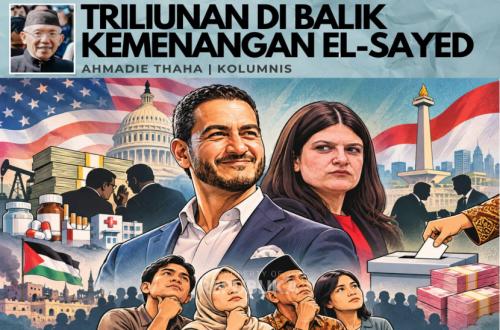
Several friends, including veteran journalist Banjar Chairuddin, sent me messages about the 38 Muslim candidates who won in the US midterm elections. I replied: “Alhamdulillah, but it came at a very high cost.”
Abdul El-Sayed’s victory, for example, came with political spending of around US$14.5 million, or Rp261.6 billion. That was the campaign funding he had raised by mid-July. It is unclear how much he had raised by the end of the campaign.
Representing the Democratic Party in Michigan in the race for a US Senate seat, he managed to defeat an opponent backed by far greater political spending — enough money to fund a small city.
Democrat Abdul El-Sayed received 48.5 per cent of the vote, while his opponent, Republican Haley Stevens, secured 47.5 per cent. The margin was just one percentage point.
But the surface figures tell only part of the story. Behind the two candidates was a money battle on a scale unprecedented in the history of a Democratic congressional primary.
According to a 31 July 2026 report by Mother Jones, political groups outside Haley Stevens’s campaign had spent more than US$60 million to influence the result.
The spending reports were updated after the votes were counted. Novara Media, a UK-based, independent, non-profit, left-wing media organisation, put the figure at nearly US$70 million.
Consider that: nearly US$70 million for a single primary. At an exchange rate of around Rp16,000 to the dollar, that is equivalent to Rp1.12 trillion.
That is only the money spent by supporting groups, on top of the political costs borne by the candidates themselves.
The financial muscle of groups outside the campaign supporting Stevens far exceeded the candidate’s own fundraising capacity.
This is the most striking part of the story: a candidate may have substantial campaign funds and still face a far larger political money machine.
The story becomes even more compelling when we examine who is behind the sponsors: who funds these supporting groups, what interests they represent and how they channel money into the political arena.
I do not have information on El-Sayed’s donors. Stevens’s funding, however, is documented. The biggest player was the United Democracy Project (UDP), a super PAC affiliated with the American Israel Public Affairs Committee (AIPAC).
AIPAC is known as an organisation with a clear political mission. It spends millions of dollars to help elect candidates who support pro-Israel policies in the Senate.
In the Michigan primary, UDP spent more than US$30 million to help Stevens. That was twice its previous record spending in a single election.
Alongside UDP and AIPAC, it is important to understand what a super PAC is. In the United States, candidates have their own campaign committees, which may accept donations subject to certain limits.
Independent groups, however, can establish political action committees to support or oppose candidates. These groups may accept unlimited contributions from individuals, companies, trade unions and other political committees, provided they do not coordinate with candidates or their campaigns.
The rules have created a democratic oddity. A Senate candidate must comply with campaign contribution limits, while a group outside the campaign can spend far more to help elect that candidate.
Legally, these groups operate independently. Politically, however, they plainly share the goal of determining who takes a seat of power. The US Federal Election Commission (FEC) explains this mechanism openly in its rules on independent expenditures.
The tens of millions of dollars are, of course, not intended to pay a senator’s salary after election. They buy political reach.
That means television and digital advertising, social media campaigns, video production, communications consultants, voter research, polling, data collection, mail-outs and field operations to persuade or mobilise voters.
The money also pays for political attacks. Advertising teams can present a candidate as an experienced leader while portraying an opponent as dangerous, extreme or untrustworthy.
Voters encounter these messages repeatedly on television and mobile phones. In modern elections, public attention has become an expensive commodity. Whoever controls the space in which people pay attention has a greater chance of shaping their choices.
UDP’s spending, however, holds an important lesson. The advertisements supporting Stevens did not always discuss Israel. Some focused instead on other issues, such as oversight of ICE, the US immigration enforcement agency.
The strategy makes sense. An organisation seeking to preserve its political influence needs to promote candidates through issues that voters may find easier to accept. The donors’ interests can remain the same while the message presented in advertisements changes.
UDP was not the only major player. A group called A Stronger Michigan spent more than US$17 million to support Stevens.
Behind it was the Center Forward network, a non-profit organisation with 501(c)(4) status that is not required to disclose the names of all its donors to the public.
Center Forward’s funding trail points to links with the pharmaceutical industry through PhRMA, the US pharmaceutical companies’ trade association.
Meanwhile, the related political committee, the Center Forward Committee, recorded donations from Chevron, a Philip Morris subsidiary and UnitedHealth Group.
This is the complexity of modern money in politics. Funds can pass through several layers of organisations before they are spent. An organisation’s name may sound neutral and its office address may be a home or post office box, while the identity of the ultimate donor can sometimes be difficult to trace.
Mother Jones also identified another group, the Center for Democratic Priorities, which spent around US$6.5 million to help Stevens.
The group used advertisements that did not explicitly urge voters to choose Stevens. This approach allowed it to take advantage of gaps in campaign-finance disclosure rules.
AIPAC denied being behind the group, and the Mother Jones report itself acknowledged that the identity of the actual funders had not been established.
We can therefore see three layers of financial power: advocacy organisations with political agendas; companies and interest groups with economic interests; and intermediary organisations that allow money to flow through networks that are not always transparent.
Donors do not spend tens of millions of dollars simply because they have suddenly fallen in love with democracy. AIPAC, for example, has a foreign policy agenda, particularly support for the United States’ relationship with Israel.
The pharmaceutical industry, meanwhile, has an interest in drug policy and the health financing system. Oil companies have a stake in energy regulation, while health insurers are concerned with the future of the US healthcare system.
These interests converge in one arena: the Senate election. Senators have a say in legislation, budgets, government oversight, international agreements and economic policy.
Political investment can therefore generate influence worth far more than the money spent.
Of course, we should not automatically conclude that every senator backed by major donors will sell their vote.
The relationship between donations and political decisions is not always a direct transaction. Influence can operate through access, proximity, agenda-setting, pressure on public opinion and opportunities to meet decision-makers. The risk of conflicts of interest nevertheless remains real.
El-Sayed understands the issue. In healthcare and medicine, for example, he has championed Medicare for All, reform of the private health insurance system, restrictions on the influence of big money in politics, and an end to US military aid to Israel.
With such an agenda, he is confronting interlinked interests in foreign policy, the healthcare industry and financial power.
Remarkably, he won. His narrow victory sends a message: big money can buy advertising and reach, but it cannot always buy voters’ support.
A political machine that spends tens of millions of dollars can still be defeated by the million reasons voters have for choosing someone else.
Source: jawawa.id (https://jawawa.id/newsitem/the-billions-behind-el-sayeds-victory-1794369125)
Originally published by Republika (https://opini.republika.co.id/berita/tobhzp415/triliunan-di-balik-kemenangan-elsayed), translated from Indonesian