
The Beauty of the Calligraphy at Ulu Cami Mosque at the Foot of Mount Uludağ
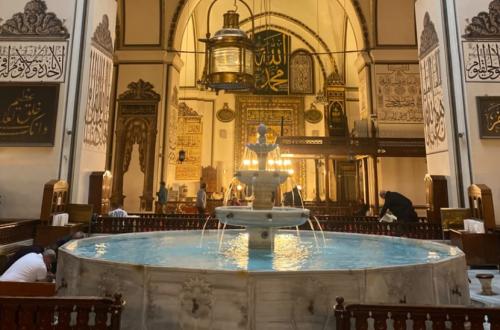
ISTANBUL — On Thursday afternoon (15 October 2026), Ulu Cami Mosque in the Osmangazi district of central Bursa, Türkiye, was shrouded in moderate rain, with temperatures at around 12 degrees Celsius. Despite the cold, local people could be seen coming and going around the mosque. Tourists from Asia and Europe also wandered past, admiring and photographing the beauty of the mosque at the foot of Mount Uludağ.
Ulu Cami is the largest mosque in Bursa. Its name consists of two Turkish words that describe the mosque’s meaning and status: ulu means large, grand or great, while cami means mosque.
The mosque was designed by architect Ali Neccar and built between 1396 and 1399, during the reign of Sultan Bayezid I of the Ottoman Empire. It is considered a masterpiece of early Islamic architecture and a symbol of Ottoman imperial glory, attracting visitors, particularly admirers of Islamic calligraphy.
Ulu Cami features transitional architecture between the Seljuk style and the early Ottoman period. The building covers 2,200 square metres and has a rectangular plan, with an interior often described as a ‘forest of columns’. Its spacious prayer hall is supported by 12 large stone pillars, which divide the space into symmetrical sections, much like those in ancient Seljuk mosques.
The roof has 20 symmetrical domes arranged in four rows of five, unlike the classical Ottoman style, which is dominated by a single enormous dome. The number of domes is said to stem from Sultan Bayezid I’s vow to build 20 mosques, which were subsequently combined into one large mosque.
The main entrance on the northern side projects beyond the building’s main walls. Its tall, monumental gateway features intricate stone carvings, a characteristic of public buildings from the Seljuk dynasty.
The mosque’s walls combine sturdy grey stone and brick decorated with geometric patterns. Ulu Cami has two towering minarets on its western and eastern sides. The western minaret was built at the same time as the main structure during Sultan Bayezid I’s reign, while the eastern minaret was built separately during the reign of Sultan Mehmet I.
Beside the mihrab, which indicates the direction of prayer, stands a wooden minbar regarded as a masterpiece of pure Seljuk art. It was made using a traditional Anatolian Seljuk technique in which geometric pieces of wood are interlocked without glue or nails, known as kündekari.
Among Ulu Cami’s most distinctive features are 192 large, monumental panels of Islamic calligraphy, written by 41 renowned Ottoman masters. The calligraphers include Sheikh Hamdullah, Abdulfettah Efendi and Kazasker Mustafa Efendi.
The inscriptions throughout the mosque include verses from the Qur’an, the Asmaul Husna (the 99 names of Allah), hadiths of the Prophet Muhammad, aphorisms, and calligraphy in distinctive symmetrical and figurative forms. The scripts include thuluth, jali thuluth, ta‘liq and kufic.
As worshippers and visitors enter, the beautiful inscriptions seem to welcome them into Ulu Cami. The view makes the eyes sparkle and brings a sense of calm as they take in the mosque’s interior.
The calligraphy is not the only feature to captivate the eye and heart. A fountain for ablutions at the centre of the mosque, known as a şadırvan, is another attraction. The octagonal marble basin, with water flowing from it, creates a tranquil atmosphere. Its gentle trickling is said to have a meditative effect and to offer natural respite within the mosque.
When Republika visited Ulu Cami, worshippers were engaged in various activities: some were performing ablutions at the şadırvan, praying, reciting the Qur’an or talking. Many tourists were also taking in the mosque and photographing its different corners, especially the hundreds of captivating Islamic calligraphic inscriptions around the interior.
Source: jawawa.id (https://jawawa.id/newsitem/the-beauty-of-the-calligraphy-at-ulu-cami-mosque-at-the-foot-of-mount-uludag-1792590710)
Originally published by Republika (https://news.republika.co.id/berita/tn91hj423/keindahan-kaligrafi-masjid-ulu-cami-di-kaki-gunung-uludag), translated from Indonesian