
The Bandung Spirit Resurfaces at 2026 BRICS Summit in India
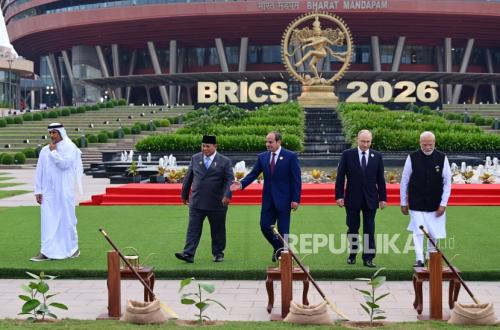
Never forget history—this appears to be the common thread in the statement made by Indonesian President Prabowo Subianto at the 18th BRICS Summit, held at Bharat Mandapam, New Delhi, India, on 12–13 September 2026, under the leadership of Indian Prime Minister Narendra Modi.
In his speech, as reported by various media outlets, President Prabowo conveyed three vital messages regarding national independence and resilience (specifically in food and energy), the strengthening of unity among Global South nations, and the pursuit of inclusive and fair global governance. A key point emphasised by President Prabowo was Indonesia’s commitment to strengthening multilateral cooperation, rejecting intervention or dictation by foreign powers, and reviving ‘The Spirit of Bandung’ (the 1955 Asian-African Conference).
Given the summit’s theme, ‘Building for Resilience, Innovation, Cooperation, and Sustainability’—particularly among developing nations, many of which are members of BRICS—there appears to be a close correlation with the Spirit of Bandung. This raises the question: is this forum truly an effort to curb Western (US) hegemony within the new world order and the global economy?
President Prabowo’s statement stems from the premise that the 1955 Bandung Conference marked a historical turning point, challenging an international order centred on Western powers and initiating decolonial international norms. Furthermore, the core principles of the Bandung Spirit have been inherited and transformed through various Global South institutions, such as the Non-Aligned Movement (NAM), the Group of 77 (G77), BRICS+, and the South-South Cooperation Summits.
An in-depth analysis of the final declaration of this BRICS Summit and the official records of the group’s primary cooperation frameworks reveals three significant adoptions, both direct and indirect. First, the Bandung principles of sovereignty, non-intervention, equality, and mutual cooperation have been gradually expanded to encompass new global agendas, such as economic independence. This is being pursued through the expansion of local currency use in trade and the development of alternative payment systems to reduce dependence on the US dollar—viewed as a symbol of resistance—and to mitigate exchange rate risks, even though the group has not yet adopted a single currency.
Second, BRICS is expected to act as a normative challenger to the neo-colonial international economic order by advocating for fairer global trade and strengthening South-South cooperation. Consequently, flexible financing instruments are required through the reform of the international financial system and the development of accessible financing tools, such as the New Development Bank (NDB) established by BRICS.
Third, BRICS does not function as a single political bloc, but rather as a networked form of multilateralism with complementary functions, striving to realise an alternative form of governance outside the Western-centric order. This confirms that BRICS member states are not merely passive recipients of norms, but are actively participating in creating international norms alongside the Global North, positioning themselves as central actors in the restructuring of the world order.
Returning to President Prabowo’s remarks during the closed session themed ‘Inclusive Global Governance and Strengthening Multilateralism’, the President brought the spirit of unity of the Global South nations through an Indonesian proverb regarding the importance of togetherness in facing global challenges: ‘united we stand, divided we fall’. According to Cabinet Secretary Teddy Indra Wijaya, for President Prabowo, this proverb is more than just an expression of unity.
The message reflects a spirit that, for decades, has united Asian and African nations in their struggle to stand as equals, determine their own futures, and fight for common interests. This spirit, according to the President, remains relevant amidst current global shifts and geopolitical changes. Global South nations, possessing historical experience in fighting for independence from imperialism and colonialism, now stand together as equal nations.
With a strong foundation, President Prabowo believes that BRICS can continue to expand and strengthen cooperation in various fields that directly impact the resilience of its member states. One area deemed strategic is energy, particularly through the strengthening of energy system connectivity and inter-regional energy security.
Source: jawawa.id (https://jawawa.id/newsitem/the-bandung-spirit-resurfaces-at-2026-brics-summit-in-india-1789815166)
Originally published by Republika (https://analisis.republika.co.id/berita/tllvak282/gelora-spirit-bandung-dalam-ktt-brics-2026-di-india), translated from Indonesian