
The Bandung Spirit Is Not Finished: The Palestinian Nakba and Asia–Africa's Moral Duty
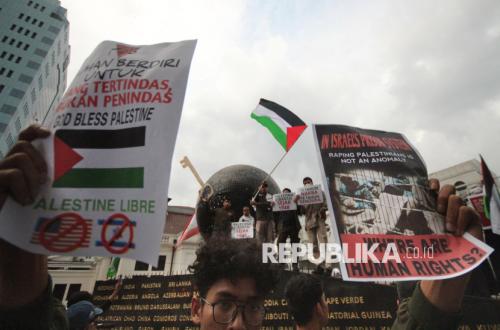
Every May 15, the world marks Nakba Day — the great tragedy of the mass expulsion of the Palestinian people from their land by the Zionist occupation of Israel in 1948. The event left more than 750,000 people displaced, over 15,000 killed, and involved the widespread destruction of towns and villages in Palestine by the occupying Israeli forces (Pappe, 2006). Nakba is not merely a historical tragedy; it is an ongoing reality in Palestine, with forced displacement, occupation, blockade, demolition of settlements and recurring wars as a persistent pattern of Israeli policy that ignores international norms and values.
Commemoration of the 78th Nakba Day in 2026 is not just observed by the Palestinian people but by the global community. Symbolic demonstrations, campaigns, civil society movements and social media discussions, including the voyage of the Global Sumud Flotilla back to Gaza, Palestine, signal that international conscience still endures.
The genocidal violence against Gaza in the Gaza Wars of 2023–2025 extended the tragedy. More than 2 million Palestinians were displaced, with over 75,000 confirmed dead, and massive destruction of Gaza, Palestine (UNOCHA, 2025). The tragedy repeats itself, or as Palestinian humanitarian advocates often phrase it, an ‘ongoing Nakba’.
The Palestinian tragedy, for many Asia–Africa nations, is not merely a familiar conflict but a bitter experience of colonialism, occupation, expulsion and the struggle to reclaim the right to self-determination once endured in the past. It is at this point that solidarity with the Palestinian people has always emerged not only from religious or humanitarian motives but also from a shared anti-colonial consciousness.
This awareness propelled the leaders of Asia and Africa to gather in Bandung in 1955 with the fundamental belief that the world should not be governed by colonialism. The 1955 Bandung Conference gave birth to the Bandung Spirit — the idea that nations once subjected to conquest have the right to determine their own futures, build solidarity and strive for a just world order (Acharya, 2016).
Within this context, Nakba and the Bandung Spirit are united by a common experience. Both speak to the anti-colonial ethos and the struggle against domination and injustice.
Solidarity That Has Not Yet Become Political Power
If we consider the historical context, the Bandung Conference arose in a world undergoing change. The newly independent Asian–African nations faced a transformed global order shaped by Cold War competition between the United States and the Soviet Union, which divided the world into power blocs. This major challenge prompted newly independent states to recognise the need for political paths of their own that were not subservient to great powers (Westad, 2007).
From Bandung, essential principles emerged: anti-colonialism, respect for sovereignty, the right to self-determination, pursuit of peaceful settlement and solidarity among oppressed peoples. This spirit laid the foundations for the Non-Aligned Movement and various Global South collaborations.
Bandung 1955 also produced a moral consciousness that the suffering of one people is not only their problem. When a people remains under oppression and injustice, other nations have a moral responsibility to speak out and strive for justice. But is that solidarity still strong enough?
On paper, Asia–Africa nations today possess greater capacity than in 1955. Global South states comprise the majority of the world’s population and are increasingly influential economically. China’s rise, India, Indonesia, Turkey, Arab and Gulf states, rising African capacities and stronger collectivities through BRICS and MIKTA, for instance, suggest a world no longer entirely dominated by the West (Stuenkel, 2016).
Sadly, economic power does not automatically translate into political solidarity. In many global issues, Asia–Africa are often fragmented by economic interests, geopolitical rivalries and security-state pressures. Consequently, the Asia–Africa spirit often feels more like a historical symbol than a real political force.
This reality is evident in the Palestine issue. It cannot be denied that today’s world has not lost its conscience regarding Palestine. Demonstrations around the world, massive civil society mobilisations, moral pressure from humanitarian organisations, and steps through the rule of law and international norms show that conscience remains alive.
Yet solidarity often stops at moral and symbolic expression. It has not fully consolidated into political power and sufficient collective pressure to curb Zionist arrogance.
History shows that major change does not arise solely from public sympathy. The anti-apartheid struggle in South Africa succeeded in attracting international pressure as global solidarity evolved into a political movement organised through diplomatic isolation, economic pressure, civil society mobilisation and international policy or norm enforcement (Klotz, 1995).
That is where the world learned that moral solidarity acquires political meaning.
The greatest pressure for Palestinian solidarity today is not merely to sustain empathetic feelings but to convert solidarity into real collective power to achieve Palestinian justice.
Reviving the Bandung Spirit
In today’s world of geopolitical rivalry, wars and heightened tensions, the field is set for a renewed appeal to the Bandung Spirit: to turn moral solidarity into tangible political influence that can pressure for justice for Palestine.
Source: jawawa.id (https://jawawa.id/newsitem/the-bandung-spirit-is-not-finished-the-palestinian-nakba-and-asia-africas-moral-duty-1779546445)
Originally published by Republika (https://analisis.republika.co.id/berita/tf8u5x393/bandung-spirit-belum-usai-nakba-palestina-dan-tugas-moral-asiaafrika), translated from Indonesian