
The Aroma of Dunia Kopi from Pasar Santa Reaches International Markets
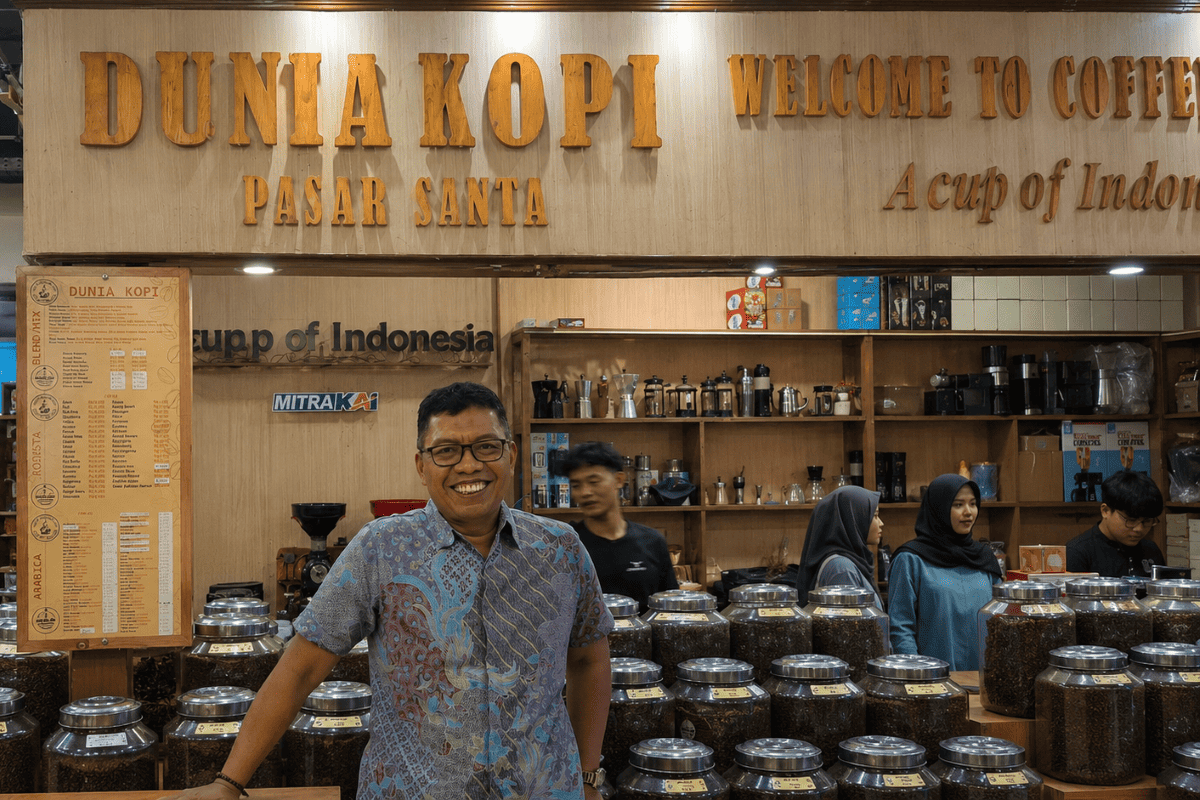
The aroma of coffee immediately greets every visitor descending to the ground floor of Pasar Santa, South Jakarta. Amidst the hustle and bustle of the market, a modest shop named Dunia Kopi has become a sanctuary for coffee lovers from all walks of life. Rows of jars filled with coffee beans are neatly arranged in the display, showcasing a tempting variety of Indonesian and international coffees.
From this humble stall, 54-year-old Suradi has brought Indonesian coffee to the global market. To support his business growth, he has utilised the People’s Business Credit (KUR) from PT Bank Rakyat Indonesia (BRI) as additional capital to expand the marketing of Indonesian coffee.
However, the journey to this point was not achieved overnight. Before becoming the owner of Dunia Kopi, Suradi spent many years as a basic commodities trader in Pasar Santa. He shared that his entry into the coffee business began in 2000, when he purchased a stall from a friend who was moving to the United States.
“I spent 13 years in Pasar Santa selling basic commodities. Then I had a Chinese friend who moved to America. I bought his stall. He also taught me about coffee,” he said when met at the Dunia Kopi shop recently.
Through this learning process, Suradi began to understand the various types of coffee and their respective characteristics. He notes that there are four main types: Arabica, Robusta, Liberica, and Excelsa. This understanding led him to delve deeper into the world of coffee, bringing various beans from different regions and countries to his shop.
Dunia Kopi provides coffee beans from countries such as Brazil, Ethiopia, and Timor-Leste, while almost all coffee-producing regions in Indonesia are available in his shop.
“For Indonesia, almost everything is available. There are many varieties, such as Bourbon, Caturra, Sigararutang, up to the S795 line. The post-harvest processes also vary, including semi-wash, full-wash, yellow honey, black honey, and red honey,” he explained.
He admitted that he intentionally collects coffee from various regions so that Dunia Kopi can serve as a sort of ‘coffee tourism’ for customers.
According to Suradi, the coffee business has continued to grow in recent years. During the rise of the specialty coffee trend around 2014, the majority of his customers were foreigners.
“Back then, 70% of buyers were foreigners. There were many from Japan and Korea as well, because foreigners prefer whole beans. Previously, Indonesians mostly drank ground coffee,” he said.
Now, the customer composition has shifted. Suradi noted that the domestic market is growing rapidly as coffee becomes part of the local lifestyle.
“Now, it is 50% international and 50% domestic. Coffee has become a lifestyle. Drinking coffee is now like a necessity,” he said. He believes coffee is not just a drink, but part of a modern experience, as people are becoming more aware of the quality and process behind every cup.
Activity at Dunia Kopi is almost never quiet. Staff can be seen busy weighing beans and serving orders. In one corner of the basement, Suradi also provides a special area for free coffee tasting for guests.
“Here, guests do not necessarily have to buy. They can try any coffee for free,” he said. For the free tastings alone, Suradi admits he can use 5 to 10 kilograms per day. The shop operates from 06:00 to 18:00 WIB, and sales figures are substantial. On a typical day, Dunia Kopi sells at least one tonne of coffee, and has even reached three tonnes.
“One tonne a day is routine. We have reached three tonnes or even more,” he said. During the interview, a customer was noted to have just purchased 200 kilograms of coffee. According to Suradi, large transactions are common as many buyers are resellers.
On weekends, the sale of prepared coffee drinks increases sharply, with the shop able to sell up to 1,200 cups in a single day.
Suradi’s enterprise began with modest capital. He recalled his initial investment to secure the space in Pasar Santa was Rp9.5 million, covering the kiosk, equipment, and initial stock. Over time, Dunia Kopi has expanded to offer premium varieties, such as Java Geisha, which sells for around Rp800,000 per kilogram, as well as Luwak coffee and infused coffee at approximately Rp500,000 per kilogram.
According to Suradi, one of the flagship coffees attracting attention is the Gunung Puntang coffee from West Java, which gained international fame after setting a high sales record at a coffee auction in Atlanta, USA, in 2016.
Suradi’s success in building Dunia Kopi relies not only on his perseverance and passion for coffee but also on the access to capital provided through BRI’s KUR. He stated that he has utilised KUR loans several times to scale his business, using the funds to upgrade equipment, expand his stock from various regions, and support the ongoing operational growth of his business.
Source: jawawa.id (https://jawawa.id/newsitem/the-aroma-of-dunia-kopi-from-pasar-santa-reaches-international-markets-1780922829)
Originally published by Media Indonesia (https://mediaindonesia.com/ekonomi/891271/aroma-dunia-kopi-dari-pasar-santa-menembus-mancanegara), translated from Indonesian