
The 'API' of the Muslim Community
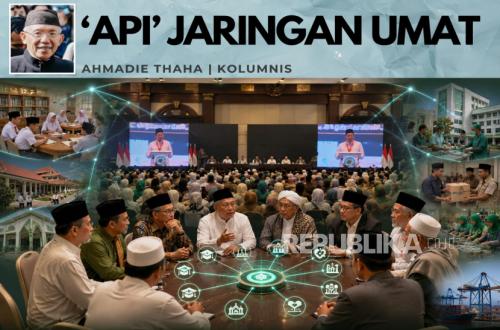
At Hotel Bidakara, Jakarta, in late July, there was a scene perhaps difficult to find in many Muslim countries. Kiai, ulama, intellectuals, state officials, leaders of Islamic organisations, academics and pesantren administrators sat together in a single forum.
Some recite qunut at dawn prayers, some do not. Some perform eight rakaat of tarawih, others twenty. Some determine the start of Ramadan by moon-sighting, others by calculation. Yet there was no news of them fighting over prayer mats because of these differences.
They came for the eighth Indonesian Muslim Community Congress (KUII VIII). More than 400 participants, including representatives of 87 national-level Islamic community organisations, gathered under a grand theme: “A United Community, a Sovereign Nation, a Strong State.”
The chairman of the KUII VIII steering committee, KH Marsudi Syuhud, offered two more operational terms for the theme: taswirul manhaj, the alignment of mindsets, and tansiqul harakah, the coordination of movements.
But the theme raises a question: after eight congresses and decades of organisation among Indonesian Muslims, is the community’s biggest problem today still ‘unity’?
It once was, because its meaning was easier to recognise. Relations between Muslims were once consumed by debates over furu’iyah matters: qunut, tahlil, talqin, mawlid, grave visits, the number of tarawih rakaat, even the determination of the start of Ramadan and Eid al-Fitr.
Differences in jurisprudential methodology, rarely understood by ordinary Muslims, transformed into social identity. Mosques sometimes had an ‘organisational madhhab’, even if it was not written on their signboards.
Even when KUII VI was held in Yogyakarta in 2015, the need to strengthen ukhuwah and consolidate the community remained part of the atmosphere of discussion. Yet at that time the congress agenda had already moved far towards politics, economics, socio-cultural issues, and strengthening the community’s role in national life.
More than ten years later, many of those fences have lowered. A Muhammadiyah member can pray in an NU mosque without an ideological inspection at the door. A Nahdliyin travelling does not need to find another mosque because the imam does not recite qunut.
Families even live with mixed religious traditions: a Muhammadiyah father, an NU mother, children schooled in another institution, while the grandchildren may one day choose their preacher from YouTube.
What still regularly appears is the difference in determining the start of Ramadan and Eid al-Fitr. Even that is no more than a difference in the method of determining ‘times of worship’, not a difference in worship itself. All still fast during Ramadan and pray the Eid prayer. What sometimes differs is only when to start cooking opor.
So KUII VIII confronts us with a new question: if the qunut quarrels are fading, where exactly are Indonesian Muslims now divided? I believe the fault line has shifted.
Their divisions are now no longer primarily on the prayer mat, but in ‘institutions, economics, politics, human resources, technology, data, media, and the capacity to organise strength’. We have increasingly succeeded in building ritual ukhuwah, but we do not necessarily yet possess institutional ukhuwah.
The number of Indonesian Muslims is extraordinarily large: more than 240 million people. Almost every major issue of the community is automatically an issue of the nation. The community is the nation. The nation is the community.
But numbers are not identical to strength. Mancur Olson long ago warned in The Logic of Collective Action that large groups are not automatically better at achieving common interests. The larger the group, the more difficult coordination can become.
There is a long road from ‘many’ to ‘strong’. Let me formulate it as an arrow diagram for easy understanding: ‘Numbers → Unity → Organisation → Capacity → Strength’. Now, the theme of KUII VIII already has its two ends: ‘a united community’ and ‘a strong state’. What is often missing is precisely the arrow in the middle.
Look at Muhammadiyah and Nahdlatul Ulama. Both are extraordinary treasures of Indonesian civilisation, but they grew with different institutional architectures.
Muhammadiyah is relatively easy to count. The organisation’s own data mention thousands of schools, hundreds of pesantren and universities, more than a hundred hospitals and hundreds of clinics.
They have a term that embodies an organisational philosophy: ‘Amal Usaha Muhammadiyah’ (Muhammadiyah’s charitable enterprises). A university does not belong to its rector, a hospital does not belong to its director.
All of Muhammadiyah’s wealth forms part of an institution that can be inherited beyond a human lifespan. KH Ahmad Dahlan passed away long ago. But his schools keep growing. That is one of the miracles of institutions: ‘people die, but the organisation is not buried with them’.
NU has a different ecology. Among the Nahdliyin there is a network of pesantren, Ma’arif schools, universities, hospitals, clinics, cooperatives, mosques, endowed land and various very large economic activities.
But a pesantren that is culturally very NU is not necessarily an ‘asset of PBNU’ (NU’s executive board). It may be owned by a foundation, a kiai’s family, a separate legal entity or a local waqf. Its cultural ties are strong, while its ownership structure is dispersed.
Therefore, comparing the value of Muhammadiyah’s assets with those of PBNU outright is like ‘comparing an apple with a mango orchard’.
Muhammadiyah resembles a federation of institutions whose assets are easier to identify. NU more closely resembles a giant social ecosystem with thousands of autonomous nodes. One fits more easily into a spreadsheet; the other must be sought out village by village.
It is precisely that difference which brings us back to the great gathering at Bidakara. If even the two largest organisations have different architectures, imagine the 87 organisations gathered at KUII VIII.
What do they actually possess if all their strengths were mapped? How many schools, universities and pesantren? How many hospitals and clinics? How many hectares of land and waqf assets? How many cooperatives, BMTs and companies? How many media outlets? How many doctors, professors, researchers, engineers, economists, legal experts, entrepreneurs and artificial intelligence specialists?
The more unsettling question: ‘does anyone actually know the answer?’ If not, the community’s problem may not be a lack of resources. I want to state it plainly: what we lack is a ‘resource map’.
A general may have a million soldiers, but if he does not know where they are, their skills, their logistics and who can mobilise them, then statistically he does indeed have an army; operationally, he merely has a crowd.
This is where unity needs a new meaning. Robert Putnam distinguishes bonding social capital, the ties that bind people within a group, from bridging social capital, the bridges that connect different groups.
Indonesian Muslims are rich in the former, bonding social capital. NU has its NU network, Muhammadiyah has its Muhammadiyah network, likewise PUI, Persis, Al-Irsyad, Al Washliyah, Hidayatullah, Mathla’ul Anwar, and feel free to name any other organisation.
But in my view, and perhaps you will agree, the next challenge is not to dissolve those houses, but to ‘build bridges between the houses’.