
The Accidental Discovery That Led an 82-Year-Old to Create 'Scrap Rice Fields' in Gunungkidul
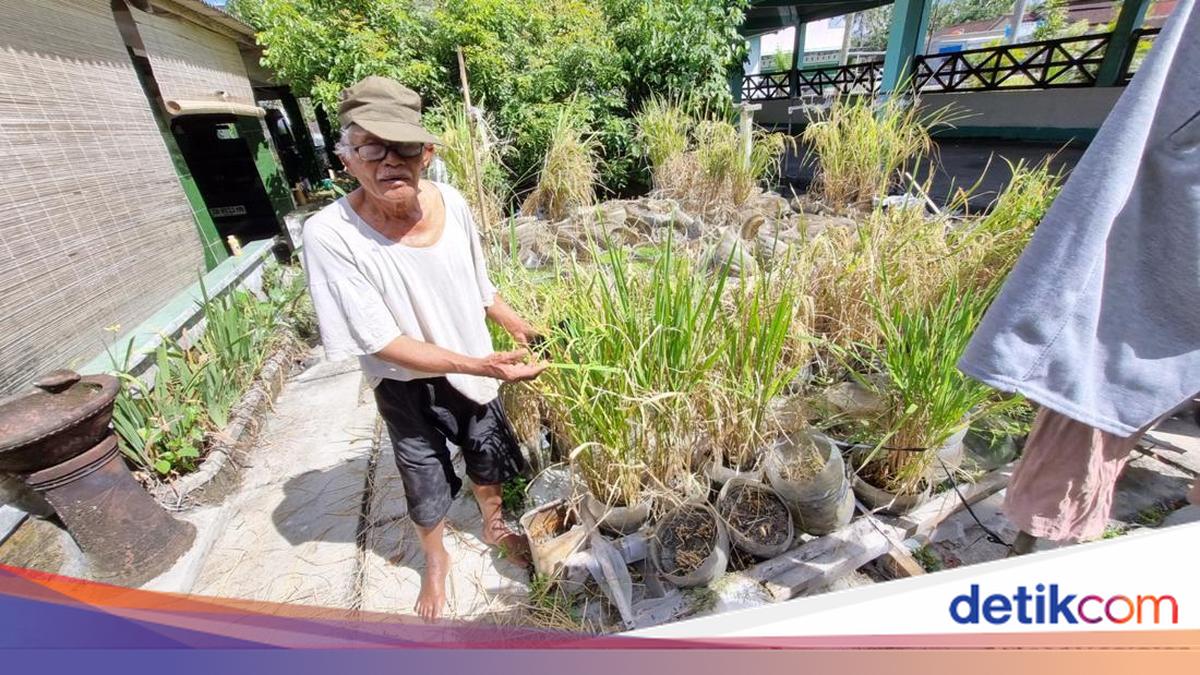
Suhantara, an 82-year-old resident of Susukan II, Genjahan, Ponjong, Gunungkidul, has drawn attention for his innovative idea of turning discarded items into planting media for rice. The idea came to him by accident.
He revealed that the concept began when he saw grains of rice that had fallen into a tin. The grains grew very well even though they were not in a large expanse of soil. ‘I brought the dry unhusked rice home and some of it scattered on the ground. The scattered grains grew into seedlings,’ Suhantara said when met at his home on Tuesday (7/7/2026).
The grains came from Inpari-24 seeds. He then tried planting the seedlings using several used tins. ‘I watered the tin containing the seedlings regularly and they grew well. Because they grew well, I had the idea to enlarge the medium, since tins are small,’ he said.
Suhantara then tried using used gallons, simply because they could hold more soil. ‘I bought about 100 gallons, at Rp 2,000 per gallon. I filled the gallons with any soil, added manure and a little chemical fertiliser, then planted the seedlings,’ he said.
The plants were then cared for just like those in a paddy field. He named the method ‘sawah rongsok’ (scrap paddy fields). ‘It is actually just like planting rice in a paddy field, only this uses gallons. When the water runs out, you just water it again until it’s full. Because it uses used gallons and tins, I call it a scrap paddy field,’ he said.
Having started planting in 2025, he claims to have harvested the rice in gallons four times. ‘The yield from one gallon with three rice plants can produce about 130 grams of dry unhusked grain. For the hybrid variety that was tested, it grows more densely, with one seedling producing up to 30 tillers before harvest; at harvest, it can yield 300 to 400 grams of dry grain per gallon,’ he explained.
By his calculations, 100 gallons alone could produce 30 to 40 kilograms of dry unhusked grain, provided hybrid rice is used. ‘Therefore, I hope many people will follow what I am doing. If you want to learn, please come to my house and we can learn together. Moreover, the cost is cheap, you only need to buy gallons and fertiliser,’ said the chairman of the Genjahan Makmur Farmers Group Association.
Suhantara added that eight of his members are now planting rice in gallons in their yards. He hopes the number will continue to grow as it does not require large capital. ‘Hopefully, the number will increase and more people will be interested in planting rice using gallons,’ he said.