
The 3T Wetlands
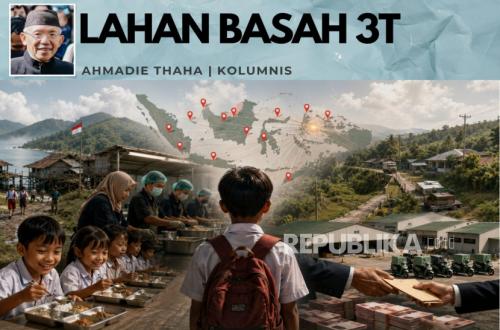
Initially, the programme arrived like a party invitation. Schoolchildren would receive nutritious food, and mothers would no longer need to worry about their children going to school on empty stomachs. Alongside this, farmers hoped for their harvests to be absorbed, and livestock farmers imagined a steady market for their eggs and poultry. The state was present not through speeches, but in the form of warm rice, side dishes, vegetables, and a glass of milk.
The idea was simple, even too beautiful to reject. Who would dare oppose nutritious food for children? Therefore, when President Prabiente Subianto launched the Free Nutritious Meal (MBG) programme, many welcomed it with applause—some for ideological conviction, others for humanitarian reasons. Furthermore, this programme was not merely depicted as providing lunches for students in well-paved schools with air-conditioned classrooms. MBG was introduced as an effort to save the future of Indonesia’s most vulnerable children: those in underdeveloped, frontier, and outermost (3T) regions; pregnant women in poor villages; and areas that for decades have seen more promises than policies.
Who could refuse? The vision of children studying on empty stomachs possesses immense persuasive power, capable of melting political calculations. Like a hot knife through butter, humanitarian reasons often dissolve objections, especially when the sacred ‘3T’ acronym is mentioned. This republic knows that development often behaves like a wedding guest who stays too long in the front room, while the back rooms are only glanced at before an election and forgotten once the party ends. Thus, when the government stated that MBOG would reach 3T areas, many saw it as the most noble aspect of the programme. The state was finally arriving, not just with flags and speeches, but with a plate of nutritious food.
Unfortunately, good intentions often invite uninvited guests. Recently, the narrative surrounding MBG has changed drastically. A programme originally promoted as an investment in the nation’s future has suddenly entered the legal arena. Criticisms against MBG had actually emerged from the start, with some questioning its implementation readiness, others warning of potential budget leakages, and some calling for stricter supervision. However, the managers appeared calm, treating criticism like the sound of crickets in the night: heard, but deemed too insignificant to wake anyone from their slumber.
Finally, the tide turned. President Prabowo Subianto dismissed the managers of the National Nutrition Agency (BGN) and replaced them with new officials. Shortly thereafter, the Attorney General’s Office took further action. Five individuals have been named suspects by the Attorney General. These were not kitchen staff who miscalculated the number of eggs or incorrectly recorded rice purchases; they were individuals within the decision-making circles.
The Attorney General’s Office has named the former Head of the National Nutrition Agency, Dadan Hindayana, as a suspect, along with two former deputies, Sony Sonjaya and Lodewyk Pusung. From outside the agency, Asep Yusuf Somantri, described as a close associate of Sony Sonjaya, and Andri Mulyono, a Commissioner of PT Yasa Artha Trimanunggal, were also implicated. According to the Attorney General, two clusters of corruption are being uncovered. The first cluster involves the buying and selling of SPPG points—the Nutrition Fulfilment Service Units or MBG kitchens. The second cluster involves the procurement of goods and services, including an alleged markup on electric motorcycle procurement worth approximately Rp1.1 trillion.
The second cluster is certainly serious, and the modus operandi feels all too familiar. This country has too often witnessed procurement projects turn into budgetary magic tricks, where originally slim prices suddenly swell, and documents intended as safeguards become red carpets. State funds evaporate in almost the same way, with only the perpetrators’ names changing.
However, the first cluster is far more interesting to dissect. It is here that we find a near-perfect irony. The very logic that made MBG easy to accept is allegedly the same logic used to manipulate the project. If 3T areas are considered most in need, their budgets are more easily prioritised. If 3T areas involve the fate of the most vulnerable children, proposals for additional service points become harder to reject. If 3T areas are perceived to be far from the spotlight, the playground becomes much looser. Like a farmer seeking the most fertile soil to plant rice, rent-seekers seem to know exactly where the ‘wettest’ lands are located. And indeed, these allegations are reflected in the figures. Initially, the number of SPKG points planned for 3T areas was around 2,000. This seemed reasonable.