
The 3.20am Raid
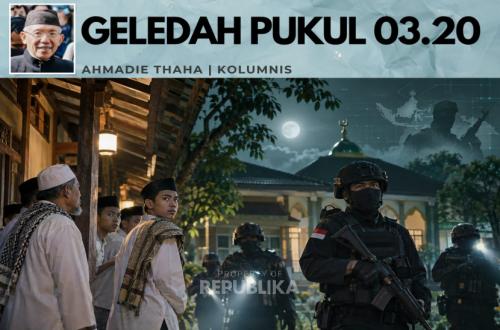
By Ahmadie Thaha, columnist
JAKARTA — It was 3.20am. The air in Sukoharjo was still cold. Some students may just have woken up, preparing to perform wudu before offering the tahajud prayer.
In the stillness of the night, while most people were asleep and some had begun whispering prayers from the corners of the dormitories, the sound of a door being forced open suddenly shattered the calm.
Dozens of armed officers arrived, some wearing tactical gear. They entered the grounds of the Hamalatul Quran Islamic boarding school, a name also found in Jombang, Yogyakarta and elsewhere.
The female students, who had been asleep, were startled by the arrival of armed men. A night that should have been a place of peace for children studying the Quran became an experience that may stay with them for a long time.
That is how the raid on the boarding school in Sukoharjo, Central Java, on 27 October 2026 has been described, based on a timeline provided by the school and information gathered by the National Commission on Violence Against Women (Komnas Perempuan).
The commission recorded allegations that dormitory doors were forced open, weapons were pointed at people, officers shouted and intimidated residents, and female students were made to come out without their headscarves. Twelve students aged 10–16 and four female teachers were caught up in the incident.
Of course, we must wait for the investigation to establish all the details and determine who breached procedure. But one thing is already clear: searching an educational institution where girls live demands exceptional care.
Police carry weapons to deal with security risks. They must also bring common sense, restraint and respect for human dignity.
The incident has since become a national controversy. Criticism has come from the public, Islamic boarding-school circles, the National Commission on Human Rights (Komnas HAM), Komnas Perempuan and others, with calls for the police to account for how they conducted the operation.
On Monday, 2 November 2026, National Police Chief General Suyudi Ario Seto finally took action. He removed Sukoharjo Police Chief AKBP Andika Dharma Sena, Criminal Investigation Unit chief Iptu AS, General Crimes Unit head Ipda FA and Women and Children’s Protection Unit head Ipda RAP. The four are being examined by the police Professional and Security Division (Propam) over alleged breaches of the code of ethics during the search.
The National Police chief’s move deserves recognition. But the removals raise a bigger question: what responsibility does Central Java Police Chief Inspector General Roy Hardi Siahaan bear?
The question arises because the regional police chief himself appeared in public to explain the operation. On Friday, 30 October 2026, he held a press conference at Central Java Police headquarters, accompanied by Central Java Deputy Governor Taj Yasin Maimoen.
At the press conference, the police chief gave an explanation that sounded highly convincing. He said the search was part of the investigation into the arson and destruction of the Tepi Sawah pork noodle shop in Parangjoro village, Sukoharjo.
Police, he said, were hunting a fugitive identified by the initial I, who was allegedly linked to a suspect identified as ST. Both were described as former terrorist convicts who had been involved in the 2015 attack on Kliwon Police Station.
The arson case itself must, of course, be kept in perspective. The incident on 12 September 2026 was a criminal offence that must be thoroughly investigated.
The shop owner is entitled to protection and justice. The police are entitled to pursue suspects, develop their investigation and seek evidence.
But we also need to ask: what was the actual basis for directing the police pursuit to the boarding-school grounds? Did investigators find concrete evidence that the fugitive was hiding there?
Did they develop an intelligence assessment linking the location to a terrorist network? Or did the former convict’s history dominate the investigators’ reading of everyone and everywhere they encountered?
The police need to explain the factual basis. A person’s history may provide a lead for an investigation, but it must not replace proof.
Moreover, suspicion that an individual has been involved in a crime does not automatically make everyone at a place they have visited part of a criminal network.
At the press conference, the police chief also said that police had obtained a warrant and a court order to search two locations in Sukoharjo and Karanganyar.
Officers seized a number of items, including swords, samurai swords, sickles, bayonets, bows and arrows, a strong acid, materials involving methylated spirits, communications equipment and certain books.
That is the police account, which has yet to be verified. In any case, judicial authorisation to conduct a search does not automatically justify every method officers use to carry it out.
The legality of an action and compliance with procedure are two requirements that must go hand in hand. A warrant does not give officers immunity to disregard the rights of those at the premises.
The problem is that, at the press conference, the police chief focused mainly on explaining why the police went there and what they found. He stressed that protecting women and children was a priority.
But what about the alleged intimidation of the students? What about the way officers entered the dormitory at 3.20am? How did police safeguard the residents’ dignity when they woke girls with long-barrelled firearms?
The police chief’s official account needs to be tested, particularly now that state institutions have raised serious concerns.
Komnas HAM has called for the search procedures to be reviewed and stressed that the 12 students aged 10–16 are children entitled to special protection.
Komnas Perempuan has condemned the alleged violence, intimidation and disregard for legal procedures affecting the students and female teachers. It has also called for an independent investigation and psychosocial support for those affected.
If so, we must question the quality of the information the police chief presented on 30 October. Had he personally checked the operation’s timeline? Had he heard from the students and teachers?
Did he receive a complete report from the police chief in Sukoharjo? Or did he simply accept his subordinates’ account and package it as an official statement that created the impression that everything the police had done was entirely proper?