
The 25th ATV International Audit Seminar Discusses the Transformation of Auditors' Roles in the Digital Era
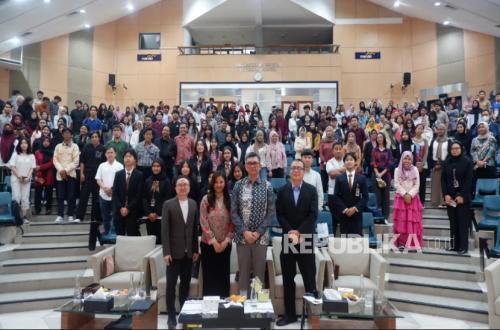
REPUBLIKA.CO.ID, DEPOK - The 25th ATV International Audit Seminar was held on Wednesday (18/2/2026) at the Dean’s Auditorium of the Faculty of Economics and Business, Universitas Indonesia (FEB UI). The event, broadcast live via Zoom, brought together regulators, audit practitioners, academics, and students to discuss the transformation of auditors’ roles amid accelerating digitalisation.
The seminar adopted the theme ‘Adapting Audit Roles and Responses in the Digital Era: From Digital Tools to Strengthened Controls’. The main focus of the discussions highlighted how auditors must redefine their responsibilities, assess risks, and strengthen governance amid technological developments such as artificial intelligence (AI), data analytics, automation, and blockchain.
The event was opened with speeches from various figures, including Anies Rasyid Baswedan, Sandiaga Salahuddin Uno, and Selvia Vivi Devianti, a member of the National Board of the Indonesian Institute of Accountants (IAI). They emphasised the role of auditors in implementing adaptive digital governance, strong oversight, and cross-sector collaboration to ensure audit integrity and public trust in Indonesia’s continuously developing business ecosystem.
Transformation of the Audit Profession
The first keynote session featured a ‘strategic perspective’ on the transformation of the audit profession from Tiffany Tan, Audit and Assurance Lead at CPA Australia. She explained how digital transformation has changed the way businesses operate and the evolving risk profiles.
She introduced the concept of the “3Rs”: Redefine Roles, Reassess Risks, and Respond to Change, as a framework for auditors facing the technology era. In this era, auditors are also undergoing transformation in their roles, no longer limited to checking financial statements but also utilising technology to improve quality, efficiency, and generate value-added insights in audits.
She stressed the importance of using technology responsibly, especially artificial intelligence, by maintaining principles of independence, transparency, professional judgement, and human oversight to preserve public trust amid rapid technological developments.
Digital Transformation Opens Opportunities for Transparency
In the second keynote session, Sophia Isabella Wattimena, Chair of the Audit Board and Member of the OJK Board of Commissioners, highlighted how digital disruption and AI developments are shaping the modern financial ecosystem. She emphasised that digital transformation indeed opens opportunities for transparency and efficiency but also presents new challenges such as increased cyber risks, weakened fraud management, and complexity in implementing technologies like AI and data analytics in modern financial systems.
Therefore, the financial services sector needs to strengthen governance and business continuity management through enhanced information systems, cross-sector collaboration, and adaptive policies. According to her, OJK has responded to this through various policies, including the OJK Regulation on Strengthening Information Technology Governance, OJK Infinity 2.0 and Regulatory Sandbox, and the utilisation of supervisory technology (suptech).
Sophia also affirmed that the use of technology, including AI, must be accompanied by principles of accountability, human oversight, and reliability to strengthen stability and trust in Indonesia’s digital financial system.
AI Assists the Audit Process
Handrow Cahyadi, Partner and Head of Financial Services & IT Audit and Assurances at KPMG Indonesia, stated that through the utilisation of AI, automation, and data analytics, the audit profession is undergoing a transition.
Currently, AI is more commonly used as a ‘Copilot’ for auditors to improve work efficiency. In the future, AI is expected to evolve into more sophisticated systems capable of handling nearly the entire audit process from start to finish.
Therefore, the role of auditors will focus more on supervision and making important decisions to maintain trust in audit results. Although technology makes work faster and more efficient, the human role remains irreplaceable.
Juan Ramon Siahaan, Audit Partner at Liana Ramon Xenia & Rekan Public Accounting Firm, stated that the presence of AI will not replace the auditor profession but rather enhance the effectiveness and quality of audits.
AI can be used at every stage of the audit process, from planning (such as determining materiality and processing client data), risk assessment, testing, to report preparation and result analysis.
Nevertheless, the primary responsibility remains with the auditor. Professional judgement remains key to maintaining audit quality. With the right approach, AI can be positioned as a supportive tool capable of increasing efficiency and added value in the audit process.
Source: jawawa.id (https://jawawa.id/newsitem/the-25th-atv-international-audit-seminar-discusses-the-transformation-of-auditors-roles-in-the-digital-era-1775037060)
Originally published by Republika (https://news.republika.co.id/berita/tct59d368/the-25th-atv-international-audit-seminar-bahas-transformasi-peran-auditor-di-era-digital), translated from Indonesian