
The 14 Major Earthquakes of 2026: Thousands Killed
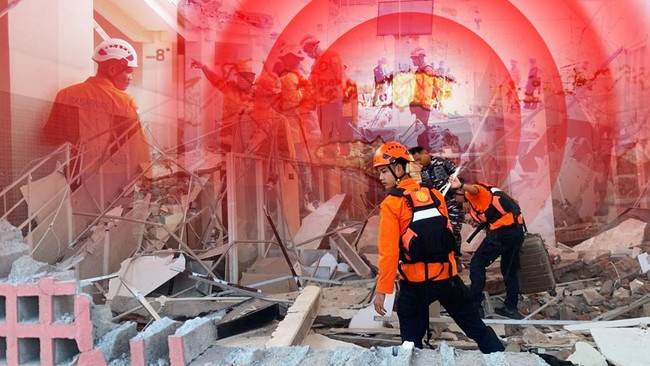
Jakarta, CNBC Indonesia — A major earthquake has again struck the Pacific region. Most recently, Vanuatu was hit by a magnitude 7.0 earthquake on Saturday (24 October 2026) at 9.31am Western Indonesian Time (WIB).
The Meteorology, Climatology and Geophysics Agency (BMKG) said the earthquake occurred at a depth of 10 kilometres, with its epicentre at sea, around 500 kilometres north-west of Port Vila, Vanuatu.
The quake was triggered by normal fault activity in the outer-rise zone near the New Hebrides Trench. BMKG confirmed it did not pose a tsunami threat to Indonesia. By 10am WIB, one aftershock measuring magnitude 6.3 had been recorded.
The event brings to 14 the number of major earthquakes recorded in 2026 up to 24 October, based on data from the US Geological Survey (USGS), BMKG and reports from relevant disaster-management agencies.
Their impacts have ranged from shaking with little significant damage to disasters that have claimed thousands of lives.
Several earthquakes have claimed thousands of lives
The death tolls and damage caused by major earthquakes in 2026 have varied considerably from one region to another.
One of the deadliest disasters occurred in Venezuela on 24 June local time.
The country was struck by two major earthquakes, measuring magnitudes 7.2 and 7.5, just around 32 seconds apart.
The quakes caused widespread damage in northern Venezuela, including in Caracas, La Guaira, Miranda and surrounding areas.
According to a 27 August 2026 report by the UN Office for the Coordination of Humanitarian Affairs (OCHA), Venezuelan authorities had recorded 6,509 deaths from the series of earthquakes, based on figures through 24 August.
Tens of thousands of homes also needed to be inspected for damage, while economic activity and various public services were disrupted.
Another major impact was felt in Colombia, when a magnitude 7.4 earthquake struck the country’s west on 10 August 2026.
The Pan American Health Organization (PAHO) reported 331 deaths and 4,519 injuries in an update in early September.
The earthquake also affected hundreds of thousands of people and damaged homes, health facilities, schools, roads and bridges.
Meanwhile, the magnitude 7.8 earthquake that struck the Mindanao region of the Philippines on 8 June was the strongest in this year’s list.
According to figures from the National Disaster Risk Reduction and Management Council (NDRRMC) as of 21 July 2026, the disaster killed 106 people and injured 1,316.
Around 1.68 million people were affected, while more than 120,000 homes were partially or completely damaged.
Indonesia also faced serious consequences when a magnitude 7.7 earthquake struck Flores on 15 August 2026.
The quake was triggered by activity along the Flores Back-Arc Thrust, which also caused sea levels to rise in several coastal areas.
As well as causing fatalities, the disaster damaged thousands of homes and forced residents to leave their houses.
Earthquake impacts do not stem solely from buildings collapsing during the main shock. Conditions in evacuation centres, disrupted access to healthcare and damage to essential facilities can also increase risks for affected communities.
By contrast, some high-magnitude earthquakes have not caused comparable levels of damage.
For example, the magnitude 7.1 earthquake in Sabah, Malaysia, in February 2026 occurred at a depth of about 629 kilometres. Although shaking was felt in several areas, no major damage or tsunami was reported.
This shows that magnitude alone does not determine the severity of earthquake damage.
Why have so many major earthquakes occurred in 2026?
Daryono, a member of the Indonesian Disaster Experts Association (IABI), explained that most major earthquakes occur around tectonic plate boundaries, particularly along the Pacific Ring of Fire.
The region includes several countries that experienced major earthquakes in 2026, such as Indonesia, Japan, the Philippines, Tonga and Vanuatu.
These areas lie near active plate-interaction zones, where stress continually builds up and energy is released through rock faulting.
However, the mechanisms that cause earthquakes are not always the same.
Earthquakes can result from subduction, or one plate moving beneath another; reverse faulting; strike-slip faulting; or normal faulting.
For example, the magnitude 7.7 earthquake in Panama was associated with strike-slip fault activity, while the earthquake on the Tibetan Plateau was linked to crustal deformation caused by the collision of the Indian and Eurasian plates.
Daryono also said major earthquakes can occur at different depths: shallow, intermediate or deep.
Shallow earthquakes near populated areas generally have the potential to cause stronger shaking at the surface, while very deep earthquakes do not necessarily cause the same level of damage, even when their magnitude is high.
Although many high-magnitude earthquakes have occurred in 2026, this does not in itself prove that the Earth’s tectonic activity is rising abnormally.
According to Daryono, the number of earthquakes can vary naturally from year to year.
Determining whether seismic activity has increased significantly requires statistical analysis of long-term earthquake records.
In addition, earthquakes occurring in different countries within a short period are not automatically connected.
Each region has its own tectonic conditions and accumulated stress, so a sequence of major earthquakes cannot be used on its own to predict where or when the next earthquake will occur.
Indonesia must remain prepared
The series of major earthquakes around the world is an important reminder of the threat posed by geological disasters.
Indonesia’s location at the meeting point of several active tectonic plates means that many parts of the country are at risk of powerful earthquakes and tsunamis.
Nevertheless, Daryono emphasised that science is not yet able to predict precisely when and where a major earthquake will occur.
“We cannot yet predict precisely when and where a major earthquake will occur, but we have the scientific knowledge to identify hazard-prone areas and reduce the risks,” Daryono said.
Efforts to reduce the impact of disasters must therefore begin well before an earthquake happens.
These include building earthquake-resistant infrastructure, applying spatial planning based on disaster risk, improving public understanding of how to protect oneself, and strengthening tsunami early-warning systems.
Daryono said the death toll and scale of damage are determined not only by the strength of an earthquake, but also by building conditions, regional vulnerability and public preparedness.
“Earthquakes are a natural process that cannot be prevented, but the scale of casualties and damage is strongly influenced by vulnerability, exposure and community preparedness,” he stressed.
The major earthquakes of 2026 should therefore not be a concern only while disasters are unfolding. More importantly, lessons from these events can provide a basis for strengthening preparedness and reducing future casualties.
Source: jawawa.id (https://jawawa.id/newsitem/the-14-major-earthquakes-of-2026-thousands-killed-1792831877)
Originally published by CNBC Indonesia (https://www.cnbcindonesia.com/research/20261024124314-128-779131/daftar-14-gempa-dahsyat-sepanjang-2026-ribuan-korban-jiwa-berjatuhan), translated from Indonesian