
Thamrin Road Remains Busy During WFH Every Friday, Outbound Traffic from Jakarta Rises Nearly 6 Percent
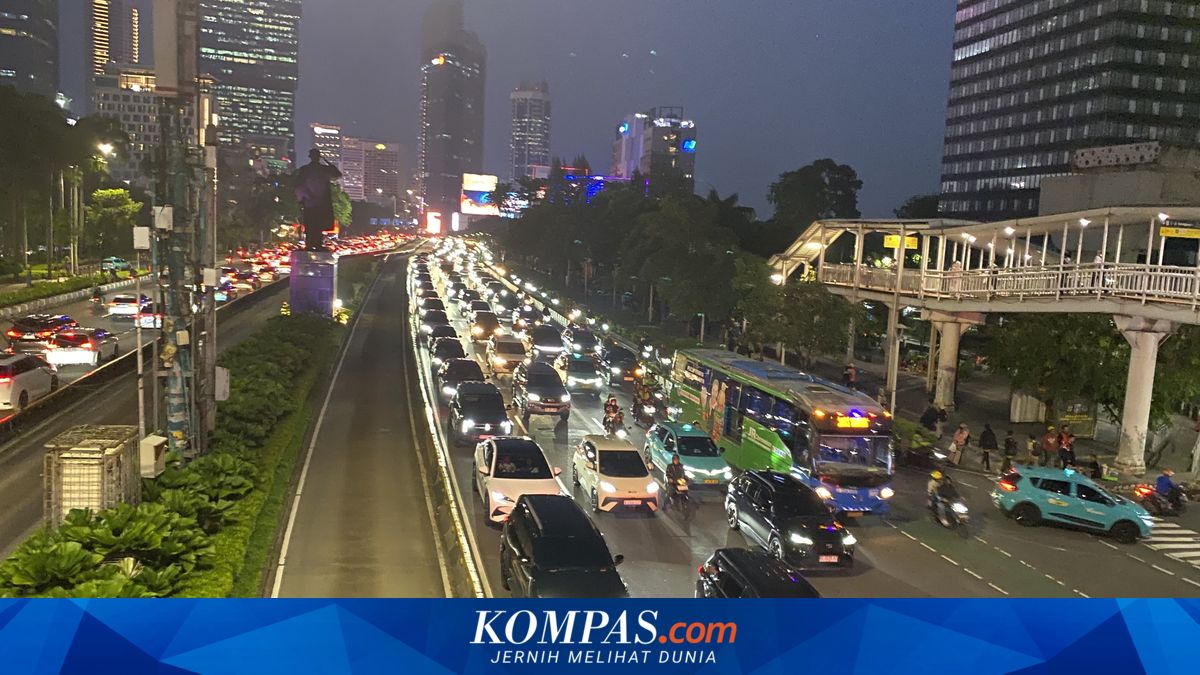
JAKARTA, KOMPAS.com - The work-from-home (WFH) policy for civil servants (ASN) every Friday, in effect since early April 2026, has not immediately cleared Jakarta’s protocol roads of traffic.
In several corridors, traffic has indeed decreased, but the reduction is slight and insignificant. In fact, on Jalan MH Thamrin, outbound vehicle flow towards leaving Jakarta has increased by nearly 6 percent.
Data from Deputy Head of the DKI Jakarta Transportation Agency (Dishub), Ujang Harmawan, shows that on the first Friday of ASN WFH implementation, 10 April 2026, the volume of outbound vehicles or those heading out of Jakarta in the Jalan MH Thamrin corridor rose 5.97 percent compared to the average normal working day.
This increase mainly occurred in motorbikes, rising from 29,434 to 31,823 vehicles. Four-wheeled vehicles also increased from 19,816 to 20,620 vehicles.
Meanwhile, the volume of vehicles heading into Jakarta on the same stretch actually decreased.
Dishub recorded an average total inbound vehicles on MH Thamrin on working days (Monday–Thursday) at 27,171 vehicles. However, on WFH Friday, the figure dropped to 26,175 vehicles, a 3.67 percent decrease.
Despite the reduction in inbound flow, the surge in outbound flow on Thamrin stands as an anomaly amid expectations that the ASN WFH policy could reduce congestion in the city centre.
Kompas.com contacted Ujang to further examine the impact of the ASN WFH policy on traffic density in Jakarta.
Based on traffic counting sensor data, Dishub assesses that the WFH policy does have an impact, but its scale is not yet substantial.
“Overall, the total vehicle volume on Fridays with ASN WFH implementation shows a downward trend compared to normal working days, although the magnitude of the decrease is still not significant,” Ujang stated.
According to Dishub, the downward trend is evident in several main corridors, but it is not uniform. In some road stretches, the decrease even only occurs in certain types of vehicles.
Besides Thamrin, Dishub monitored the Jalan Jenderal Sudirman-Karet corridor, known as one of the vital arteries of Jakarta’s business centre. The results show a very slight decrease in total inbound vehicle volume on this stretch.
Dishub noted that the average total vehicles during rush hour on working days (Monday-Thursday) in April 2026 for inbound to Jakarta reached 38,611 vehicles. On WFH Friday, the number was 38,577 vehicles, a 0.09 percent decrease.
In more detail, motorbikes decreased from 19,443 to 19,020 vehicles. Heavy vehicles such as buses and trucks dropped from 1,217 to 1,177 vehicles.
However, four-wheeled vehicles actually experienced an increase. Dishub recorded light vehicles rising from an average of 17,950 to 18,379 vehicles on WFH Friday.
This condition indicates that a reduction in some traffic volume does not always equate to a reduction in private cars.
Meanwhile, for outbound flow on Sudirman–Karet, the decrease is more noticeable. Total vehicles dropped from 30,348 to 28,728 vehicles, a 5.34 percent decrease.
The largest decrease occurred in four-wheeled vehicles, from 17,040 to 15,631 vehicles, an 8.27 percent drop.
The next corridor monitored by Dishub is Jalan HR Rasuna Said, an area also filled with offices and business centres.
On this stretch, inbound vehicle volume remained relatively stable, even experiencing a slight increase.