
Textile Waste Art Featured at Purana 17: Renjana Perca Exhibition
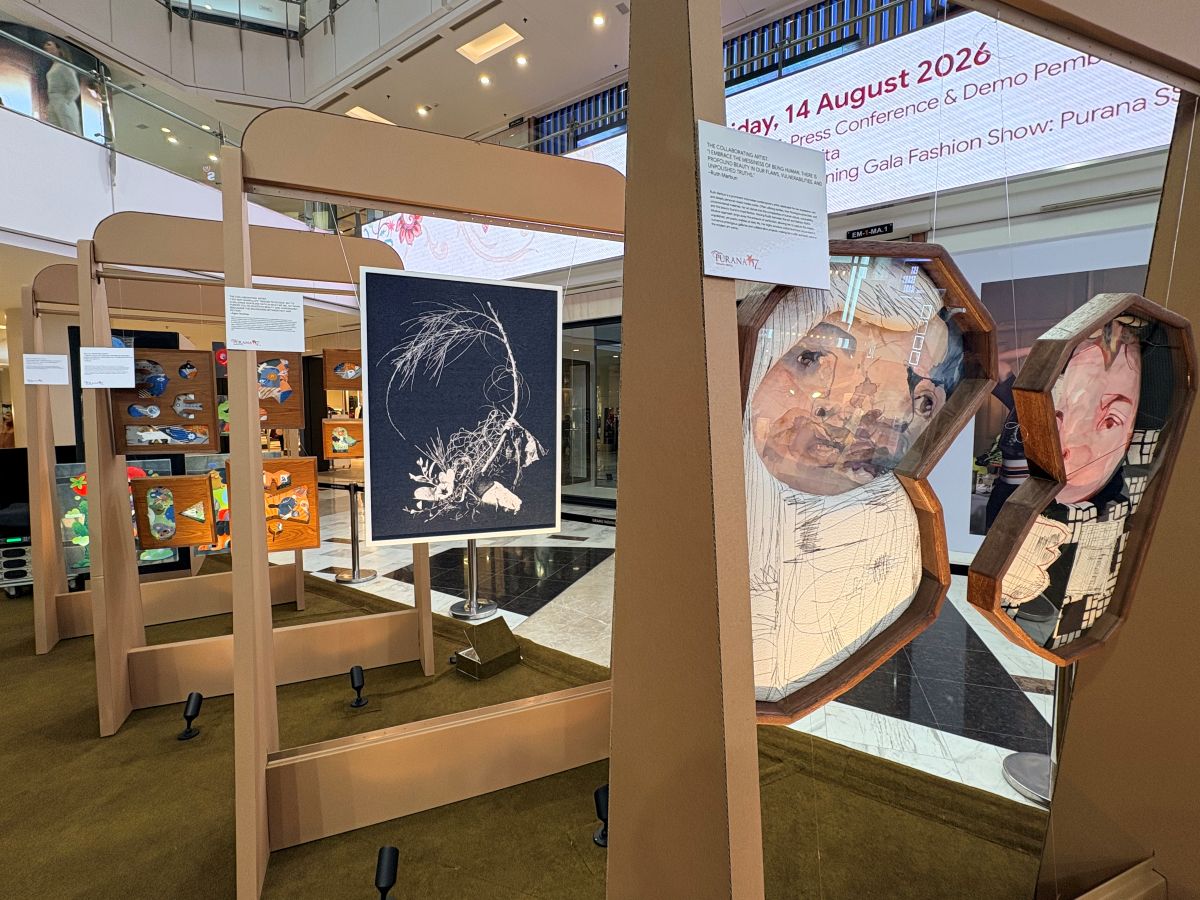
A fairly large tapestry hangs on one side of the Main Atrium of Grand Indonesia, Jakarta. From a distance, the tapestry displaying an island object with its blue ocean is beautifully displayed and steals attention. Adding a special impression, the tapestry turns out to be made from textile waste, illustrating how the artist gives a second life to forgotten materials.
The artwork belongs to Hana Surya, an artist who has long sought to transform textile waste into new usable items such as wall art, tapestries and other accessories. The tapestry is one of the longest recycled art works in the event titled ‘Purana 17: Renjana Perca’, running from 14 to 23 August 2026.
“This event is a celebration of 17 years of Purana Perca’s journey. It is more than a celebration of our journey, but rather a freedom to continue creating without limits. All works in this exhibition are 100 percent made from recycled materials, such as used cardboard, used wood, and also fabric remnants from our production team,” said Purana Founder Nonita Respati at a press conference in Jakarta on Friday (14/8).
Not only Hana Surya’s artwork, a dozen other artists were also involved in the event, including Sutjipto Adi, Francisca Puspitasari, Arief Susanto, Ruth Marbun and Hendra Harsono. Painting maestro Sutjipto Adi presented a fairly large artwork made from denim.
Hanging in the middle of the exhibition space, through the artwork Sutjipto Adi carefully utilised denim waste joined to form a 6x6 metre square, which was then painted with special patterns using colourful paint, making it look beautiful when viewed.
“He created a large work in our midst, this is a 6x6 metre work made from denim patches that were joined together, and then Mr Sujipto painted on top of the denim patches,” said Nonita.
One of the special things about ‘Purana 17: Renjana Perca’ is that Nonita introduced an innovation developed by Purana, an innovation that turns plastic bottle waste into fabric. One of the items displayed is a cushion cover, illustrating how waste can be processed in such a way to be reused.
“We present the ‘Waste to Fabric’ innovation, where we process plastic bottle waste into fibre, which is then spun into yarn and subsequently woven into fabric.”
Nonita further explained that the process of transforming plastic bottle waste into fabric requires several stages. First, plastic bottles are shredded into small pieces and then processed using a machine to turn them into fibre or cotton.
“For the machine, we use a cotton candy maker. So the shredded plastic bottles, which have certainly been cleaned, are put into the machine, and the machine will turn the plastic into fibre or cotton. The fibre is then spun into yarn,” Nonita explained.
As the stages for turning plastic bottle waste into fabric are quite simple, she hopes this innovation can serve as a reference for the wider community without requiring deep pockets. It is hoped that this innovation can empower more people out there.
“My aspiration is for this to be mass-produced, and I hope it can be managed by friends in villages or sub-districts so that they have the motivation to manage waste,” she concluded.