
Textile Industry Remains Resilient Amid Rupiah Volatility and Capital Market Shocks
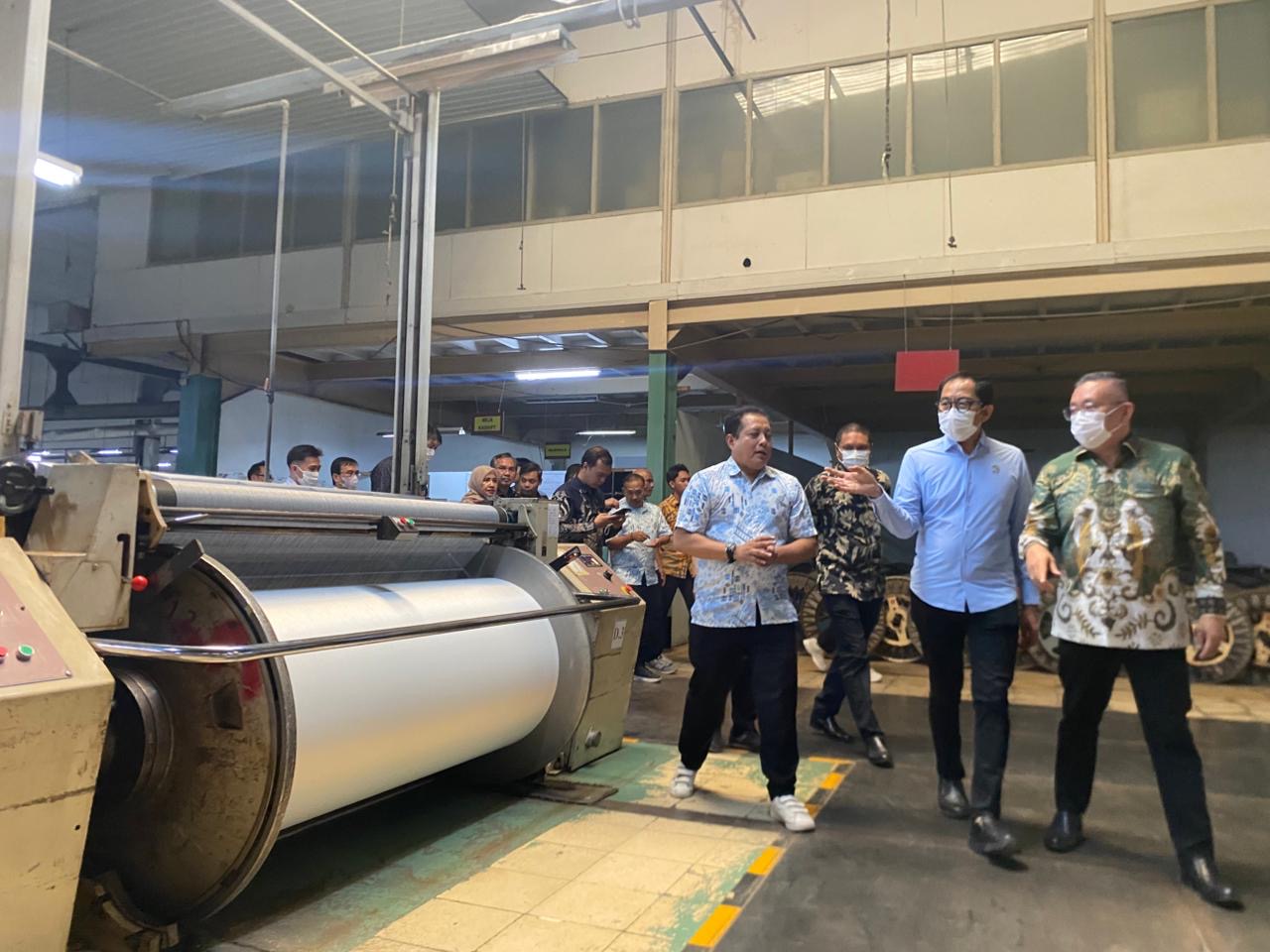
The weakening of the rupiah exchange rate and capital market volatility have not had a significant impact on the national industry, specifically the textile and textile products (TPT) sector. This was stated by the Deputy Minister of Industry, Faisol Riza, during a visit to PT Gajah Angkasa Perkasa in Bandung, West Java, on Thursday.
The Deputy Minister’s visit was intended to inspect several industrial sectors, including textiles, amidst public concern regarding the impact of the depreciating rupiah and current capital market instability.
“Recently, there have been many issues suggesting that the rise in foreign currencies and the pressure on the rupiah would have a massive impact on the industry. However, we know that certain sectors are actually experiencing a harvest of opportunities,” said Rised.
“It is evident that our industry has good fundamentals and is almost unaffected by the instability of the rupiah exchange rate or the capital market. I also see that our national industry possesses strong resilience in facing unstable global situations,” he added.
During the visit, the Deputy Minister personally observed the production process at PT Gajah Angkasa Perkasa. He expressed his appreciation for the garment industry’s achievements, noting its ability to meet not only domestic needs but also to penetrate international markets.
Consequently, Riza noted, this proves that Indonesian textile products are competitive with imported products in terms of both quality and price. “We can compete with the prices of textiles produced in other countries and even within the market. This is a point of pride. Naturally, the government will continue to support the textile industry in Indonesia,” said Riza.
Furthermore, the Deputy Minister encouraged the textile industry to utilise geopolitical challenges to increase export market expansion. One such method is through Indonesia’s trade agreements with Europe, which provide zero per cent import duties for Indonesian textile products.
“The government is also ensuring that border controls are strictly enforced. The President has ordered that Customs becomes our economic strength by limiting illegal goods, products that do not meet standards, and goods that damage the domestic market,” said Riza.
Meanwhile, the Director of Gajah Group, Dedy Zein, stated that PT Gajah Angkasa Perkasa is currently capable of producing a total of 3 million metres of garment products per month to meet both domestic and export markets, particularly for military and government uniform needs in Malaysia, Japan, and India.
With a Domestic Component Level (TKDN) reaching 85 per cent, Dedy is optimistic that they can continue to add more export destinations, with targets including Saudi Arabia, Egypt, the United Arab Emirates, France, the United Kingdom, Spain, South Korea, Vietnam, Papua New Guinea, and Canada.
“We hope that in the future, we can export finished goods, specifically specialty items turned into military and government uniforms in other countries,” said Dedy.
It is noted that, in addition to uniforms, PT Gajah Angkasa Perkasa’s business lines also produce various garment products, including shoes, epaulettes, batik fabrics, and footwear.
Indo Intertex-Inatex 2026 is considered increasingly relevant and strategic, not only as an exhibition venue but also as a momentum to accelerate the strengthening of the national TPT industry. In the fourth quarter of 2025, the textile and textile products industry recorded a year-on-year growth of 4.37 per cent amidst global pressure and slowing demand in several export destination countries.
Minister of Industry Agus Gumiwang Kartasasmita appreciated the expansion steps taken by PT Citra Terus Makmur as a strategic move to strengthen the national textile industry. The competitiveness of Indonesian TPT products is evident in one of the most important export markets, the United States. However, surges in both legal and illegal imports are cited as major factors causing the national textile industry to struggle.
Source: jawawa.id (https://jawawa.id/newsitem/textile-industry-remains-resilient-amid-rupiah-volatility-and-capital-market-shocks-1781189786)
Originally published by Media Indonesia (https://mediaindonesia.com/ekonomi/899612/industri-tekstil-tetap-kokoh-hadapi-gejolak-rupiah-dan-pasar-modal), translated from Indonesian