
Textile Industry Contracts, Convection Entrepreneurs Cry Out Over Remaining 50% Orders
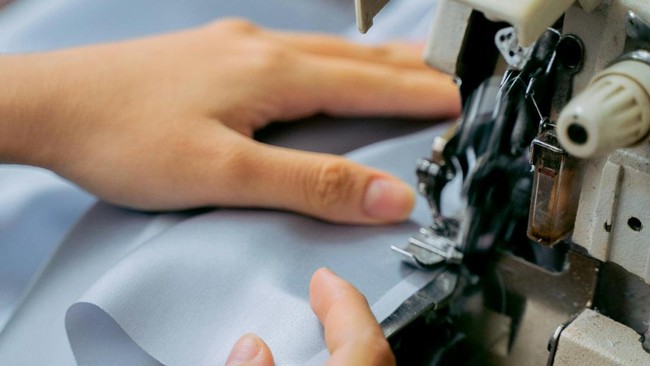
Jakarta, CNBC Indonesia - Small and medium-sized industry players (IKM) in the convection sector are facing heavy pressure due to a decline in orders in recent times. This is also reflected in the Industrial Confidence Index (IKI) value for April 2026 at 51.75, but the textile sector is experiencing contraction.
This situation is forcing many business players to carry out production efficiency amid domestic market uncertainty. This is occurring amid the dynamics of the national textile industry, which is undergoing contraction in April 2026. Although the garment subsector still records relatively good performance, pressure from imported raw materials and price competition leaves IKM players in a vulnerable position.
Convection business players admit that the decline in orders directly impacts production capacity, which has long been the backbone of their businesses. Adjustments are unavoidable.
“Of course. For example, normally an order is for 100 pieces, but now it could be 60, 50, or even half,” said the General Chairman of the Bandung Convection Entrepreneurs Association (IPKB), Nandi Herdiaman, to CNBC Indonesia on Wednesday (29/4/2026).
This decline in orders not only affects production output but also workforce planning. In normal conditions, production capacity is adjusted to the available workforce.
However, now many business players are holding back on expansion and even reducing production activities to cut operational costs. This situation creates a dilemma because on one hand, the business must continue to operate.
“So if up to now we say we’re closing, not yet, we’re still holding on, but holding on like this for a long time will drain savings too,” he said.
This pressure is increasingly felt due to unstable market demand. Business players face uncertainty in determining weekly or monthly production targets.
On the other hand, business sustainability heavily depends on the domestic market, which has been the main absorber of IKM products. Without market protection, the pressure is expected to deepen.
“Because what IKM produces, especially, is almost 95% for the domestic market,” he said.
Competition with cheap imported products also poses a serious challenge. Overseas products entering at lower prices are seen as eroding the competitiveness of local products in the domestic market.
This situation has business players hoping for policy interventions to maintain market balance, particularly in product distribution and import control.
“What we’re worried about is that the domestic market is still dominated by many cheap foreign products. This is a dilemma for us,” said Nandi.
Meanwhile, manufacturing industry activity is beginning to show signs of slowdown from the demand side. From the IKI release, there is a decline in the new order index to 51.43 and production to 51.34.
Amid this condition, the domestic market remains the main support. The domestic demand index is recorded to have increased to 50.90, while export-oriented industry performance is slowing with the index dropping to 52.28. This means the local market’s absorption capacity is still strong enough to sustain industrial activity.
Several subsectors recorded contraction during this period. The beverage, textile, wood and wood products, chemical, non-metallic mineral products, metal products, and other transport equipment industries show weakening performance. Specifically for the textile industry, pressure is occurring due to supply chain constraints from the petrochemical sector.
The Ministry of Industry sees different dynamics at the subsector level. The ready-made clothing industry, especially in bonded zones, is considered to benefit from easier access to raw materials.
However, on the other hand, the government highlights the need to regulate the flow of goods so as not to create pressure on domestic industry players.
“We hope that the flow of products entering and leaving the domestic market can be well regulated, because this is what is causing the textile industry to face constraints,” said the Ministry of Industry Spokesperson Febri Hendri Antoni Arief in his statement on Thursday (30/4/2026).