
Textile Factories Face Collapse Within 1-2 Years if Bill is Passed
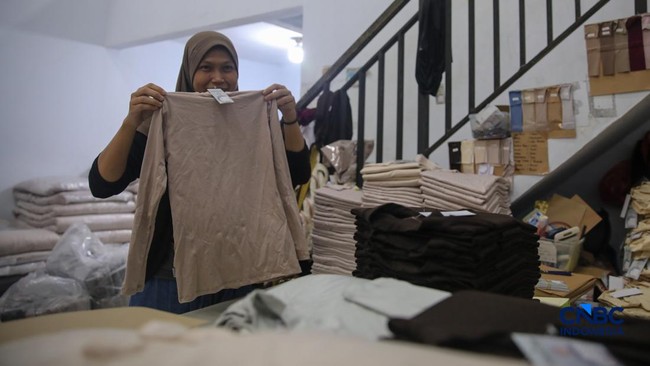
Jakarta, CNBC Indonesia - The Indonesian Textile Association (API) projects that numerous textile factories could potentially collapse within the next 1-2 years if the Labour Protection Bill (RUU Pelindungan Ketenagakerjaan) is implemented. Business owners believe that several provisions within the draft bill risk stalling investment and industrial expansion.
API Executive Director Danang Girindrawardana stated that the current condition of the textile industry has not yet fully recovered. The industry continues to face geopolitical pressures, a dependence on imported raw materials, and the influx of illegal imported goods.
He noted that the additional regulatory burden imposed by the Labour Protection Bill could exacerbate the situation for this labour-intensive industry. “Our projection is that if this is implemented, investment will fail to develop. It is not about closing down entirely, but in the next 1-2 years, many factories will certainly collapse because the trade situation is not improving. Our export-import trade will decrease, compounded by increasing domestic burdens,” Danang told reporters at his office in Jakarta on Monday (5/10/2026).
Danang emphasised that the textile industry’s current state has not fully recovered. “The situation has not improved; rather, it is being made heavier by this Bill. We are facing double the anxiety,” he said.
He noted that the textile industry recorded a production growth of approximately 3% in the second half of 2026. However, he expressed pessimism regarding industrial performance in 2027 if the bill is enacted. “We are pessimistic that 2027 will be good if this regulation is applied,” he added.
According to Danang, the concern for entrepreneurs is not merely the threat of factory closures, but also the stagnation of investment and corporate expansion. API believes the Labour Protection Bill should not only focus on protecting existing workers but also consider the creation of new jobs. He emphasised the importance of balancing worker protection, legal certainty for employers, industrial competitiveness, and job creation.
Danang even suggested that overly strict regulations could encourage companies to reduce human labour in favour of technology. “Companies will create jobs for robots, not humans; the shift will certainly happen. Because employing humans is incredibly complicated. We are more frequently threatened with criminal sanctions. It is better to recruit robots,” Danang remarked.
One point of focus for API is the high number of criminal sanction provisions in the draft bill. He noted that Law No. 13/2003 on Manpower contains six articles covering criminal provisions, whereas the Labour Protection Bill expands these criminal threats to 33 articles. Danang assessed that this expansion includes several violations that previously fell under administrative law.
API Vice Chairman Ian Syarif requested that the government and Parliament clearly distinguish between administrative violations, industrial relations disputes, and criminal acts. “Employers must comply. But administrative errors should not be immediately escalated to criminal charges. Criminal law should be placed as ‘ultimum remedium’, or a last resort, not the first response to every labour violation,” Ian said during the same session.
API also highlighted the restrictions on outsourcing within the draft bill. Ian assessed that such restrictions could disrupt the business models of the textile industry, which relies heavily on cooperation with small and medium-sized industries. According to Ian, the majority of textile companies in West Java collaborate with third parties for specific parts of the production process. For large industries, capacity sharing practices can reach approximately 20%, while for the SME sector, the proportion can be even higher.
“Therefore, when restricting based on industry type, I believe it is very dangerous,” he said. He also emphasised that outsourcing restrictions should not kill business models but rather strengthen the compliance of service providers.
In addition to outsourcing and criminal sanctions, API highlighted the regulation of working hours. The association proposed a regular working hour limit of up to 45 hours per week, with adjustments for specific sectors with unique characteristics. Ian explained that this issue relates to industries operating on shift systems and continuous production. “The 45-hour proposal is not to reduce worker rights. What we are asking for is space for working hour regulations that are more competitive and suited to the industry’s character, while ensuring rest periods, occupational safety, and worker protection are maintained,” he explained.
API also warned of the impact of these regulatory changes on small and medium industries (IKM). Ian stated that the ability of companies to absorb additional regulatory obligations varies, particularly for SMEs with limited margins and working capital.
Furthermore, the association believes the impact of the bill could extend to the economic ecosystem surrounding industrial zones if labour-intensive companies reduce production or expansion. While the textile industry’s contribution to the trade balance is relatively small, it has a significant multiplier effect on local economies, including boarding houses, food stalls, workshops, and transport services.
API has called on the government and Parliament to reconsider the design of the bill to ensure that worker protection does not inadvertently hinder job creation.