
Testing the waters? Businesses weigh China’s new trade shortcut to Southeast Asia
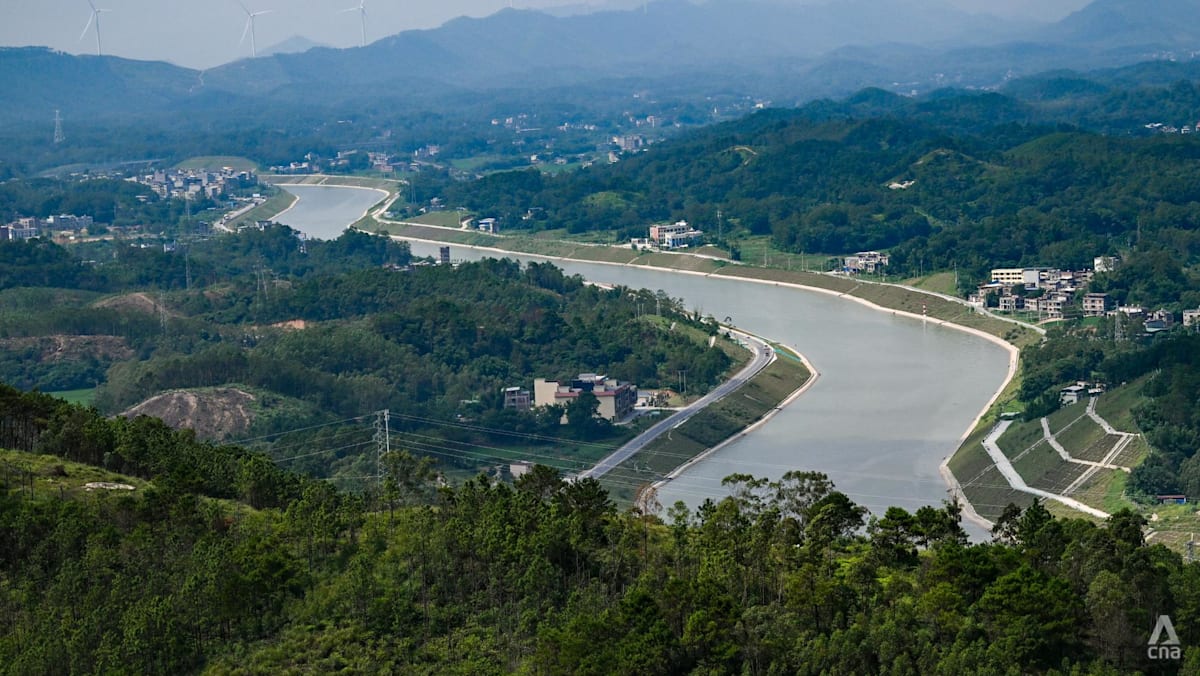
Testing the waters? Businesses weigh China’s new trade shortcut to Southeast Asia
The Pinglu Canal provides China’s landlocked southwest region with a much shorter water route to the South China Sea - and Southeast Asia. But turning early business interest into sustained demand will be the bigger test, say analysts.
NANNING, Guangxi: For one liftmaker in China’s landlocked southwest, getting its products to the coast can cost almost as much as shipping them abroad.
China Aviation Guizhou Elevator exports to Malaysia from its factory in Zunyi, Guizhou. Because the factory is far inland, around 800km by road from Qinzhou Port, each lift must first be transported overland to a seaport.
Simply getting its products to Qinzhou or Shanghai costs 2,000 to 3,000 yuan (US$300 to US$450) more than what manufacturers based in port cities pay.
“That weakens the price competitiveness of our products,” Xu Renyin, 36, who oversees the company’s foreign trade business, told CNA.
“It is a major pain point for inland companies trying to go overseas.”
A new 72.7 billion yuan canal is aimed at narrowing that disadvantage.
The Pinglu Canal, which opened in Guangxi on Sep 16 after four years of construction, gives inland southwest China a new water route through Qinzhou port to the South China Sea and Southeast Asia.
It cuts more than 560km off the existing river journey through Guangdong and will reduce transport costs by 18 to 30 per cent, generating annual savings of more than 5 billion yuan, according to state media.
The new route has already drawn early interest from businesses. But whether the touted savings materialise - and are large enough to persuade companies to switch from established routes - is less certain.
The canal will need enough cargo flowing both ways to keep freight rates competitive, said analysts.
They added that the longer-term test will be whether it can attract new industries and generate new cargo in southwest China - and whether demand holds up once initial subsidies and incentives are withdrawn.
“Shifting existing cargo is the short-term goal … generating entirely new cargo volumes is what will determine the canal’s long-term commercial value,” Wang Guowen, a logistics expert with the China Development Institute (CDI), a Shenzhen-based economic policy think-tank, told CNA.
A MULTIBILLION-DOLLAR SHORTCUT
State broadcaster CCTV has described the Pinglu Canal as China’s first river-to-sea canal planned at the national level since 1949.
The 134.2km route was not built entirely from scratch. Most of it follows existing rivers that were widened and deepened, while builders cut a new 6.5km channel through the higher ground between them.
Guangxi has a coastline stretching 1,600km from the Guangdong border to the Vietnamese border, but its major rivers flow east towards Guangdong.
Before the canal opened, river cargo from Nanning and surrounding areas had to travel through the Pearl River system and Guangdong to reach the sea.
“Southwest China has long been at the far end of the country’s water and logistics networks,” Gordon Kee, a research associate at the Hong Kong Institute of Asia-Pacific Studies, under the Chinese University of Hong Kong (CUHK), told CNA.
The new route allows vessels to instead head south towards Qinzhou Port on the Beibu Gulf, effectively creating a shortcut to the sea.
It can accommodate ships with a capacity of up to 5,000 tonnes, with qualified vessels able to sail from inland ports to the sea without unloading cargo along the way.
On Sep 8, ahead of the formal canal opening, vehicle parts made by Chinese automaker SAIC-GM-Wuling travelled through the Pinglu Canal en route to Can Tho in Vietnam.
The company said the new route could cut its logistics costs by about 10 per cent. It did not specify its current route taken or how much time or distance the canal would save.
“For us, the freight saved is real profit, and that translates directly into greater price competitiveness in ASEAN (Association of Southeast Asian Nations) and other global markets,” Cai Yan, a senior technical officer at the automaker, told CNA.
Pinglu also adds a waterway to the New International Land-Sea Trade Corridor, a China-Singapore initiative whose rail-sea service began in 2017, carrying freight from western China by rail to Qinzhou and onward by ship to Southeast Asia and other overseas markets.
Combined with those links, the canal could serve a potential hinterland of about 250 million people across Guangxi and southwest China, a region with major industries and natural resources.
Four days after the canal opened, operator Pinglu Canal Group told CNA it had arranged shipments for more than 30 customers.
The group has also signed agreements covering 3 million tonnes of cargo, said Liang Junze, 39, marketing head at one of its supply-chain subsidiaries.
Of that, 1.8 million tonnes, or 60 per cent, was backed by actual transport contracts, an early indication of demand, although it remains unclear how quickly the contracted volumes will materialise or whether that demand can be sustained.
“The Pinglu Canal is expected to handle at least 5 million tonnes of cargo in 2026 and more than 100 million tonnes annually by 2035,” Liang said.
WHO WILL COME ABOARD?
For some businesses, the new canal is already shaping expansion plans.
Meijiamei is best known for its 120 neighbourhood supermarkets in Nanning. Two years ago, it moved into farming, growing vegetables and passion fruit while raising pigs and fish in a low-waste system.
The company now hopes to use the canal to export produce to Thailand and Malaysia.
“When we started, we were already thinking about going overseas,” deputy general manager Liu Dejun told CNA.
“The catalyst, of course, was the Pinglu Canal.”
Transporting refrigerated vegetables to Guangzhou by road can cost up to 1 yuan per 500g, Liu estimated. For a 10-tonne truckload, the example he gave, that would amount to about 14,000 to 20,000 yuan.
While Liu did not provide a compa
Source: jawawa.id (https://jawawa.id/newsitem/testing-the-waters-businesses-weigh-chinas-new-trade-shortcut-to-southeast-asia-1790031024)
Originally published by CNA (https://www.channelnewsasia.com/east-asia/pinglu-canal-asean-business-china-guangxi-6397476)