
Testing the Quality of Indonesia’s Economic Growth
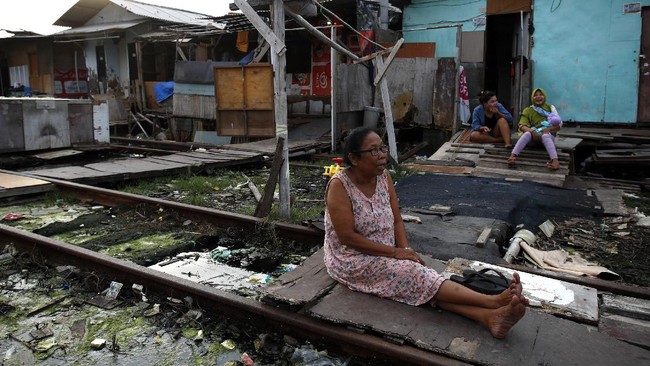
A father sits silently in front of his mobile phone screen, calculating how much money he has left until the end of the month. The mortgage instalment is due soon, while his child has brought home a notice about school activity fees. In the next room, his wife crosses several items off the shopping list—not because they are unnecessary, but because they cannot afford them.
They both work. They are not unemployed, nor are they idle. Yet in recent years, maintaining the standard of living that once felt adequate has become a task in itself. They used to talk about family holidays and education savings. Now their conversations are more often about which bills to defer, which savings to withdraw, or who might be willing to lend them money.
The pressure is gradually entering the household. Minor arguments are becoming more frequent, not because there is less affection, but because the anxiety never truly goes away. This is an illustrative story, not an account of one particular family. But anyone familiar with the lives of Indonesia’s middle class will have heard something like it, or perhaps experienced it themselves.
On 5 November 2026, Statistics Indonesia (BPS) is scheduled to announce Indonesia’s economic growth for the third quarter of 2026. We naturally hope the figures will be encouraging. But before they are released and debated, the story of this family raises a question: who is the economy growing for?
The Right Figures, Different Realities
Economic growth is an important measure. It records the total value added by goods and services produced in the economy. Without adequate growth, job opportunities and the government’s ability to fund public services are also difficult to expand. But growth figures do not automatically show how the additional income is distributed.
Gross domestic product can continue to rise as some companies’ profits increase, capital-intensive sectors attract investment, or government spending grows. At the same time, the real wages of some workers may stagnate, small traders’ turnover may weaken, and the cost of living may feel increasingly burdensome to households. These two realities can coexist.
There is also a difference between being counted as employed and having a job that provides a decent livelihood. Someone may remain in work even as their hours are cut or their income no longer covers their needs. A business owner may keep a shop open even though profits are swallowed by rent, electricity and supplier payments.
Our statistics count someone who worked for at least one hour in the previous week as employed, rather than unemployed. That is acceptable as a statistical classification, but it is not a measure of whether the job provides a decent livelihood.
If we look only at employment status or production activity, pressures such as those facing the family in this story can easily be missed. Yet this is precisely where the resilience of the middle class and vulnerable groups is being tested. Quality growth must consider not only the volume of economic activity, but also the purchasing power and decent living standards it delivers.
This is where economists need to distinguish aggregate growth from the transmission of growth into welfare. The question is not simply how much the economy expands, but through which channels that growth becomes decent jobs, real income and the ability of families to meet their living costs.
Personal experience is no substitute for a national survey. Complaints I hear from workers, traders and business owners are not enough to conclude that everyone is worse off. But national statistics should not be used to dismiss difficulties genuinely experienced by some people. The gap between the two calls for more serious investigation. This is where experts’ skills must be used wisely.
When Opportunity Depends on Access
One important question is whether growth opens up broad opportunities or is concentrated among networks of recipients of government spending. Large programmes such as the Free Nutritious Meals programme create demand for kitchen operators, suppliers and related activities. But the scale of budget circulation does not, by itself, prove that the opportunity to benefit is fairly distributed.
Who can enter the supply chain? How are suppliers selected? Do small businesses without connections to decision-makers have an equal chance? These questions are not an accusation that every contract recipient benefits through political connections. They are a demand for public money to generate open competition and verifiable benefits.
We need to be wary of an economy in which proximity to government funding becomes more important to business success than productivity, innovation and the ability to create added value. The state must play a role in the economy, but that role should widen markets and opportunities, not create an ever more closed circle of beneficiaries.
When Growth Does Not Reach Households
The failure of growth to reach people’s households is not merely a question of inequality. It also poses a risk to the sustainability of the economy itself.
When an increase in economic value added is not accompanied by a broad rise in people’s real incomes, their capacity to consume is limited. Households begin to cut spending, defer necessities, or use savings and debt to maintain their standard of living.
In turn, that pressure can spread to businesses through weaker demand, delayed investment and more limited job creation. In other words, growth that is not adequately distributed risks weakening one of the sources of future growth.
More broadly, prolonged economic pressure can turn an income problem into a social one. Children’s education is sacrificed, family assets are sold, and household relationships come under increasing strain. When this happens on a wide scale, we face not only a purchasing-power problem, but also the risk of weakening human capital and intergenerational social mobility.
Growth that does not reach households therefore fails not only to improve lives today; it also risks eroding the foundations of tomorrow’s economic growth.
A Household Livelihood Balance Sheet
I therefore propose that every economic growth release be accompanied by an assessment more closely connected to people’s lives: something like a Household Livelihood Balance Sheet. It would not replace GDP or create a rival figure, but would set growth alongside changes in families’ economic capacity.
The government could report trends in real wages and income by group, job quality, small-business profits, essential household costs, and families’ ability to set money aside after paying regular expenses and instalments. Some of this data is already available; other information would require stronger surveys and more consistent reporting.
Furthermore, every major programme should be assessed using a map of its beneficiaries: how much added value it creates, who gains in welfare, which regions receive business opportunities, and which groups are left behind. Such measures would help the government improve policy design rather than simply sustain claims of success.
Economic success cannot be demonstrated solely by an increase in national production; it must also be reflected in more families having room to save, invest and plan for the future.
What Are We Growing For?
When the growth figures are announced, economists will of course examine consumption, investment, exports and the sectors contributing to expansion. That matters. But once the press conference is over, the family in this story will still have to decide which bill to pay first.
They are not asking for statistical figures to be changed to match their feelings. They hope that the growth that is genuinely taking place will one day reach their dining table, their child’s classroom and the peace of their household.
The economy must grow. But growth loses its social meaning if the additional prosperity circulates among only a small group while many families continue to struggle simply to get by. So, before celebrating the next set of figures, let us ask more seriously: Indonesia’s economy is growing—but for whom?
Source: jawawa.id (https://jawawa.id/newsitem/testing-the-quality-of-indonesias-economic-growth-1793706728)
Originally published by CNBC Indonesia (https://www.cnbcindonesia.com/opini/20261103173204-14-781997/menguji-kualitas-pertumbuhan-ekonomi-indonesia), translated from Indonesian