
Testing Indonesia’s Energy Transition Consistency on the Diplomatic Stage
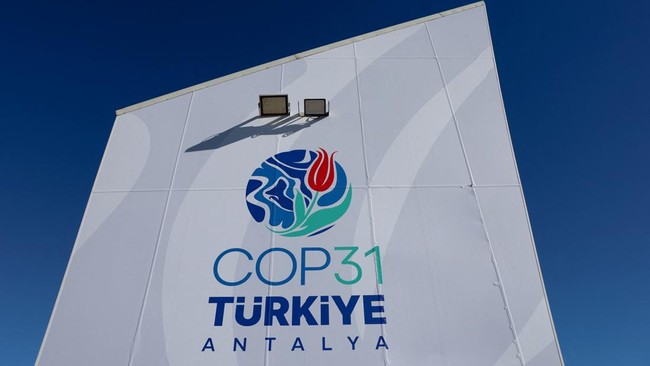
Pressure to move away from fossil fuels grew louder as the UN’s 31st Climate Change Conference, or COP31, closed in Antalya, Türkiye. The major climate meeting, which for the first time acknowledged that the Earth’s surface temperature had exceeded the 1.5°C threshold, once again became an arena for competing interests, as COP meetings have in previous years. One point of contention was the expansion of electrification and the direct reduction of fossil fuel use.
That push was reflected in the launch of the 35 by 35 Global Electrification Pledge, initiated by the COP31 Turkish Presidency alongside Australia, which led the negotiations. The pledge aims to increase electricity’s share of global final energy consumption to 35% by 2035, from about 20% today. As of 19 November 2026, at least 90 government entities had said they would join, including Japan, Germany, the United Kingdom and the European Union.
However, even as COP31 negotiations ran beyond their scheduled end, Indonesia’s name had yet to appear on the list of participants. This was despite the country having several national plans aligned with the pledge. Indonesia’s absence was a regrettable diplomatic opportunity.
The 35 by 35 pledge is not simply a call to replace fossil fuels with electricity. It gives countries scope to accelerate electrification in high-emissions sectors such as transport and industry. It could also help strengthen electricity grids and energy storage infrastructure.
The economic prospects are promising, too. International Energy Agency (IEA) analysis indicates that currently available technologies could economically raise electricity’s share of global final energy consumption to around 33% by 2035, from 23% in 2025.
A 35% target is therefore not entirely out of reach. Electrification could also strengthen energy security, particularly for countries that remain dependent on fuel imports and vulnerable to global geopolitical shocks.
Although Indonesia is one of the world’s largest coal producers and exporters, pursuing this agenda is not impossible. The government has set an ambition to develop 100 gigawatt-peak (GWp) of solar power capacity over the next three years. This ambition should provide a basis for Indonesia to contribute to the global target.
More broadly, electrification powered by renewable energy could underpin the growth of Indonesia’s green industries. As global markets increasingly demand low-carbon products, access to clean electricity is becoming more important to industrial competitiveness.
Energy-intensive sectors such as nickel processing, electric vehicle batteries, data centres and export-oriented manufacturing will face greater pressure if they continue to rely on electricity generated by burning coal.
The 100 GWp solar ambition could help drive that growth. The Institute for Essential Services Reform (IESR) estimates that the projects could require more than US$100 billion in investment. That sum would fund more than additional generating capacity.
It could also create opportunities for supporting industries to grow, from manufacturing components and energy storage to building grids and supplying electrical technologies. This is where the government’s policy-making ability will be tested: how can policy attract the investment needed to realise the ambition?
Electrification targets need to be translated into coordinated planning instruments. Revisions to the National Energy Policy (KEN), the National Electricity General Plan (RUKN), PLN’s Electricity Supply Business Plan (RUPTL), the 2025–2029 National Medium-Term Development Plan (RPJMN), and climate commitments under the Nationally Determined Contribution (NDC) must all move in the same direction.
The 100 GWp ambition must also be broken down into an annual road map specifying the locations of power plants, the electricity systems they will supply, funding arrangements and the parties responsible.
Policies must also cover industrial estates. Nickel smelters and other energy-intensive industries cannot continue to rely on new captive coal-fired power plants to meet their electricity needs. The government must set mandates or provide incentives for industrial estates to switch to renewable electricity. Otherwise, increased electrification could prolong dependence on coal and gas.
Electrification does not automatically mean decarbonisation. The COP31 35 by 35 initiative does not specify the sources of electricity to be used to meet its target. This leaves open the possibility that fossil-fuel-generated electricity will be used.
Electrification that does not rely fully on renewable sources could backfire in efforts to mitigate the climate crisis. Climate Analytics warns that electrification without a requirement to use clean electricity could add around 0.11–0.14°C to global warming by 2050, compared with a scenario powered by clean generation. Cumulative greenhouse gas emissions by 2050 could reach as much as 317 billion tonnes of carbon dioxide equivalent (CO2e).
Therefore, if Indonesia adopts the spirit of 35 by 35, the word ‘clean’ cannot be treated as optional. The addition of electric vehicles, electrification of industrial estates and use of electric household appliances must go hand in hand with the development of renewable power plants and supporting grids. Otherwise, the form of energy consumption will change while the sources of emissions remain.
Another crucial question in the debate over clean electrification is who will benefit from the transition and who will bear its side effects.
A just energy transition cannot be measured solely by the number of coal-fired power plants retired early or the volume of emissions reduced. It must also account for workers’ ability to move into new jobs, people’s access to affordable energy, and how investment benefits are distributed. The meaning of fairness also varies by context: the circumstances of coal-mining workers in Kalimantan differ from those of people on small islands who still face limited access to electricity.
The government must also prepare workers for renewable energy projects while helping fossil-fuel-sector employees move into new jobs. Skills training, social protection and certainty of employment opportunities need to be designed from the outset. Without such preparation, the transition could create new centres of growth while leaving behind workers and regions that supported the old energy industry.
Indonesia’s decision not to sign the 35 by 35 initiative at COP31 was a missed opportunity. But the country need not wait for the next conference to pursue the same policy direction. The government can adopt the ambition voluntarily in national planning, adapting it to the needs and capabilities of the domestic electricity system.
The 100 GWp solar ambition is already on the table and could be a starting point for building a more resilient energy system to support electrification and strengthen industrial competitiveness. The next step is to ensure that achieving the target benefits people across society and leaves no one behind.
Source: jawawa.id (https://jawawa.id/newsitem/testing-indonesias-energy-transition-consistency-on-the-diplomatic-stage-1795585933)
Originally published by CNBC Indonesia (https://www.cnbcindonesia.com/opini/20261125122428-14-788295/menguji-konsistensi-transisi-energi-indonesia-dalam-ruang-diplomasi), translated from Indonesian