
Tens of Thousands of KSPN Workers Ready to Rally for Labour Law Reform
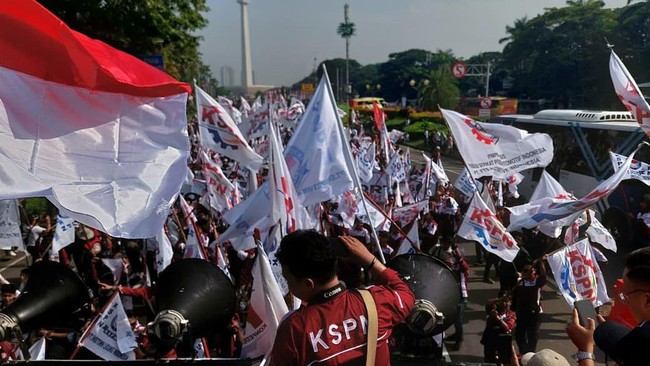
The Confederation of Nusantara Workers’ Unions (KSPN) is planning to stage a large-scale demonstration at the House of Representatives (DPR RI) and the State Palace in late August or September. The action will be joined by tens of thousands of KSPN member workers, plus workers from thousands of independent company-level trade unions that are not affiliated with any confederation or federation.
KSPN President Ristadi said the action aims to champion the aspirations that have been drawn up by the KSPN’s drafting team for a proposed new Labour Law. He stressed that his group is an independent labour movement that is not affiliated with the labour party coalition or any other labour struggle coalition.
“We are a labour group with no political interest tendencies nor co-opted by anyone; we can be said to be the independent middle axis of the Indonesian labour movement,” Ristadi said in a press release received on Saturday (9/8/2026).
Ristadi added that his side is carrying out continuous consolidation down to the grassroots level, and invited the media to verify trade union membership data directly with the Ministry of Manpower.
He claimed that the proposed aspirations have gone through a long debate process taking into account philosophical, sociological and juridical aspects, drawn from KSPN members across Indonesia as well as input from experts, and aligned with developments in the industrial and labour world.
The following are the five main points of KSPN’s aspirations that will be championed in the action:
- National Sectoral Minimum Wage
KSPN highlights the widening minimum wage disparity between regions, citing the Bekasi City minimum wage of Rp5.99 million, while Yogyakarta is only Rp2.8 million. KSPN proposes a National Sectoral Minimum Wage system, in which the minimum wage is determined based on the same type and scale of business across Indonesia, rather than based on company location.
- Establishment of the National Labour Supervisory Agency (BPKN)
KSPN considers that labour law enforcement has been weak due to a lack of officers, facilities and infrastructure, as well as political obstacles such as the closeness of employers to local authorities. KSPN proposes the establishment of a BPKN that is directly under the President with more adequate authority and budget.
- Restriction of the Outsourcing System
KSPN asks employers to choose only one employment relationship scheme, either a contract with restrictions on the type and duration of work, or to abolish the practice of outsourcing entirely.
- Apprenticeships Included in Education Curriculum
KSPN proposes that apprenticeships or field work practice become part of the high school and university education curriculum, rather than a separate employment relationship after graduation.
- Regulation of Digital Platform Workers
KSPN also highlights the need for clearer regulation of the employment relationship of digital platform workers, although the issues of layoffs and severance pay are considered not much different from the demands of other labour groups.
Ristadi stressed that the proposed BPKN is not intended to become a “monster” that frightens investors or the business world, but rather remains based on the principle of supporting the investment climate while protecting workers’ welfare in accordance with applicable regulations.