
Tens of Thousands of Containers Pile Up at Tanjung Priok, Majority from China
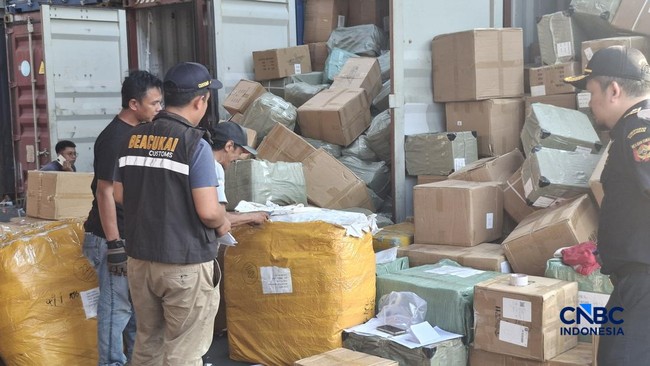
Jakarta, CNBC Indonesia - The accumulation of imported goods containers at Tanjung Priok Port has come under scrutiny, as the number had reached 10,000 containers last May. Among these containers, many imported goods from China were discovered.
CNBC Indonesia, checking directly at the Customs post at the Koja Container Terminal (TPK) on Wednesday (17/6/2026), found several containers of imported goods undergoing inspection by Tanjung Priok Customs. The majority of the containers originated from China, evident from the writing on the packaging boxes of several items.
Based on CNBC Indonesia’s observation at the Customs post at the Koja Container Terminal (TPK) in North Jakarta on Wednesday (17/6/2026) at 16:00 WIB, several goods being inspected were marked “Made in China” and featured Chinese characters. Not only were the packaging boxes marked “Made in China” and Chinese characters, but several brands were also known to originate from China. Examples include brands of lamps and electrical equipment, namely Lovov, Semny, and Lanbo.
There were also imported bags from China, identifiable from the packaging boxes written in Chinese characters. The bags featured floral patterns on a white base. Besides imported bags and electrical equipment, there were also motor dynamos for electric bicycles and electric scooters, model MY1016, as well as paint sprayers also originating from China.
However, only one item was found from outside China, namely frozen buffalo meat under the Allana brand from India. A Customs officer stated that the majority of imported goods undergoing inspection came from China. “Yes, most of the imported goods here are from China,” the Customs officer said when met by CNBC Indonesia on Wednesday (17/6/2026).
The imported goods, however, were not used or counterfeit items, but rather new goods. “There are no used or counterfeit items here, because they are not allowed to enter,” the officer stated.
Regarding the 10,000 containers, Tanjung Priok Customs confirmed the number has drastically decreased. Head of Compliance Guidance and Information Services at Tanjung Priok Customs, Niko Budhi Darma, said that as of Thursday (18/6/2026), the number of containers piled up at Tanjung Priok—including BYD, Wuling, and VinFast—had been reduced to 1,500, from the previous peak of 10,000 containers.
“Currently, as of 18 June 2026, the number of containers that have not been released within 4-30 days after SPPB is around 1,500. These containers are gradually being released by their owners,” Niko told CNBC Indonesia, quoted on Thursday (18/6/2026).
Niko added that the container pile-up problem occurred due to a combination of three processes: pre-customs clearance, customs clearance, and post-customs clearance. “The 10,000 containers were in the post-customs clearance process, representing the total number of containers that had obtained SPPB, both from the red lane and the green lane,” Niko explained.
Customs has implemented several measures to reduce the container backlog. Steps taken include increasing inspection personnel, adding inspection locations at the Jakarta International Container Terminal (JICT) and Koja Container Terminal (TPK), extending inspections into the night, and adjusting services.
“We then carried out comprehensive mitigation across these three processes. The mitigation steps already undertaken include coordination and mitigation with relevant stakeholders, increasing the number of inspectors, extending inspection times (day and night shifts), arranging effective mechanisms for goods inspection, and adding inspection locations,” he detailed.
Additionally, Customs facilitated business-to-business (B to B) meetings among entities related to the logistics business, such as importers, logistics associations, trucking associations, and others.
Regarding customs procedures at TPK Koja and JICT, it was explained that under normal conditions, containers requiring physical inspection would be moved to the Graha Segara Integrated Physical Inspection Facility (TPFT). However, as an acceleration effort and to ease congestion, “We requested TPK Koja and JICT to add temporary inspection areas at the TPK Koja and JICT Inspection Yards. This inspection is carried out without moving containers to the TPFT and is conducted for imported goods categorised as low risk,” Niko stated.