
Tencent Targets Indonesian Companies for AI and Cloud Computing Partnerships
Shenzhen (ANTARA) – Chinese technology company Tencent is targeting several countries, including Indonesia, to provide artificial intelligence (AI) and cloud computing services.
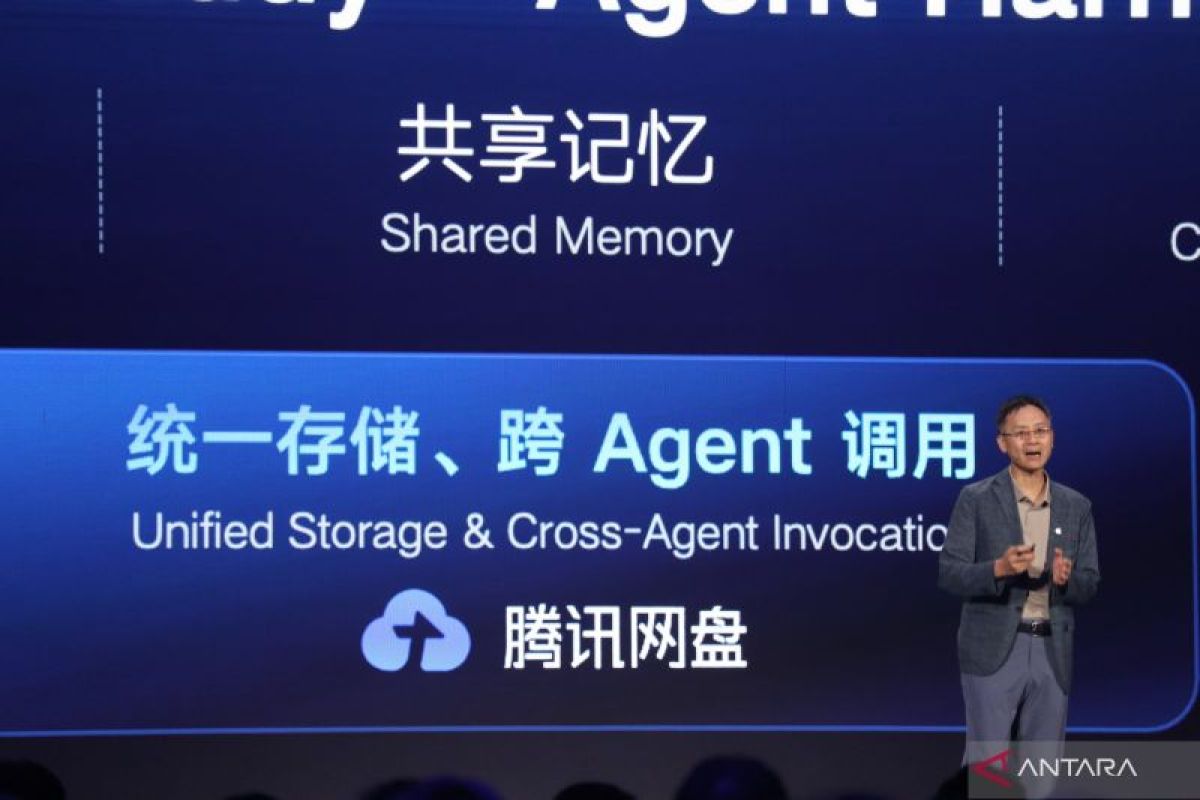
“In Indonesia, we are working with XLSmart to reorganise and improve its existing systems so they are more cost-efficient and easier to manage. The migration involved more than 1,000 microservices and terabytes of data, coordinated by a large number of AI agents from the identification stage through to system deployment,” Tencent Senior Executive Vice-President and Chief Executive of its Cloud and Smart Industries Group, Dowson Tong, said in Shenzhen, Guangdong province, on Thursday.
Tong made the remarks at the Tencent Global Digital Ecosystem Summit 2026, the company’s annual event bringing together partners and clients from various countries in the AI and cloud sectors.
“Through close cooperation with our team, XLSmart successfully migrated its core systems to Tencent Cloud in just five months. Previously, a similar project might have taken one to two years without the assistance of AI agents,” Tong said.
An AI agent is an advanced form of artificial intelligence that can not only answer questions but also carry out tasks automatically. While conventional AI mainly helps users think, AI agents can help them take action and complete work.
Tencent has a number of AI agents tailored to the needs of different customers.
“Throughout the process, there was no disruption whatsoever to services that are critical to operations,” Tong added.
Tong said Tencent Cloud currently serves customers in more than 150 countries and territories. The number of Tencent’s active customers overseas doubled last year, while the company’s AI business in international markets recorded triple-digit growth.
“In Indonesia, we have taken early steps and are actively promoting comprehensive cooperation in cloud and AI with the three major telecommunications operators: XLSmart, Telkomsel and Indosat,” Tong added.
In Thailand, Tencent is also seeking to work with various companies to improve efficiency, reduce costs, accelerate intelligent transformation and expand services to leading telecommunications operators, the stock exchange and banks.
“When choosing cloud and AI, companies no longer consider only resources, costs and performance. They are increasingly paying attention to the cost-efficiency of AI models and the ease of use of AI toolsets,” Tong said.
“Tencent Cloud and its partners are bringing these capabilities to global markets to support the international expansion of Chinese companies while serving customers around the world,” he added.
Tong outlined at least three strategies for Tencent’s overseas expansion.
“First, we will strengthen the development of data centres overseas. Globally, we operate more than two million servers,” Tong said.
Over the past year, Tencent has added data centres in Frankfurt, Malaysia, Mexico, Osaka, Thailand and other locations. Over the next year, it will further expand its infrastructure network in Asia, the Middle East, Europe and the Americas.
“Second, we will build highly cost-efficient infrastructure. In response to the surge in demand for data, general computing and storage driven by the AI wave, we are continuing to design and optimise our hardware and software architecture,” Tong added.
He cited Tencent’s new-generation SA10 cloud server, which supports high-capacity computing configurations that can be highly cost-efficient for customers and are well suited to running AI agents.
“For customers with their own data centres who want to upgrade from virtualisation technology to a cloud-native architecture, we have reduced the minimum deployment size for our TCE private cloud solution from 14 servers to eight, thereby lowering deployment costs,” Tong said.
The third strategy is to accelerate the international expansion of various AI-agent products, including CodeBuddy, WorkBuddy, Tencent Design, ADP, Magic AI, Agent Runtime and others.
“Both employees of Chinese companies assigned overseas and local teams at international customers can work together through a unified AI workspace. We are also continuing to help overseas platform companies build local super-app ecosystems,” Tong said.
XLSmart Chief Information Technology Officer Yessie D Yosetya said during a plenary session that working with Tencent had made it easier to merge the systems of the two companies.
“With Tencent’s help, we were able to complete the process in just four and a half months, in line with the modernisation plan. More than 60 applications have been modernised and migrated to Tencent Cloud,” Yessie said.
She also said that more than 1,100 APIs, over 1,200 microservices and databases totalling 15 terabytes had been migrated to Tencent Cloud in a very short time.
“In my view, Tencent’s greatest strength is its investment in developing tools that enable us to migrate quickly,” Yessie said.
Yessie said Tencent had been persistent in finding solutions and resolving problems during the migration.
“After a merger, we do have to reassess the entire infrastructure because, from the user-experience perspective, users do not need to know what is happening behind the scenes. What matters is that the applications are easier to use, smoother and more seamless,” she added.