
Temanggung Tobacco Farmers Seek Protection from Planned Nicotine and Tar Restriction Rules
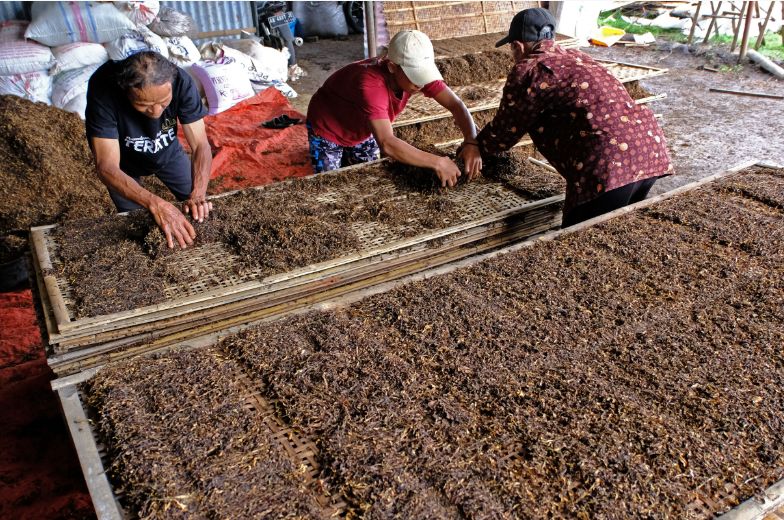
Representatives of farmers belonging to the Indonesian Tobacco Farmers Association (APTI) in Temanggung have voiced their concerns over the planned derivative regulations of Government Regulation No. 28 of 2024, which governs the restriction of nicotine and tar levels in tobacco products. The aspirations were conveyed during a meeting with Commission IV of the Indonesian House of Representatives (DPR RI).
Speaking on behalf of the farmers, Soleh assessed that the policy being drafted could potentially threaten the viability of tobacco farming businesses, particularly in Temanggung Regency, which is known as a producer of high-nicotine tobacco.
“All this time, farmers have only been a source of state revenue without obtaining protection and business certainty. We are struggling and sincerely hope the State will be present, not just treat tobacco farmers as cash cows through various levies and fiscal policies. The government must also provide tangible support so that the sustainability of farmers’ businesses is maintained. To this day, the policy direction regarding tobacco itself is unclear and faces much pressure,” Soleh said on Thursday (23/7).
According to him, the restriction of nicotine and tar levels could potentially eliminate the existence of Temanggung’s distinctive tobacco varieties, including Srintil tobacco, which naturally has a nicotine content of around 8 milligrams.
“This is tantamount to killing off Indonesian tobacco, especially tobacco from Temanggung which naturally has higher nicotine levels. Where will the farmers’ harvests go if this regulation is forced through? Local tobacco, which has been the farmers’ source of livelihood, will die,” he stressed.
Therefore, Soleh urged the government to formulate regulations that consider conditions on the ground and do not harm farmers.
“We ask the government to draft regulations that do not disadvantage farmers and consider the real conditions in the field. Please provide protection, empower tobacco farmers so we can live and not continue to be harmed by rules that actually oppress the condition of domestic commodities,” he added.
Data for the 2026 planting season shows the tobacco area in Temanggung Regency reached 13,391 hectares. Kledung District is the area with the largest land, at 1,880 hectares. Of the total area, approximately 8,925.7 hectares are dry-field tobacco land, while 4,465.3 hectares are in paddy fields. The dominance of dry-field land reflects the cultivation character of Temanggung tobacco, which thrives in mountainous and dryland areas.
Responding to these aspirations, Deputy Chairman of Commission IV DPR RI, Panggah Susanto, stated that his party would exercise its oversight function over government policy and coordinate with relevant commissions and ministries/agencies so that the resulting regulations can accommodate various interests.
According to Panggah, the policy on limiting nicotine and tar levels must consider the balance between public health protection, the sustainability of farmers, the tobacco products industry, and the regional economy.
“This draft regulation could reduce the industry’s absorption capacity for local Indonesian tobacco, which has long been known for its high quality with distinctive nicotine levels. Consequently, the absorption of domestic tobacco farmers’ harvests could potentially decline, while industrial needs may shift to imported tobacco. Ultimately, farmers are disadvantaged,” Panggah said.
He also reminded of the significant contribution of the tobacco sector to the national economy. The tobacco products industry, he said, absorbs around 300,000 workers in the industrial sector, about 2.5 million tobacco farmers, and overall involves around 6 million workers when including distribution and other supporting sectors.
“The tobacco industry also absorbs a large number of workers, starting from around 300,000 workers in the industrial sector, about 2.5 million tobacco farmers, to a total of around 6 million workers if the distribution sector and other supporting businesses are included. Therefore, the state must view the position of the tobacco sector correctly and fairly, so as to maintain a balance between health interests and national economic sustainability,” he explained.
Meanwhile, Commission IV DPR RI member Firman Soebagyo assessed that the government needs to align policies between ministries in drafting the derivative rules of PP No. 28 of 2024 so as not to further burden farmers.
“The government must have a clear policy direction regarding the future of the national tobacco commodity. The draft restriction on nicotine and tar levels does not match the characteristics of Indonesian tobacco. This impacts the Temanggung tobacco varieties. Temanggung tobacco, for example, has a nicotine content that can reach 5 to 10 milligrams. Once again, regulatory certainty is key for the national tobacco sector to continue developing,” Firman stated.