
Telkomsel Forecasts 11 Percent Increase in Data Traffic During 2026 Ramadan-Eid al-Fitr Period
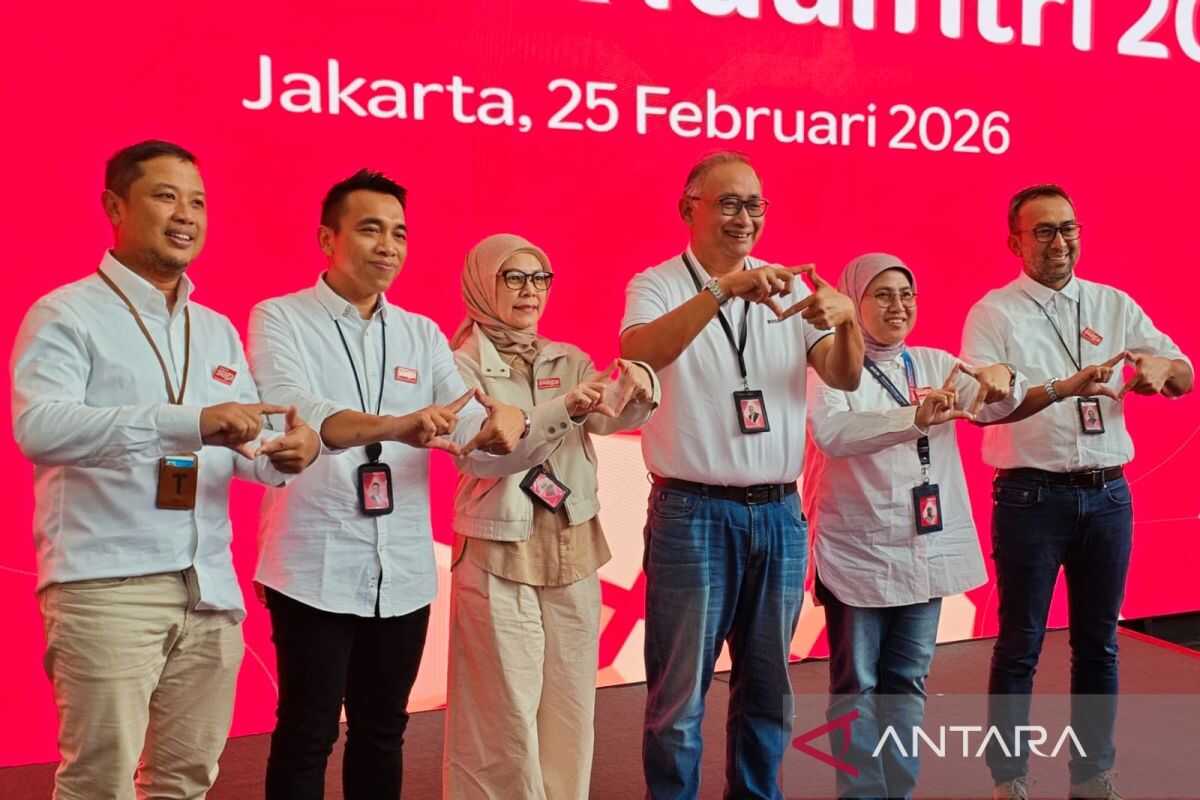
Jakarta (ANTARA) - Telkomsel forecasts that data traffic during the 2026 Ramadan and Eid al-Fitr period will increase by 11.1 percent compared to normal days, with the peak reaching 70.85 petabytes on the third day after Eid al-Fitr.
“Our projection is that the highest data usage will reach 70.85 petabytes, which is predicted to occur on H+3. We predict an increase of 11 percent from normal days and a 5 percent increase from the 2025 Ramadan and Eid al-Fitr period,” said VP of Global Network Operation at Telkomsel, Juanita Erawati, in Jakarta on Wednesday.
She explained that this surge in traffic is due to increased digital activity among customers across various application categories, such as video streaming, communication, gaming, online shopping, and social media.
The company also predicts an increase in voice call traffic by 1.4 percent compared to normal days, and SMS traffic by 11.2 percent compared to normal days. The highest increase in the number of customers is expected in the regions of Central Java, the Special Region of Yogyakarta, West Java, and East Java.
According to the mapping of customer mobility between regions during the 2026 Ramadan and Eid al-Fitr period, the number of customers leaving the Greater Jakarta area (Jabodetabek) is quite significant.
Most of this movement is towards Central Java, with 2.5 million customers, followed by West Java with 1.4 million customers, and East Java with 1.1 million customers.
Juanita stated that the five cities with the largest growth in data traffic are Magetan (79.5 percent), Kebumen (78.4 percent), Kuningan (78.1 percent), Wonogiri (68 percent), and Ngawi (59.9 percent), which are destinations for travelers during the Eid al-Fitr holiday.
To maintain network reliability during the 2026 Ramadan and Eid al-Fitr period, Telkomsel is optimizing its network at 494 priority points (Points of Interest/POI), including special/crowded areas, transportation hubs, routes for travelers, residential areas, and places of worship.
Juanita explained that the determination of these priority points is done through machine learning analysis with 99 percent accuracy.
“This means that the POIs we design and determine based on machine learning are 99 percent in line with our predictions,” said Juanita.
In addition, Telkomsel implements an AI-based Autonomous Network for end-to-end monitoring 24/7, including early detection, diagnosis, and automatic repair, as well as 15 Network Readiness Posts to maintain service quality.
Telkomsel also has 45 COMBAT (Compact Mobile BTS) units on standby in locations with high potential for congestion to ensure that capacity and signal quality remain optimal.
The mobile operator also conducts drive tests along approximately 18,406 km (including 4,167 km of toll roads) to ensure that coverage and the quality of voice and data services are safe and adequate.