
Telkom University and NUS Collaboration Strengthens Digital Talent Ecosystem and Global Innovation
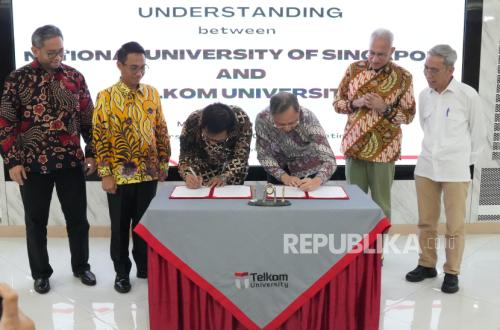
PT Telkom Indonesia (Persero) Tbk (Telkom) continues to strengthen its commitment to building a national digital talent and innovation ecosystem through strategic collaborations with leading global institutions. One such step was realised through a partnership between Telkom University (TelU) and the National University of Singapore (NUS). A Memorandum of Understanding (MoU) was previously signed circularly by both parties. To mark the commencement of the collaboration’s implementation, TelU and NUS held a cooperation ceremony at the Telkom University Campus in Jakarta on Monday (6/7/2026). This partnership serves as a foundation for both institutions to develop collaboration in education, research, innovation, and digital talent. Through this cooperation, Telkom hopes the synergy between the education sector and industry can be further strengthened to support the company’s digital transformation as well as the development of the national digital talent ecosystem. The establishment of this cooperation is a follow-up to an initiative pioneered by Indonesia’s Coordinating Ministry for Economic Affairs to strengthen Indonesia–Singapore cooperation in the digital economy and talent development. The initiative emerged during a working visit by the Coordinating Minister for Economic Affairs to Singapore in April 2026. This initiative became a catalyst for the birth of a strategic partnership between TelU and NUS as part of efforts to strengthen the competitiveness of Indonesian human resources in the digital economy era. Telkom’s Director of Strategic & Business Development, Seno Soemadji, stated that this collaboration is part of Telkom’s commitment to building an innovation ecosystem that connects the worlds of education, industry, government, and global partners to accelerate the emergence of digital talent capable of competing at the international level. “Digital transformation requires not only infrastructure and technology, but also world-class talent and a strong innovation ecosystem. The collaboration between Telkom University and the National University of Singapore is a strategic step to expand Indonesian talent’s access to global networks, knowledge, and world best practices,” said Seno. The scope of cooperation includes graduate certificate programmes, student and faculty mobility, joint research, as well as collaboration in the fields of Artificial Intelligence (AI), digital business, sustainability, Internet of Things (IoT), cybersecurity, logistics & supply chain management, data centres, and cloud computing. Through these various programmes, both institutions are expected to expand knowledge exchange and research capacity, as well as produce talent increasingly relevant to the rapidly growing needs of the digital industry. The partnership with NUS is a step by Telkom to strengthen digital talent development and research capacity relevant to industry needs. NUS’s reputation as one of the world’s best universities, including its position ranked 8th in the QS World University Rankings 2026, opens wider collaboration opportunities for Telkom University as part of the Telkom Group ecosystem, ranging from curriculum strengthening and lecturer development to enhancing applied research. According to Seno, as a digital telecommunications company in Indonesia, Telkom has a broader role than merely being a digital service provider. Telkom is committed to being an orchestrator that brings together the academic world, industry, government, and global partners to accelerate the birth of innovation and strengthen national competitiveness. Through collaborations like this, Telkom is also building a digital talent pipeline that will support the company’s future business needs, including as an enabler for strengthening national digital sovereignty. “Telkom wants to continue being an orchestrator that brings together the academic world, industry, and government. Through this collaboration, we hope more programmes will emerge, such as digital talent exchanges, joint research, innovation partnerships, and the development of solutions based on AI, cloud, cybersecurity, and other digital technologies capable of answering industry needs. We believe the best innovation is born from cross-ecosystem collaboration, and through this synergy we want to continue nurturing talent that will become the driving force of Indonesia’s digital transformation,” added Seno. For Telkom, the partnership with NUS is a strategic step considering the university’s track record as one of the world’s best educational institutions in research and innovation. This collaboration is expected to expand the Telkom University academic community’s access to global networks, strengthen the quality of education, and encourage the creation of innovations that provide added value for industry. Senior Vice Provost of the National University of Singapore, Prof. Bernard C Y Tan, welcomed the cooperation with Telkom University in advancing education, research, and innovation. He believes the partnership will open various opportunities for knowledge exchange, talent development, and joint research that can address challenges at both regional and global levels. “We hope this long-term collaboration can have a meaningful impact for both institutions and society,” he said. Similarly, Telkom University Rector, Prof. Dr. Suyanto, explained that this cooperation is a momentum for TelU to strengthen its role as an educational institution capable of bridging the needs of the academic world with the development of the global digital industry. According to him, Indonesia still needs more digital talent to support digital transformation and realise the Golden Indonesia 2045 vision. “Through the partnership with the National University of Singapore, we want to present various tangible programmes, from academic exchanges and joint research to community service. We hope this cooperation can strengthen the quality of graduates while providing an increasingly relevant global experience.”