
Telkom Strengthens ESG Efforts Through UN Global Compact and Zero Waste Programme
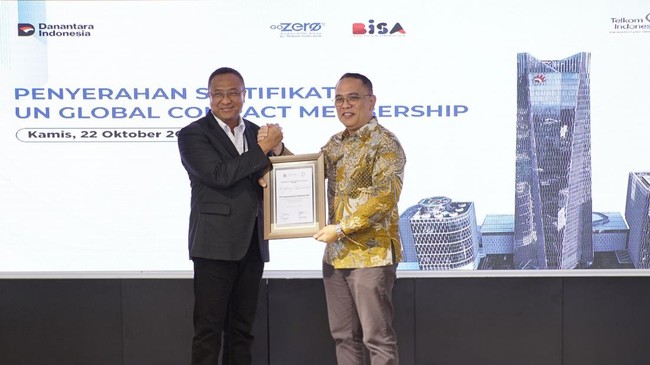
PT Telkom Indonesia (Persero) Tbk (Telkom) is strengthening its participation in the global sustainability movement through membership of the United Nations Global Compact (UNGC). The membership certificate was presented on Thursday (22 October), alongside the launch of the Zero Waste to Landfill programme with Waste4Change at The Telkom Hub in Jakarta.
Both initiatives form part of Telkom’s efforts to integrate sustainability principles into its corporate governance and operational activities.
Telkom President Director Nanang Hendarno said sustainability was an important part of the company’s transformation as it seeks to build a responsible business that remains competitive over the long term. This is being pursued through consistent governance and practical measures, from energy efficiency and emissions reduction to waste management.
“At TelkomGroup, sustainability is not just about meeting standards or carrying out environmental initiatives. It is also about making these principles part of our business strategy and working culture,” he said.
“Membership of the UN Global Compact strengthens our direction as we continue to implement responsible business practices, while the Zero Waste to Landfill programme is a concrete example of how this is being applied in the workplace,” Nanang added.
“We want to ensure that the transformation towards a sustainable company is supported by policies, systems and the involvement of everyone at TelkomGroup,” he said.
Through the Zero Waste to Landfill programme, Telkom sorts waste at source so that material that can still be reused or processed does not end up at a final processing site (TPA). Employees, housekeeping staff and Waste4Change are involved in sorting, collection and processing in accordance with procedures, without mixing waste again once it has been sorted.
The initiative is in line with Law No. 18 of 2008 on Waste Management and Jakarta Governor’s Instruction No. 5 of 2026, which encourages waste to be sorted at source into categories: organic, non-organic, hazardous and toxic materials (B3), and residual waste. Restrictions on the waste that can be sent to the Bantargebang Integrated Waste Processing Site (TPST) further underline the importance of managing waste at source.
Telkom has worked with Waste4Change as its waste-management partner since 7 October 2026.
From January to June 2026, monthly waste volumes at The Telkom Hub ranged from 14,604kg to 30,334kg, with the highest figure recorded in February. Residual waste accounted for 51% and organic waste for 32%, while plastic and paper each made up 7%.
This composition highlights the importance of sorting waste to optimise processing and reduce the amount sent to landfill.
Waste4Change Chief Operating Officer Ridho Malik Ibrahim said the Zero Waste to Landfill programme encourages more responsible waste management, from sorting at source to increasing recycling potential.
“We appreciate the steps taken by Telkom Hub, which is now beginning to divert waste from being sent directly to landfill. This collaboration is an important step towards building a more integrated waste-management system while encouraging changes in behaviour in the workplace,” he said.
On the same occasion, Telkom received its UNGC membership certificate, which was presented to President Director Nanang Hendarno. Telkom has been an active UNGC participant since 16 July 2026 and is seeking to apply the organisation’s Ten Principles in its strategy, culture and operations.
The UNGC is a United Nations corporate sustainability initiative that encourages companies to apply its Ten Principles across four key areas: human rights, labour, the environment and anti-corruption. Membership is part of Telkom’s efforts to align its business practices with those principles.
M. Windrawan Inantha, Executive Director of the UN Global Compact Network Indonesia, said sustainability needed to become part of a company’s strategy and working culture at every level. The UNGC provides companies with a framework for integrating principles on human rights, labour, the environment and anti-corruption into business practices.
“Telkom’s Zero Waste to Landfill initiative is an example of how environmental sustainability principles can be translated into concrete action and encourage more responsible practices and lifestyles across TelkomGroup,” he said.
In the environmental field, TelkomGroup is pursuing a decarbonisation strategy through its Climate Transition Plan, launched in 2025 as a roadmap towards net zero emissions by 2060. In the short term, TelkomGroup aims to reduce Scope 1 and Scope 2 emissions by 20% by 2030.
In 2026, The Telkom Hub also achieved net zero emissions for operational Scope 1 and Scope 2 emissions.
TelkomGroup is also promoting the use of renewable energy at various operational sites, developing green data centres and improving network energy efficiency through the adoption of an Autonomous Network. These measures complement efforts to reduce the environmental impact of the company’s operations.
Waste management at The Telkom Hub began in December 2024 with the use of a Reverse Vending Machine (RVM). More than 900 users have taken part in the initiative, which has collected over seven tonnes of plastic bottles for recycling and avoided around 38 tonnes of CO₂e emissions.
The Zero Waste to Landfill programme extends these efforts to all office waste, with the aim of ensuring that none of the waste from The Telkom Hub ends up at a landfill.
Going forward, Telkom is encouraging all employees to sort waste as part of their daily working habits. It hopes practices at The Telkom Hub can be replicated at other TelkomGroup offices.
“By applying UNGC principles, decarbonisation and integrated waste management, Telkom continues to develop more responsible operations while supporting sustainable development in Indonesia,” he concluded.