
Telkom Posts Rp113.5 Trillion in Revenue, Driven by Four Main Business Segments
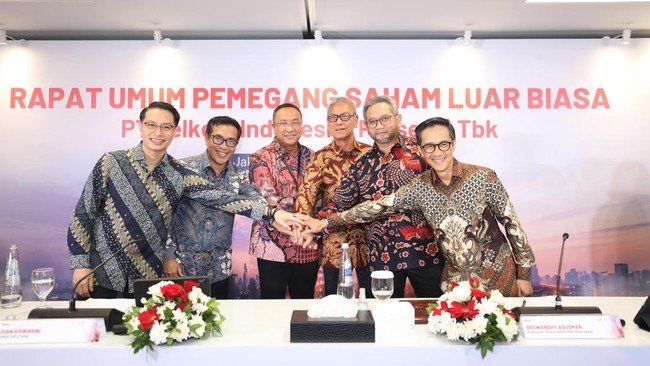
PT Telkom Indonesia (Persero) Tbk (Telkom) maintained its performance growth in the first nine months of 2026. At the end of the third quarter, it posted consolidated revenue of Rp113.5 trillion, up 3.5% year on year (YoY).
Growth was driven by data, internet and IT services, which rose 8.3% YoY to Rp71.5 trillion. EBITDA reached Rp55.5 trillion, an increase of 2.0% YoY, with an EBITDA margin of 48.9%.
Net profit for the period was Rp14.4 trillion, with a net profit margin of 12.7%. The company’s normalised net profit rose 3.9% YoY to Rp16.5 trillion, with a margin of 14.6%.
Telkom President Director Nanang Hendarno said the company was continuing to implement its TLKM 30 strategic direction, focusing on strengthening its core businesses and carrying out a beneficial transformation.
“Our transformation focuses on growth while strengthening the fundamentals of the business for the long term. We are seeing continued growth in public consumption of data services, alongside an increasing need for more reliable digital services,” he said in a written statement on Monday (2 November 2026).
“This trend presents an opportunity for TelkomGroup to continue developing its business and increase the value of its connectivity and infrastructure capabilities. We are therefore preparing a more adaptive and integrated business to capture future opportunities in the digital industry,” Nanang added.
Four Main Business Segments Record Positive Growth
In the B2C segment, covering mobile and fixed broadband, Telkom recorded revenue of Rp81.6 trillion, up 3.5% YoY. At Telkomsel, revenue rose 1.8% YoY to Rp82.9 trillion, mainly supported by digital business, which grew 7.7% YoY to Rp60.7 trillion.
Growth was supported by customer-value management, product simplification and disciplined commercial strategies to strengthen monetisation of mobile services as customer consumption shifts towards digital offerings. Telkomsel’s mobile average revenue per user (ARPU) consequently rose 7.1% YoY to Rp45,400, while data yield increased 6.5% YoY.
IndiHome revenue was Rp19.1 trillion, partly reflecting the restructuring of its customer base. Nevertheless, several indicators began to improve quarter on quarter.
In the third quarter of 2026, IndiHome’s customer base increased 1.2% quarter on quarter (QoQ) to 9.63 million, while ARPU rose 3.2% QoQ to Rp217,700.
In the B2B Infrastructure segment, revenue grew 5.5% YoY to Rp7.1 trillion, supported by data-centre services, connectivity and the leasing of TelkomGroup infrastructure. Mitratel recorded revenue of Rp7.01 trillion from its telecommunications tower and fibre-to-the-tower (FTTT) businesses, up 1.8% YoY.
With increasingly effective cost management, Mitratel posted EBITDA of Rp5.81 trillion, a slight increase on the previous year, and net profit of Rp1.55 trillion. Its EBITDA and net profit margins remained stable at 82.9% and 22.2%, respectively.
In line with the development of digital infrastructure, NeutraDC recorded revenue growth of 17% YoY to Rp1.39 trillion through September 2026. EBITDA rose 35% YoY, with an EBITDA margin of 40.9%.
The growth was supported by data centres in Singapore and Cikarang, amid rising customer demand and demand for AI-based computing through Neutra Compute services. NeutraDC plans to expand data-centre capacity to 400 megawatts (MW), with an ambition to reach 1 gigawatt (GW) in anticipation of strong market demand for data-centre services.
To support these plans, TelkomGroup is exploring strategic partnerships to strengthen its technical capabilities, market access and funding.
The B2B ICT segment posted revenue of Rp11.2 trillion, up 3.1% YoY. Small and medium-sized enterprises (SMEs) were the main growth driver, with revenue increasing 10.2% YoY to Rp3.3 trillion. This was supported by 10.9% YoY growth in Indibiz customers, to 771,100.
Telkom Solution’s High-Speed Internet (HSI) connectivity business also grew 6.2% YoY during the period.
The International segment also recorded positive growth, with revenue up 5.8% YoY to Rp8.9 trillion. This was primarily supported by network revenue, which rose 50.2% YoY to Rp1.37 trillion, as the company strengthened international connectivity services for global hyperscalers and carriers.
On the infrastructure side, Telin is expanding international connectivity through submarine-cable development. This includes ICE 1, which landed in Batam in July 2026, and the INSICA project, which is scheduled to be ready for operation in the fourth quarter of 2026. These developments also support Batam’s position as an integrated submarine-cable hub linked to NeutraDC data-centre facilities.
“Growth in international connectivity, including the development of submarine cable networks and the Batam hub, is part of TelkomGroup’s effort to strengthen Indonesia’s digital infrastructure. We want to ensure that Indonesia is not merely a market, but also has a strategic role in the regional and global connectivity ecosystem,” Nanang added.
Streamlining a Priority as TelkomGroup Speeds Up TLKM 30 Transformation
Telkom is continuing its transformation through the TLKM 30 strategic initiative, which has four pillars: Operational and Service Excellence, Streamlining, Unlock Value and Modus-operandi Shift. The transformation is intended to improve process efficiency and service quality, focus the portfolio on core businesses, optimise asset value through monetisation and strategic partnerships, and strengthen Telkom’s role as a strategic holding company to promote synergies and long-term value creation.
Under Operational and Service Excellence, TelkomGroup is maintaining disciplined cost and cash-flow management to support operational efficiency, sustainable investment and service quality. Cash flow remained sound through disciplined cash management, despite adjustments to operating and employee payments. These included payments related to the Early Retirement Programme (ERP), intended to create a more effective and productive organisational structure.
Under the Streamlining pillar, Telkom had completed the restructuring of 14 entities by the third quarter of 2026: three were divested, nine closed and two merged. TelkomGroup invested Rp15.7 trillion in capital expenditure (capex), equivalent to 13.8% of revenue. A total of 94.3% of capex was allocated to the B2C and B2B Infrastructure segments to expand digital connectivity capabilities.
“Through TLKM 30, we are continuing transformation across all TelkomGroup business lines, with streamlining as this year’s main priority. Portfolio restructuring and aligning the roles of our entities are important steps towards making TelkomGroup leaner, simpler and more agile, while sharpening our focus on businesses that can create sustainable added value for the company and all stakeholders,” Nanang said.
A major milestone under the Unlock Value agenda was the completion, on 30 September 2026, of the separation of wholesale fibre-connectivity assets and businesses into InfraNexia. Through this move, more than 90% of TelkomGroup’s network assets were consolidated into InfraNexia to be developed under a carrier-neutral, open-access business model. This is intended to make better use of the infrastructure and create opportunities for commercialisation and strategic partnerships.
“We are optimistic that we can close 2026 with increasingly solid and strong performance. TelkomGroup will continue to improve service quality and deliver the best customer experience, so that every innovation and capability we develop can provide the greatest possible benefit to customers and the public,” Nanang concluded.
Source: jawawa.id (https://jawawa.id/newsitem/telkom-posts-rp113-5-trillion-in-revenue-driven-by-four-main-business-segments-1793609510)
Originally published by CNBC Indonesia (https://www.cnbcindonesia.com/market/20261102145554-17-781557/andalkan-empat-segmen-bisnis-utama-telkom-raup-pendapatan-rp1135-t), translated from Indonesian