
Telkom Hosts GoZero% Innovation Festival to Drive Real Waste Management Solutions
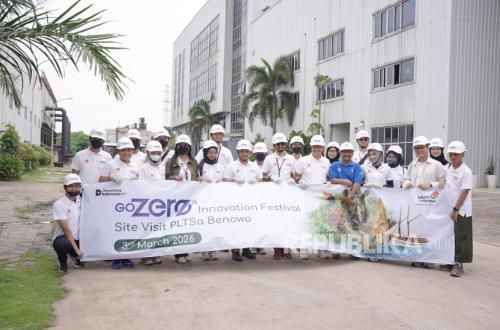
Telkom Indonesia (Persero) Tbk (Telkom) held the GoZero% Grand Champion Innovation Festival on 2–3 March 2026 at the Telkom Landmark Tower in Surabaya. The programme serves as an ESG-based innovation competition involving Telkom employees from across regions to develop innovative, applicable and sustainable solutions for operational waste management. Previously, the GoZero% Innovation Festival was staged at Telkom Regional (TREG) I to V, covering Bandung, Makassar, Medan, Tarakan, and Yogyakarta.
Best ideas from each region were then contested at the national level through the GoZero% Grand Champion Innovation Festival to determine the most impactful innovations with potential for broader deployment within the TelkomGroup. The programme provides a platform for ESG-based innovations that support the company’s sustainable transformation and align with Telkom’s ESG pillars: Save Our Planet and Empower Our People.
Waste management and operational waste have become increasingly significant concerns for many companies. Cables, electronic devices and office waste often accumulate without optimal utilisation, despite their potential to be processed into sustainable solutions.
Through the GoZero% Innovation Festival, Telkom is promoting a more systematic and innovative approach to optimising waste management.
Director of Digital Collaboration for Sustainability (DCS), Dr Runik Machfiroh, regards GoZero% as an important programme in driving the company’s sustainability commitments through employee involvement. “The programme not only raises awareness, but also motivates real action from employees on sustainability issues,” he said in a statement on Sunday (8/3/2026).
The GoZero% Grand Champion Innovation Festival spans two days. The first day features presentations by the finalists; the second day includes the GoZero% Eco-Deep Dive at PLTSA Benowo as part of the validation process.
Five finalists presented their innovations: MyCarbon (TREG I), Ecoquest (TREG II), Forec (TREG III), Restylecle Transforming Uniforms Sustainability (TREG IV), and Clean Ocean IoT – CLEOO (TREG V).
Assessments considered ESG relevance, implementation potential, impact, sustainability, and the value of innovation, ensuring that the selected solutions are not only conceptual but also practical.
From the judging, Forec (TREG III) was chosen as the winner for its innovation turning waste cables into construction and paving materials. This innovation not only reduces waste generation but also opens up new economic value because the solution is practical and can be implemented in reality.
On the second day, all participants joined the GoZero% Eco-Deep Dive to deepen waste-management practices aligned with the Waste to Energy (WTE) programme or Waste-to-Energy conversion (PSEL) managed by BPI Danantara and a national priority.
This activity also demonstrates Telkom’s support for the sustainability agenda and the national energy transition.
During the occasion, Telkom’s VP Sustainability, Gunawan Wasisto Ciptaning Andri, stressed the importance of sustainable learning through this activity. “One of the objectives of the Eco-Deep Dive is that the knowledge and learning gained do not stop at this event but are carried back and implemented in each region,” Gunawan said.
The learning was delivered through an on-site visit to PLTSA Benowo, managed by PT Sumber Organik (PTSO). The facility processes around 1,600 tonnes of waste per day, or almost 70% of Surabaya’s waste.
In operation, PLTSA Benowo uses Landfill Gas (Fermentation Gas) technology with a capacity of 1.65–2 MW, and Thermochemical (Gasification Power Plant) with a capacity of 9 MW, for a total of 11 MW of electricity. The energy is equivalent to the needs of about 11,000 households and is fed into the national electricity grid managed by PLN.
During the Eco-Deep Dive session at PLTSA Benowo, participants also learned about the process of turning waste into energy. The facility’s Operations Manager, M Ali Asyar, explained that the waste managed there can be transformed into potable water, electricity, and compost. “The characteristics of household waste we handle are actually very well suited to conversion into energy.”
Through this initiative, Telkom emphasises that waste management is not merely an environmental obligation but also an opportunity to foster creativity, empower employees, and deliver innovations that create a more sustainable future.