
Telkom CEO Outlines the Future Potential of the AI Industry
Jakarta, CNBC Indonesia — The development of artificial intelligence (AI) is creating opportunities for new industries that could change how businesses and public services operate. But adopting the technology alone will not be enough to realise that potential. An ecosystem linking technology, user needs and investment is needed to turn innovation into sustainable industries.
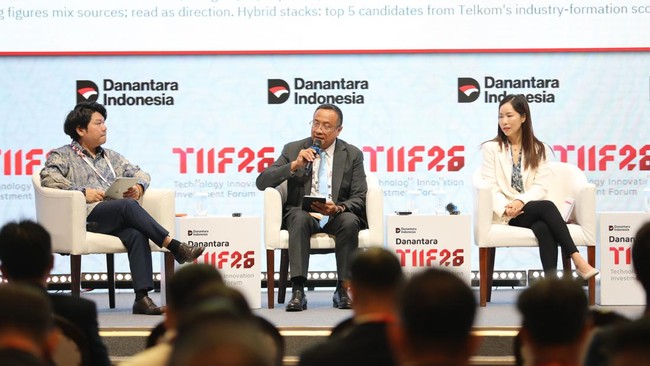
That was the message from PT Telkom Indonesia (Persero) Tbk (Telkom) President Director Nanang Hendarno during the plenary session, “The Next Industrial Wave: Which Technologies Will Create New Global Industries?”, on the second day of the Danantara Indonesia Technology and Innovation Forum (DTIIF) 2026 on Tuesday (27 October).
Nanang joined Teddy Liu, executive director and chief executive of JINGDONG Coinlink Technology Hong Kong Limited, and Sara Supaamornkul, senior director of international business development at AtkinsRéalis. The discussion, moderated by Danantara Indonesia Managing Director of Strategic Technology Initiatives Irwan Rei, examined technologies that could shape the next global industries from the perspectives of digitalisation, business and infrastructure development.
Nanang said AI could become a widely used service, meaning business opportunities lie not only in selling the technology but also in providing the infrastructure that supports its use. Since 2022, the cost per AI query has fallen by about 280 times, while AI usage on Google has increased sevenfold in a year. Lower costs create scope for higher consumption and increase demand for supporting infrastructure.
“The biggest opportunity is not simply selling AI unit by unit, but building the infrastructure that supports its widespread use. As the cost of using it falls, consumption can grow faster. Economic value will therefore increasingly be determined by the ability to provide the infrastructure and trust needed for AI to be used widely,” Nanang said on Tuesday (27 October).
Despite rising AI adoption, creating business value remains a challenge. Nanang said 95% of generative AI pilot projects had yet to affect companies’ profits and losses, while only 25% of companies had achieved the return on investment (ROI) they expected.
AI integration into corporate workflows also remains limited. Only 21% of companies have redesigned their processes to make use of the technology. This shows that adoption must be accompanied by changes to business processes and supported by five factors if it is to develop into a sustainable industry: affordable costs, market demand, workflow adaptation, an ecosystem of partners and developers, and certainty around standards and regulation.
An analysis of potential new industries identified five candidates for the next generation of global industries: integrated connectivity across land, sea, air and edge AI; large-scale AI data centres supported by reliable computing and energy; digital trust infrastructure; an economy based on AI agents; and AI-based Autonomous-as-a-Service for industry and government. The first two are core Telkom capabilities, while the other three have significant development potential.
As Indonesia’s leading digital telecommunications company, Telkom is building the foundations through connectivity, data centres, and AI platforms and applications. It has satellite capacity of 42.2 Gbps, more than 211,000 kilometres of fibre-optic and submarine cable networks, and 58 international Points of Presence (PoPs).
On the computing side, NeutraDC operated 48.4 MW of data-centre capacity in Indonesia and South-east Asia as of the third quarter of 2026, with the ambition to expand capacity to 1 gigawatt. Data-centre infrastructure development also requires reliable energy supplies and cooling systems to meet the growing computing needs of AI.
Through Model Hub, Telkom provides access to and governance of global AI models, sovereign models and models designed for specific industry needs. The service also supports the development of AI applications and use cases.
TelkomGroup’s commitment to building a national digital ecosystem was also reflected in the launch, on the first day of DTIIF 2026, of its Sovereign Digital Technology development initiative. It encompasses four strategic capabilities: AI Ready Data Center, AI ModelHub, National IoT Platform and PaDiSera. Together, these capabilities integrate computing infrastructure, AI development, device connectivity and expanded market access for micro, small and medium-sized enterprises (MSMEs). The initiative supports Indonesia’s technological independence while broadening the digital economy’s benefits across sectors.
“Telkom is building three main foundations to support the development of the AI industry: integrated connectivity, large-scale data centres, and a gateway for AI models and application development. Connectivity links users, data centres provide computing capacity, and ModelHub offers access to and governance of AI models for a range of needs. By bringing the three together, Telkom can provide technology capabilities relevant to customers and create opportunities to develop new services,” Nanang added.
Developing the AI industry will require collaboration among multiple parties. The government has a role in setting regulations, including those concerning data sovereignty and AI-agent identity. Telecommunications companies and digital infrastructure providers supply reliable connectivity and computing, while technology developers and start-ups create solutions to meet market needs. Skilled workers with expertise in AI development and integration are also needed to ensure effective implementation. MSMEs, meanwhile, can use AI to improve operational efficiency, services and sales.
Nanang also stressed the importance of long-term, or patient, capital for building foundations that may take time to generate returns. In emerging markets such as Indonesia, investment needs to come before demand is established, supported by reliable energy, certainty in permits and regulation, and the creation of initial demand.
“The next global industries will not be built only by those who adopt technology fastest, but also by those willing to build the foundations before market demand takes shape. Indonesia has needs and digital infrastructure that provide an initial advantage. We need to seize this moment to strengthen capabilities, build collaboration and develop industries that can compete globally. The technology we build today will become the global industries of the future,” Nanang concluded.
Source: jawawa.id (https://jawawa.id/newsitem/telkom-ceo-outlines-the-future-potential-of-the-ai-industry-1793263864)
Originally published by CNBC Indonesia (https://www.cnbcindonesia.com/tech/20261029145113-37-780608/dirut-telkom-ungkap-potensi-pengembangan-industri-ai-di-masa-depan), translated from Indonesian