
Technology Innovation Institute Completes Asteroid Lander for UAE's Historic Asteroid Belt Mission
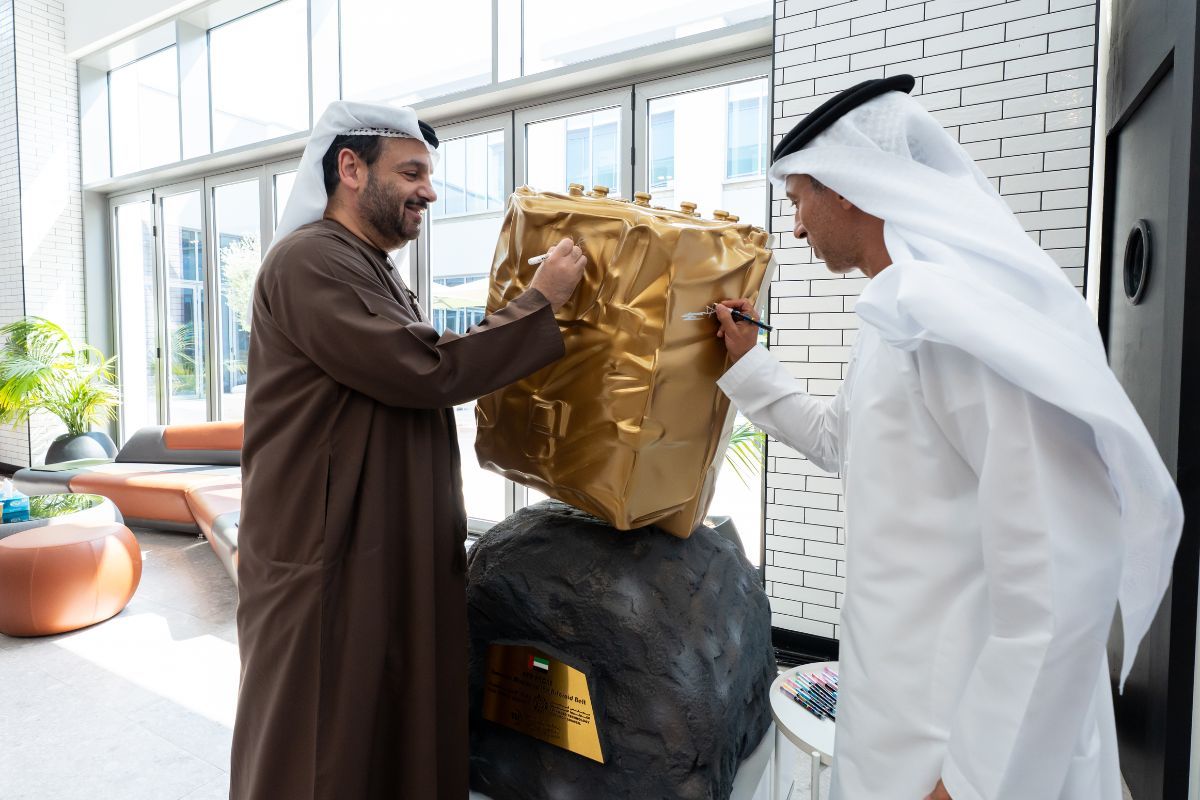
In a first-of-its-kind mission, the TII-owned lander, carried by the MBR Explorer, will traverse six asteroids in the main belt before landing on 269 Justitia, making it the seventh asteroid in history whose surface has been reached by a spacecraft.
Designed, manufactured, and tested in Abu Dhabi, the TII lander is the sole deployable payload for this mission and will operate entirely autonomously around and on the surface of Justitia. Believed to have formed in the distant Kuiper Belt in the outer Solar System, 269 Justitia may hold clues regarding how water and organic materials were distributed during planetary formation.
Abu Dhabi, United Arab Emirates (ANTARA/BUSINESS WIRE) — The Technology Innovation Institute (TII) has introduced a UAE-developed lander for the Emirates Mission to the Asteroid Belt (EMA). The lander will soon be transported to Colorado, USA, for final integration with the MBR Explorer spacecraft before its planned launch in 2028. For the first time in history, the TII lander will capture images of two planets and seven asteroids—passing six asteroids in the main belt before reaching its climax by meeting and landing on the seventh asteroid, 269 Justitia. If successful, the landing will make Justitia the seventh asteroid in history to have its surface reached by a TII spacecraft.
The TII lander was designed, manufactured, and thoroughly tested in Abu Dhabi by TII’s Propulsion and Space Research Centre, in collaboration with the UAE Space Agency, HEX20, Khalifa University, and the National Space Science and Technology Centre of UAE University. It is the only payload to be deployed during the mission. The lander will separate from the MBR Explorer to reach the surface of Justitia at the furthest point of the mission, operating fully autonomously in deep space to take close-up images and perform surface drilling to provide new insights into its composition and physical characteristics. 269 Justitia is believed to have formed in the Kuiper Belt before migrating to the main asteroid belt during the early stages of Solar System formation.
His Excellency Faisal Al Bannai, Secretary General of the Advanced Technology Research Council—the Abu Dhabi government entity overseeing TII—and Member of the UAE Supreme Space Council, stated: “If you want to build serious technological capability, you must face challenges that force you to push further. In this mission, that means developing a lander capable of making decisions and operating independently in deep space. Our team has built that technology in the UAE. The mission may still be ahead, but we have expanded the technological capabilities we can build. This is how a nation’s capabilities grow. We solve difficult problems, then turn our gaze toward even greater challenges.”
269 Justitia is one of the reddest celestial bodies ever observed in the main asteroid belt. Its spectrum more closely resembles objects in the Kuiper Belt beyond Neptune than surrounding asteroids. This suggests the object may have formed in the cold outer regions of the Solar System, beyond the distance where methane and methanol freeze, before migrating to the inner regions during the early history of the Solar System. Its surface is believed to be covered in complex organic material formed by the irradiation of ice. By reaching such a celestial body without a ten-year journey to the Kuiper Belt, the international scientific community gains access to materials that would otherwise be far beyond practical reach, providing evidence of how water and volatile substances were distributed during planetary formation.
Dr. Najwa Aaraj, Chief Executive Officer of TII, said: “The EMA Probe demonstrates what can happen when cutting-edge research is transformed into mission-ready engineering. Our team at TII has developed a system designed to withstand extreme conditions, operate with incredible precision, and produce meaningful scientific findings billions of kilometres from Earth. This mission reflects the quality of our professionals as well as the depth of scientific and engineering capabilities the UAE has built to contribute to some of the most ambitious space missions in the world.”
The MBR Explorer spacecraft will travel approximately 5 billion kilometres over eight years, using gravity assist manoeuvres from Venus, Earth, and Mars, performing close flybys of six asteroids before arriving at 269 Justitia. The spacecraft is scheduled to launch from Japan in March 2028, within a three-week launch window adjusted for interplanetary conditions. As the main spacecraft cannot safely approach the surface within a few kilometres, the TII lander will separate, make contact with the surface, and conduct the mission’s closest observations.
Dr. Elias Tsoutsanis, Chief Researcher of the Propulsion and Space Research Centre at TII, noted: “The technical challenge is not merely reaching Justitia, but ensuring the lander can survive an eight-year journey and remain functional with precision when it is needed most. Every element—from hardware and thermal design to the onboard software—has been engineered and tested to withstand that final encounter.”
The lander will operate fully autonomously throughout the mission and will not receive commands from Earth or the MBR Explorer spacecraft after launch. The onboard software will determine when to take images and how many images are required.
Source: jawawa.id (https://jawawa.id/newsitem/technology-innovation-institute-completes-asteroid-lander-for-uaes-historic-asteroid-belt-mission-1791262805)
Originally published by Antara (Indonesian) (https://www.antaranews.com/berita/5772873/technology-innovation-institute-selesaikan-wahana-pendarat-asteroid-untuk-misi-bersejarah-uni-emirat-arab-ke-sabuk-asteroid), translated from Indonesian