
Teater Besar Taman Ismail Marzuki Simplifies Wireless Workflow with Sennheiser Spectera
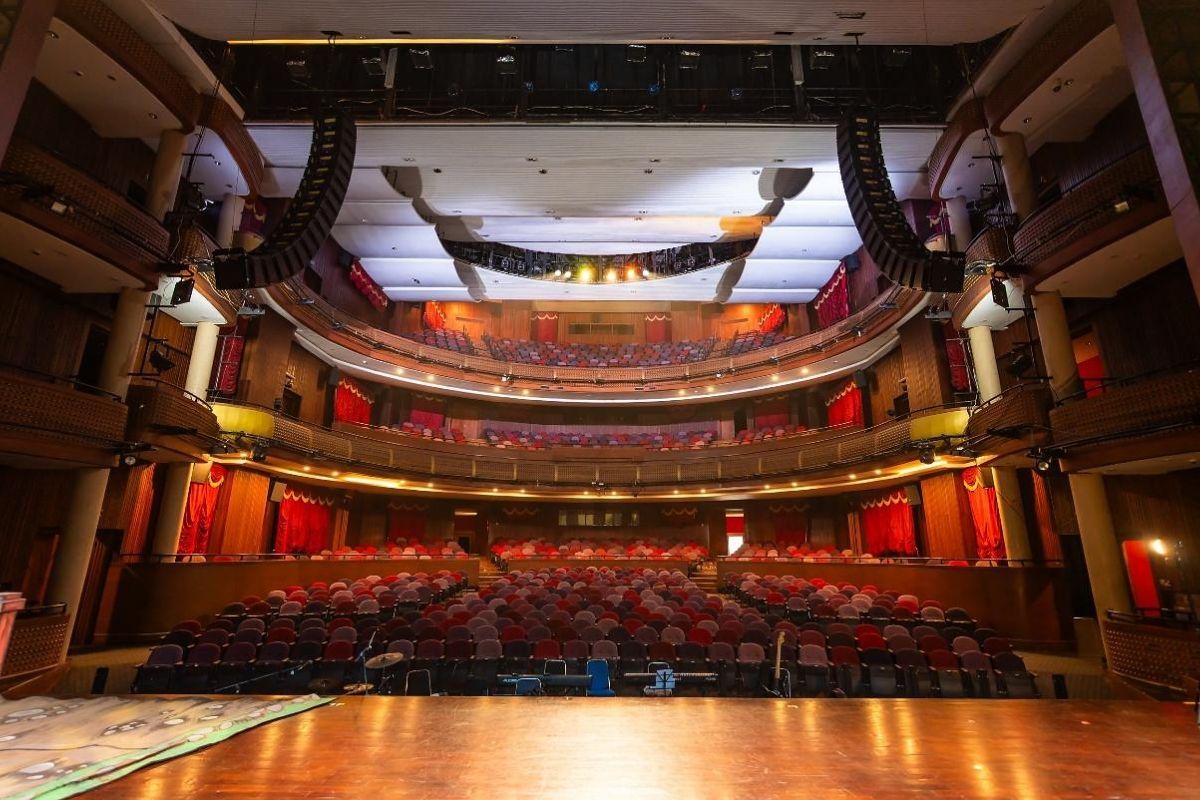
As the largest performance space within the Taman Ismail Marzuki arts and culture complex in Jakarta, Teater Besar is a venue with a 1,200-seat capacity designed for large-scale productions. Its stage and production infrastructure support theatre, musicals, concerts, and various cultural performances, each possessing unique technical requirements. To meet these needs, Teater Besar has become the first venue in Indonesia to utilise Sennheiser Spectera, the world’s first wideband bidirectional wireless ecosystem.
Organising diverse programmes means that no two performances at Teater Besar are exactly alike. Differences in production companies, technical teams, stage layouts, and wireless requirements necessitate that the venue’s technical team prepares and configures audio systems for every single show.
In 2016, the venue began planning a major upgrade to its audio system, transitioning from analogue to digital. The new system was introduced in 2018, with Albeta acting as the venue’s system integrator to oversee implementation. However, as production needs evolved, the increasing number of wireless microphones presented new challenges, particularly regarding RF coordination, setup time, and equipment space requirements.
For the venue’s technical team, the priority was to possess a wireless system that could simplify daily operations without limiting future expansion possibilities. “What we were essentially looking for was a system that is simple, easy to set up, does not take up too much space, and has a practical installation process,” said Dwi Winarno, Technical Audio Specialist at Teater Besar. “At the same time, the system must have room to grow alongside our changing future needs.”
Rather than replacing the venue’s existing audio infrastructure, the project focused on expanding its wireless capabilities to keep pace with evolving production demands.
Meeting the demands of modern live production
Large-scale theatre productions can require dozens of wireless microphones operating simultaneously, creating a complex RF environment. “One of our biggest challenges was RF interference,” said Dwi. “Previously, we used a conventional architecture of one device per receiver, so frequency clashes often occurred when 40 to 50 wireless microphones operated at once. These clashes caused unwanted noise and interference, which could significantly disrupt large-scale theatre productions.”
The venue itself also presents acoustic challenges. The architectural characteristics and sound behaviour within the room can affect audio performance, making thorough preparation a vital part of every production.
Before using Spectera, the conventional wireless architecture at Teater Besar meant that the number of receivers and supporting devices increased alongside the number of microphones required. For productions using 32 wireless channels, this necessitated large equipment racks and additional time for moving, preparing, and installing gear. For the technical team, the challenge was not just accommodating more microphones, but finding a more efficient way to manage an increasingly complex wireless environment.
A new approach to wireless audio
Teater Besar is the first venue in Indonesia to implement Spectera, introducing the platform while it was still relatively new to the market. “When I first introduced Spectera to Mas Dwi, my understanding was largely based on product presentations and discussions with the Sennheiser team,” said Yosafat. “I had seen this system being tested, but I had never seen it used in large-scale live productions.”
Its compact architecture was one of the first striking aspects during the demonstration. “Previously, when using 32 separate units, we had to prepare a very large rack to accommodate all the equipment,” explained Dwi. “With this system, one compact unit can house everything. Most of those large racks are no longer needed.”
Currently, the system consists of a Sennheiser Spectera Base Station, 2 DAD antennas, 15 bidirectional bodypacks, and Sennheiser HSP 4 headset microphones. This system primarily supports theatre and musical productions, and is also used for corporate events, talk shows, panel discussions, and similar productions.
Simplifying wireless system operation and RF management
Approximately 70 per cent of productions at the venue that require wireless systems now use Spectera, with configurations generally involving around 15 wireless channels. Since its implementation, the system has supported approximately eight to ten productions at Teater Besar.
The reduction in equipment volume has had a tangible impact on the venue’s workflow. “The difference compared to our previous analogue system is very significant,” said Dwi. “This system is much more compact and efficient, both in terms of time and space.”
RF management has also become more measurable. Before every event, the technical team can power on the devices to be used and analyse the RF environment via the Spectera WebUI. The system provides a visual display of RF activity, allowing technicians to identify frequencies with lower interference levels and select the most suitable options for production needs.
“Previously, we had no way to visualise RF conditions like this,” explained Dwi. “Now, RF performance can be seen and analysed directly through monitoring software before the event begins.”
The Spectera WebUI also provides visibility into signal quality.