
Tears of Rice Farmers: Parched, Cracked Fields Force Early Harvest
In the midst of the dry season, farmers are choosing to harvest early. Not because the yield is already at its maximum, but because they do not want their entire crop to die before it can be harvested.
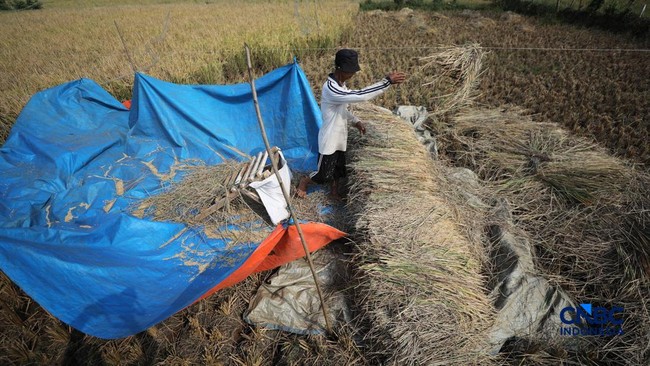
A farmer harvests rice in Kali Putih Village, Bogor, West Java, Monday (10/8/2026). Tens of hectares of farmland managed by local farmers for rice planting have suffered crop failure since early June 2026 due to drought.
The farmers lament that the rice they are harvesting has indeed begun to yellow, but it is not yet truly perfect. In the midst of the dry season, farmers are choosing to harvest early. Not because the yield is already at its maximum, but because they do not want their entire crop to die before it can be harvested.
All around them, the paddy soil appears cracked. The water flow that had been sustaining the rain-fed land has long since stopped. Fields that relied solely on rainfall have turned into a dry expanse.
“Yes, this is actually not yet harvest time. Normally it would be about two more weeks. But because it is already dry and there is no water, we are forced to harvest now rather than lose everything,” the farmer said.
The decision to harvest early means he must be prepared to accept results far below expectations. From tens of hectares of land, he is usually able to produce around eight quintals of unhusked rice. But this planting season, he is only hoping to bring home a small portion of his harvest. “The yield will certainly not be optimal. Hopefully I can get three quintals, as long as the planting capital can be recovered to prepare for the next season,” he said.
The farmer admitted that this planting season had missed his expectations. He had hoped that rain would still fall even as the dry season began, so he chose to plant short-maturity rice seeds of around 70 days. But the rain he waited for never came, while the dry season arrived sooner than expected.
“I thought this month there would still be rain. It turned out the dry season came first. Fortunately, what I planted can still be harvested even though it was brought forward. Many other farmers are using 90 to 100-day seeds, and now many are experiencing crop failure due to the drought,” he said.
The impact of the drought is also directly felt in production output. Under normal conditions, for example, one hectare of his paddy field can produce around three to four tonnes of unhusked rice. But this season, production is estimated to plummet to only around 1.2 tonnes per hectare.
According to the farmer, this year’s dry season feels much more severe than in previous years. Previously, rain would still occasionally fall even at low intensity, but this time rain has barely arrived for almost two months.
The drought has made the condition of the land increasingly concerning. The paddy soil has begun to crack, while the growth of the rice plants has been disrupted.