
Teachers' Complaints Over Free Nutritious Meals Programme Reach Constitutional Court: Dismissals and Wages as Low as Rp 50,000
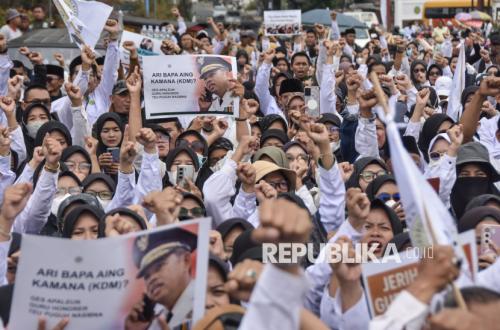
The Free Nutritious Meal (MBG) programme has once again come under scrutiny during a judicial review regarding the education budget at the Constitutional Court (MK). During the hearing on Monday, witnesses from teaching professions and educational organisations assessed that the implementation of the MBG has impacted teacher welfare, learning quality, and the allocation of the education budget.
One witness, Iman Zanatul Khairi, a history teacher at Madrasah Aliyah Alsaqofah and Head of Teacher Advocacy at the Association of Education and Teachers (P2G), presented various grievances submitted by teachers in several regions following the implementation of the MBG programme in 2026.
Iman stated that issues regarding teacher welfare existed before the MBG was launched. However, according to him, the situation has worsened after portions of the education budget were diverted to support the programme.
He cited the delayed payment of professional allowances for madrasah teachers in early 2026. He noted that the Ministry of Religious Affairs, through a circular signed by the Secretary-General, stated that these allowances could not yet be paid due to the lack of budget allocation.
“Consequently, it is very palpable that there has been a reduction in the education budget which directly impacts me,” Iman told the Constitutional Court panel.
As an official of P2G handling teacher advocacy, Iman admitted to receiving numerous reports regarding the impact of educational policies on the welfare of educators. He even described the emergence of “teacher castes” following the introduction of the part-time Government Employees with Work Agreements (PPPK) scheme.
According to him, the hope that honorary teachers could achieve a better life after being appointed as part-time PPPK has not fully materialised. He mentioned cases where part-time PPPK teachers receive extremely low incomes.
In his testimony, Iman quoted several reports received from various regions. Among them, part-time PPPK teachers in Langkat Regency, North Sumatra, and Blitar were reported to receive salaries of around Rp 500,000 per month.
Furthermore, there were reports of a teacher in Sumedang receiving only Rp 50,000. The local authorities paying that wage claimed there were no funds due to budget efficiency measures. “Even that is still subject to BPJS deductions, so the amount received in the bank account was only Rp 15,000, which could not even be withdrawn,” he told the judges while struggling to hold back tears.
He also reported instances of contract terminations for teachers in several regions. He stated that 39 PPPK teachers in Tuban lost their jobs, while similar cases were reported in other areas such as Cianjur, East Lombok, and Langkat.
“Following the 2026 MBG, there has been mass termination of PPPK teachers—even those considered well-off were dismissed—as well as honorary teachers. Honorary teachers who had been appointed as part-time PPPK are also earning less than their previous honorary status,” he said.
He understood that local governments have an obligation to pay the salaries of PPPK teachers. However, this obligation has recently become difficult for local governments to meet due to budget efficiency measures from the central government, which he believes is linked to the funding of the MBG programme.
Iman quoted a part-time PPPK teacher from a public junior high school in Serang Regency, Banten, who stated: “Due to limited budgets, local governments cannot pay teachers as they should. Local budgets are directly cut by the central government. Yet, those funds should be used to pay the salaries of part-time PPPK teachers. Because the budget is reduced, payments cannot be made as intended.”
Another testimony came from a part-time PPPK teacher at a public elementary school in Rokan Hulu, Riau: “I am a part-time PPPK teacher affected by the zero-formation issue from the Pre-service Teacher Professional Education (PPG) graduates. Since being inaugurated in December 2025 until March 2026, I have not received a single penny in salary. Instead of receiving certification, my salary has been delayed.”
Finally, a PPPK teacher from a public elementary school in Tulungagung, East Java, noted: “With the Free Nutritious Meal (MBG) programme, our salaries have become minimal. The learning process is also not conducive because children’s attention is more focused on the MBG programme. On the other hand, our school’s infrastructure still requires repairs, but so far, nothing has been realised.”