
Tax Chief Unveils 6 Strategies to Reach Rp2,593 Trillion Revenue Target by 2027
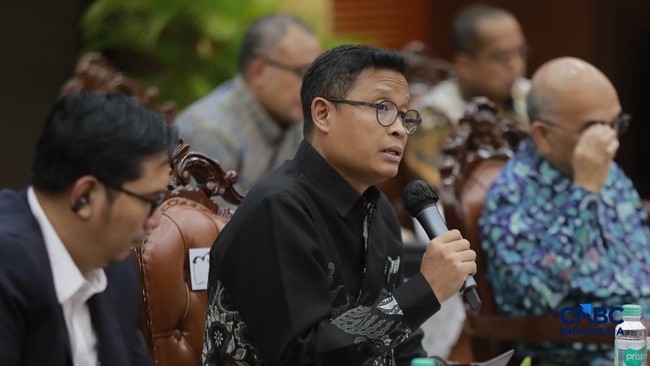
Director General of Taxes Bimo Wijayanto has revealed six primary strategies to pursue a tax revenue target of Rp2,593.4 trillion for the 2027 fiscal year. This target represents a 12.2% increase compared to the 2026 tax revenue outlook, which is estimated to reach Rp2,310.8 trillion.
Bimo stated that the strategies are focused on expanding the tax base, transforming tax administration, and closing the compliance gap without disrupting economic activity. “The focus is on transformation for base expansion, closing the compliance gap, and increasing revenue without hindering the economy. These are the six technical policies we are committed to,” Bimo said in Bogor, as reported on Monday (5/10/2026).
The first strategy involves expanding the tax base by utilising data and technology to reach digital economic activities, the shadow economy, and the informal sector, which have not yet been optimally tapped.
Secondly, the Directorate General of Taxes (DJP) will intensify the taxation of digital transactions and e-commerce, including through the implementation of a 0.5% Income Tax (PPh) Article 22 on e-commerce. Nevertheless, the government remains committed to maintaining public purchasing power and the sustainability of micro, small, and medium enterprises (MSMEs) by simplifying the mechanism for applying for a Tax Exemption Statement (SPB) for businesses with an annual turnover below Rp500 million. “This policy, in addition to protecting MSMEs, also protects public purchasing power,” Bimo added.
The third strategy is to strengthen tax administration through the optimisation of the Coretax system and the use of the Compliance Risk Management Integrated Risk Engine (CRM-IRE) to increase taxpayer compliance and boost state revenue. According to Bimo, this system will make supervision more effective and risk-based. High-risk taxpayers will face more intensive supervision, which may lead to law enforcement if serious violations are discovered. “Furthermore, law enforcement will be applied if there are indications of high non-compliance based on the outputs of the CRM-IRE engine, which is embedded with our Coretax and data warehouse,” he emphasised.
The fourth strategy is to strengthen supervision of taxpayer groups that contribute significantly to state revenue, including group taxpayers, taxpayers with affiliated or special relationship transactions, and high-net-worth individuals.
Fifthly, the strategy involves strengthening law enforcement through a multi-door approach. This step aims to increase compliance and provide a deterrent effect against tax avoidance, under-invoicing, and various other illegal activities. The DJP will collaborate with several law enforcement and financial supervisory agencies, such as the Attorney General’s Office, the Indonesian National Police, the Corruption Eradication Commission (KPK), and the Financial Transaction Reports and Analysis Centre (PPATK). “We continue to work with law enforcement institutions, including the Attorney General, the National Police, the KPK, and the PPATK, to build cases through a multi-door approach,” said Bimo. He noted that this inter-agency cooperation is part of the government’s effort to recover state rights and narrow the space for tax avoidance practices.
The sixth strategy is to optimise tax incentives by evaluating the use of various tax facilities provided by the government. This evaluation is intended to ensure that the incentives provided remain effective in supporting economic growth, enhancing business competitiveness, and maintaining the national investment climate.
Source: jawawa.id (https://jawawa.id/newsitem/tax-chief-unveils-6-strategies-to-reach-rp2-593-trillion-revenue-target-by-2027-1791165189)
Originally published by CNBC Indonesia (https://www.cnbcindonesia.com/news/20261005072354-4-773218/bos-pajak-beberkan-6-jurus-kejar-setoran-rp2593-triliun-di-2027), translated from Indonesian