
TAUD Questions Legal Basis for Arresting Activists Who Hung Banner at HI
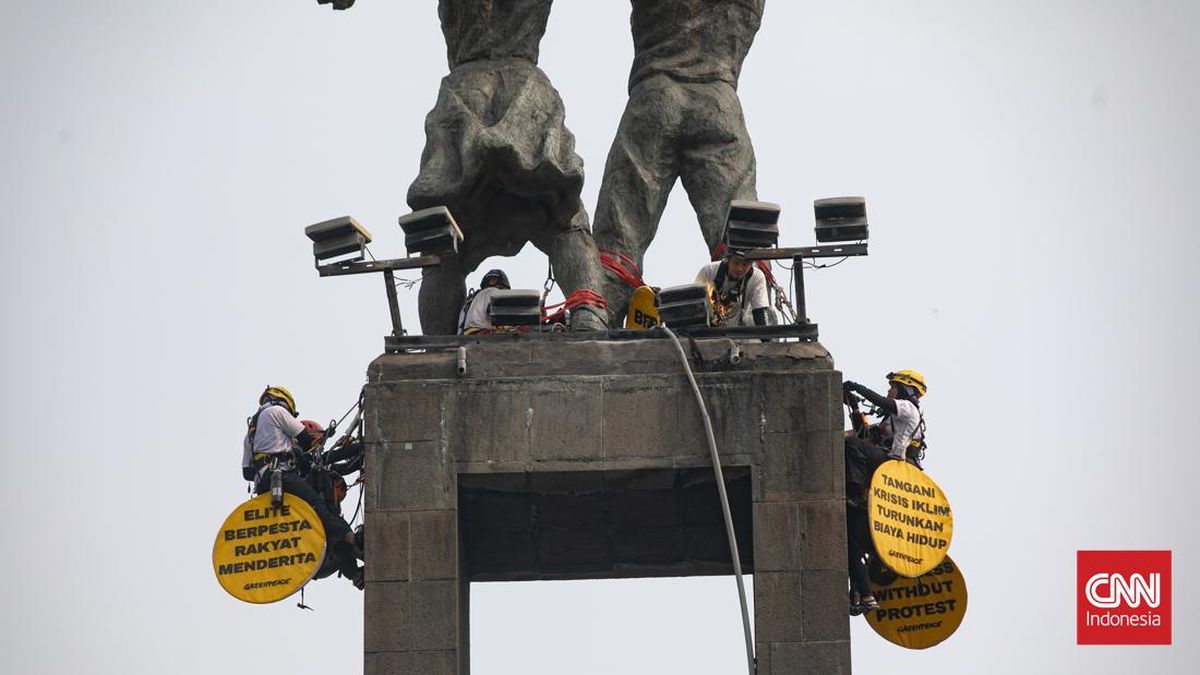
The Advocacy Team for Democracy (TAUD) has questioned the police over the legal basis for detaining six Greenpeace Indonesia activists who climbed the Welcome Monument at the Hotel Indonesia Roundabout (HI) in Central Jakarta to unfurl a protest banner on Tuesday morning (20 October).
TAUD representative Airlangga Julio said the six activists were voicing public concerns, including forest and land fires, soaring prices and other issues.
Julio said the action was protected by national and international legal instruments and human rights, and was intended to promote a better environment.
“The six Greenpeace Indonesia activists are environmental human rights defenders. This is provided for in the Human Rights Law and in the National Commission on Human Rights’ standards and regulations on human rights defenders. They carried out a peaceful, non-violent action,” Airlangga said at the Jakarta Metropolitan Police headquarters on Tuesday (20 October).
Airlangga said the activists’ action had caused no damage or losses. He added that they had made sure all equipment and other items used were returned to their places and not left behind.
“We are still waiting for clarity on the status of our six Greenpeace activist colleagues, and we are urging law enforcement officers to clarify their legal status promptly,” Airlangga said.
Another TAUD representative, Daniel Winarta, said the police had no legal basis for taking the activists to the Jakarta Metropolitan Police headquarters.
“There is no legal basis for what the police are doing now. Detaining people without a clear status has no legal basis. From the moment they were taken away, the procedure was already improper,” Daniel said.
Daniel said TAUD had been informed that the case was initially handled by the Jakarta Metropolitan Police’s General Criminal Investigation Directorate. The police were reportedly planning to transfer it to the Special Criminal Investigation Directorate because of an alleged violation of the Cultural Heritage Law.
Daniel said the criminal provisions in the law concern damaging or stealing cultural heritage. He stressed that neither the Welcome Monument had been damaged nor any items gone missing as a result of the action.
“We suspect the reason we have been shuttled back and forth, with no clarity between the special and general criminal investigation units, is that the police are making things up and trying to work out which article they can connect to this case,” he said.
TAUD therefore called on the Jakarta Metropolitan Police to provide legal certainty promptly and release the six Greenpeace activists.
“We ask the Jakarta Metropolitan Police to let our colleagues, environmental defenders and human rights defenders, return to their homes as soon as possible. They are very tired and need to rest,” Daniel said.
Earlier, Central Jakarta Police, together with the military and the Jakarta provincial government, evacuated six Greenpeace Indonesia activists who had unfurled a banner atop the Welcome Monument at the Hotel Indonesia Roundabout in Central Jakarta.
Central Jakarta Police Chief Reynold EP Hutagalung said the group comprised two women and four men, who displayed a large protest banner between 6.05am and 6.15am.
One of the women appeared weak while climbing down, Reynold said, and was taken by ambulance to receive medical care at the Jakarta Metropolitan Police’s medical and health clinic.
“All six were evacuated, and none remained on top. We hope the swift response by the Jakarta Metropolitan Police’s medical team will ensure the safety of all six. Our priority is the health and safety of our fellow citizens expressing their views atop the Welcome Statue,” he said, as quoted by Antara.
Source: jawawa.id (https://jawawa.id/newsitem/taud-questions-legal-basis-for-arresting-activists-who-hung-banner-at-hi-1792504267)
Originally published by CNN Indonesia (https://www.cnnindonesia.com/nasional/20261020185827-12-1417645/taud-pertanyakan-dasar-hukum-penangkapan-aktivis-pasang-spanduk-di-hi), translated from Indonesian